-
1. Safety glasses vs goggles — what do I actually need?
-
2. How do I judge "uvex safety glasses" style models without overpaying?
-
3. Can I buy Amazon safety shoes for a company order?
-
4. How do I get Red Wing shoe sizing right for a whole crew?
-
5. What should a Red Wing safety shoes 3228 price look like?
-
6. Are slip-on steel toe shoes safe enough?
-
7. Do I really need a written spec?
I handle quality and brand compliance at a safety products distributor. Every SKU that ships with our name on it crosses my desk first — roughly 220 items a month, everything from work boots to fire extinguishers. In 2024 I rejected 14% of first-article shipments, and almost none of those failures were visible in the product photo.
These are the questions buyers actually send me, roughly in the order I get them. I'd rather spend 10 minutes explaining markings than deal with a rejection three weeks later.
- Safety glasses vs goggles — what do I actually need?
- How do I judge "uvex safety glasses" style models without overpaying?
- Can I buy Amazon safety shoes for a company order?
- How do I get Red Wing shoe sizing right for a whole crew?
- What should a Red Wing safety shoes 3228 price look like?
- Are slip-on steel toe shoes safe enough?
- Do I really need a written spec?
1. Safety glasses vs goggles — what do I actually need?
Short answer: glasses have a brow bar and side shields, goggles seal against the face. If the hazard is fine dust, mist, or chemical splash, glasses will not do the job — the gaps around the frame are exactly where the hazard gets in.
The markings on the lens tell you what you're holding. A plain Z87 mark means basic impact. Z87+ means high impact. A D3 suffix means it passed a droplet and splash test. W means welding filter. If your hazard assessment says chemical handling, D3 is the marking to look for, and that almost always means goggles, not glasses.
From the outside, both look like "eye protection" and it's tempting to standardize on one SKU to simplify purchasing. The reality is that one SKU will either under-protect one group or over-protect another to the point where people quietly take it off. The pair sitting in a locker isn't protecting anyone.
I can only speak to mixed shop floors. If your operation is one task and one hazard, standardizing is fine and cheaper.
2. How do I judge "uvex safety glasses" style models without overpaying?
Uvex is one reference point in a crowded market, and the brand name isn't the deciding factor. What separates a $4 pair from a $14 pair is usually the coating stack and the frame fit — not the polycarbonate itself.
Ask three things. First, the lens marking (Z87+ and the manufacturer mark). Second, what the anti-fog actually is: a factory-applied coating that survives cleaning, or a surface dip that washes off in a few weeks. Third, retention — whether the temples hold when someone tilts their head down over a grinder.
People assume the cheap and mid-priced pairs are the same basic product in different packaging. What they don't see is that the anti-fog is often the first thing to go, and it goes silently. Workers don't file a complaint, they just stop wearing them.
My suggestion: buy three models, put them on the same six people for a month, and count how many come back at the end. That tells you more than any spec sheet.
3. Can I buy Amazon safety shoes for a company order?
For personal use, sure. For a company order where you're signing off on certification, the problem isn't quality — it's traceability and lot consistency.
A few things I check before a marketplace pair gets anywhere near a PO:
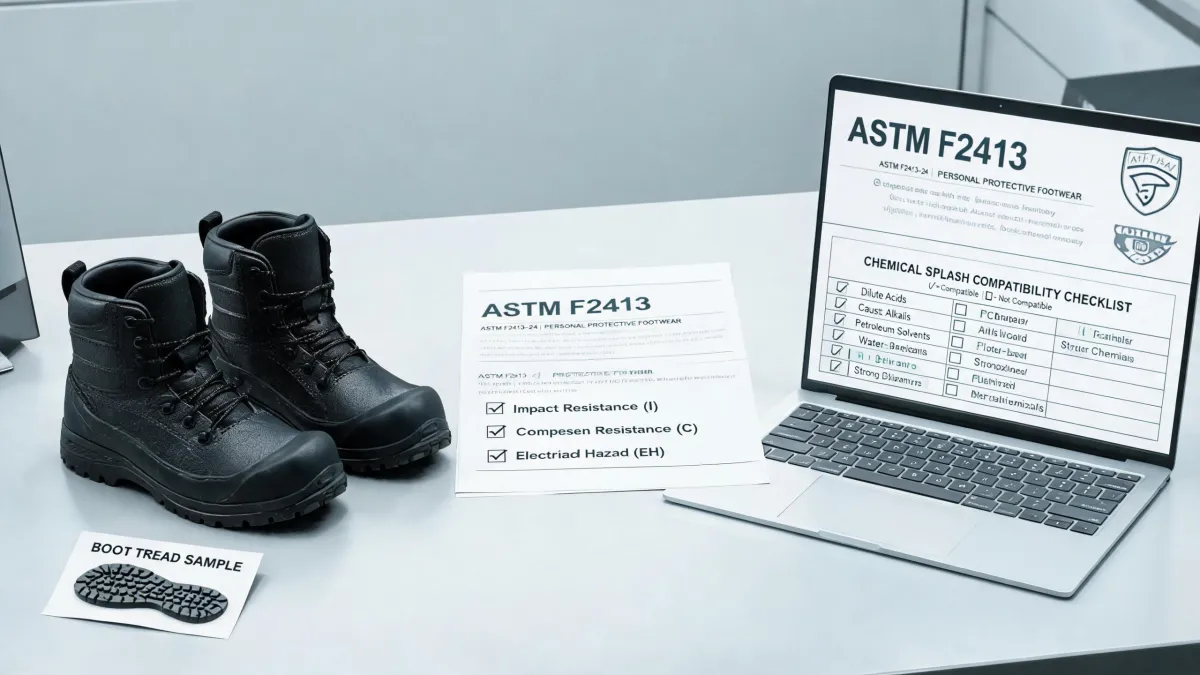
- The label inside the tongue should cite ASTM F2413 (current revision), plus I/75 and C/75 for impact and compression. Mt/75 if you're specifying metatarsal protection.
- EH rating on the label if the job calls for electrical hazard protection.
- A test report PDF — not a screenshot of a listing page.
- One sample pair in the widest size, checked at the flex point and the sole bond, before the full order.
Looking back, I should have bought a sample lot of one size before we placed a 180-pair order in 2023. At the time, the listing had 4,000 reviews and a 4.6 average, which felt like enough signal. It wasn't. Reviews tell you a pair fit one person; they don't tell you the tenth carton matches the first.
4. How do I get Red Wing shoe sizing right for a whole crew?
Measure, then try on. Both, not either. Brannock gives you a number; it doesn't tell you how a specific last feels at hour nine of a shift.
Two things trip people up. Feet swell during the day, so fittings done at 7 a.m. skew narrow. And a safety toe changes the internal volume — the same size in a soft-toe and a steel-toe version of the same boot is not the same fit.
In Q1 2024 we ran a fitting day for 62 workers. Thirty-eight of them were in a size that didn't match their measurement, and most of those were too narrow rather than too long. That's a cheap problem to fix at the fitting table and an expensive one to fix after the boots are broken in and non-returnable.
One caveat: this worked for us because we have a stable headcount and can run a fitting day twice a year. If you're staffed with seasonal labor and heavy turnover, the math is different — you may be better off with a narrower size run and a wider return window. Also, wide widths and some safety-toe versions aren't always sitting on a shelf; plan a four-to-six week buffer on a first order.
5. What should a Red Wing safety shoes 3228 price look like?
Take this with a grain of salt, because dealer pricing moves. Our last PO — November 2024, 40 pairs, standard width, no metatarsal guard — landed around $205 a pair before freight. Street pricing I've seen for the 3228 runs roughly $180 to $250 depending on retailer and spec level, with clearance events dipping under $170.
Don't hold me to those numbers. Verify with your dealer before you budget, because a lot of what moves the price isn't the model number. It's safety toe versus soft toe, a waterproof membrane, EH rating, wide sizing (sometimes carries a small premium), and how many pairs you're committing to.
Bottom line: if one listing is 30% under everybody else, find out why before you buy. Sometimes it's last season's colorway, which is fine. Sometimes it's a closeout on one width. Sometimes it isn't the same spec at all. Prices quoted here are for general reference — confirm current rates.
6. Are slip-on steel toe shoes safe enough?
They meet the same ASTM impact and compression requirements as a lace-up. What they don't have is ankle retention, and that matters in exactly two situations: when a foot can slide out during a fall, and when the shoe can be pulled off by entanglement near rotating equipment.
For welding, clean-room changeovers, and jobs where laces themselves are a snag hazard, slip-ons are usually the right call. For heavy material handling and ladder work, I'd argue laces or a boa closure are worth the extra twenty seconds at the start of a shift.
People assume slip-on means cheaper construction. The reality is the opposite — a good slip-on is harder to build. The gore panels have to hold tension for the life of the boot without stretching out, and that's where the cheap versions fail first, usually somewhere between month four and month six. Check whether the gore is replaceable, and put a straight edge against the heel counter on your sample pair.
7. Do I really need a written spec?
Yes. This is the question nobody asks until after the first bad shipment, so it belongs at the end of this list but the top of your process.
In 2022 we took a delivery of 240 pairs against a PO that said "steel toe, black, full size run." The internal toe box height on about thirty pairs measured 11mm against the 12.7mm we'd been getting. The vendor's position was that the dimension was within industry standard — and technically they weren't wrong. The standard sets a floor, not our preferred fit. We rejected the batch, they redid it at their cost, and the redo put a plant rollout three weeks behind.
Now every boot contract lists the ASTM revision, the internal clearance we expect, the sole bonding method, the lot marking, and who eats freight on a rejection. Not because vendors are dishonest, but because "black steel toe" means six different things to six different factories.
Same logic applies to the rest of the PPE list. Hard hats have a service life that starts at the manufacture date stamped inside the shell, not the date you hand it out. Fire extinguishers have hydrostatic test intervals that vary by type. Gloves and hearing protection are consumables with a replacement cadence you should write down. None of that survives a verbal agreement with a new hire doing the ordering.
An informed buyer asks better questions and gets a faster answer. That's the whole point of this list.