I'm not a safety expert. I'm the person who orders the safety gear. There's a difference—and it usually costs money to learn it.
For the past four years (closer to five now, since I took over purchasing in late 2020), I've been buying fall protection equipment, safety vests, latex gloves, and work boots for our company. We're a 75-person operation with about 60-80 purchase orders a year, roughly $130,000 in annual spend across eight vendors. I report to both operations and finance—which means I get it from both sides when something goes sideways.
Here's what I wish someone had told me upfront, minus the sales pitch.
Where should I even start with fall protection gear?
Start by figuring out who owns the safety program—because it's probably not you.
I'm an office administrator, not a fall protection specialist. The first time I ordered harnesses, I assumed "fall protection is fall protection." I was wrong. Every task has its own requirements. Roof work and scaffold work are not the same conversation.
Get your safety manager (or whoever signs off on compliance) to approve the specs before you place the order. Your safety manager should be the one verifying against OSHA 29 CFR 1926.501 and any state-level add-ons—that's their lane, not yours. You're the buyer, not the qualifying engineer. Mix that up and you're looking at a reorder on your department's budget.
I can only speak to our situation—mid-size B2B with predictable seasonal ordering. If you're smaller and don't have a dedicated safety person, that approval might land on HR or an operations lead. Either way, find your sign-off before you find a vendor.
Is a Guardian fall protection roof anchor actually worth it?
Honestly, it depends on your roof. We went with a Guardian fall protection roof anchor kit because the installation instructions didn't read like stereo instructions translated three times. For a crew that's not doing this every day, that mattered. The hardware felt solid and install day had zero "wait, where does this bracket go" moments.
But I can only say what worked for our building—metal standing-seam roof with accessible purlins. If you're on tile, or an older structure with multiple ridges, the math might be different. I'm not a structural engineer and I don't play one at work.
On price: from what I saw checking quotes in January 2025, fixed roof anchors run roughly $75-200 depending on type and load rating. Roof anchor kits tend to land between $120-300. Verify that against current quotes—pricing moves and I'm not updating this page daily.
What about Guardian Diablo fall protection—is the brand-name price justified?
I went back and forth on this for about three weeks. Longer, actually—call it a month once you count the email thread with our safety manager.
The Guardian Diablo fall protection series had appeal because it's a hybrid design—works as a rescue/retrieval unit or a positioning lanyard depending on setup. That flexibility meant fewer SKUs to track, which is a real thing when you're the one managing the inventory spreadsheet.
The catch wasn't the product. It was the retraining. Our crew had used a different brand's self-retracting lifeline for years, and switching meant a half-day refresher plus the inevitable first-week questions. We made the switch because the hybrid design cut our catalog from three devices to two.
Even after we chose it, I kept second-guessing. What if the hybrid design confused people more than it helped? Took about a month before I stopped waiting for a complaint that never came. Would I do it again? Probably. But if your crew is happy with what they have, "newer" isn't automatically "better."
How do I avoid ordering the wrong safety vests?
By actually reading the spec sheet. We ordered our third batch of safety vests without checking the reflective class and ended up with a set that wasn't rated for the night-road work our crew was doing. That was a $350 mistake, and finance wouldn't take it back.
Now I keep a simple checklist:
- ANSI/ISEA 107 class—confirm the right class for the task environment before ordering
- Solid or mesh construction (this matters more for comfort and heat than people realize)
- True-to-size sizing, not "fits like" sizing
- Closure type—zipper versus velcro. Don't assume it's interchangeable
Basic safety vests run roughly $8-15 each based on what I was seeing in January 2025. High-visibility vests with radio loops and certification tags can land in the $25-50 range. Over 50 units, that spread adds up fast.
Latex gloves—can't I just buy the cheapest ones?
You can. Your crew will hate you for it.
We tried the "lowest price per case" approach once. The gloves tore on the second or third pull. Not defective—just thin enough that they didn't last a shift. Result: more reorders, more complaints, and people taking them home because the box ran out by Thursday.
Bottom line: we moved to a vendor that puts the AQL (acceptable quality limit) in writing on the purchase order. Price went up about 18%. Total spend went down over two quarters because we stopped wasting inventory. That's a math problem most quote sheets don't show you.
Where to buy work boots—and how do I not get burned?
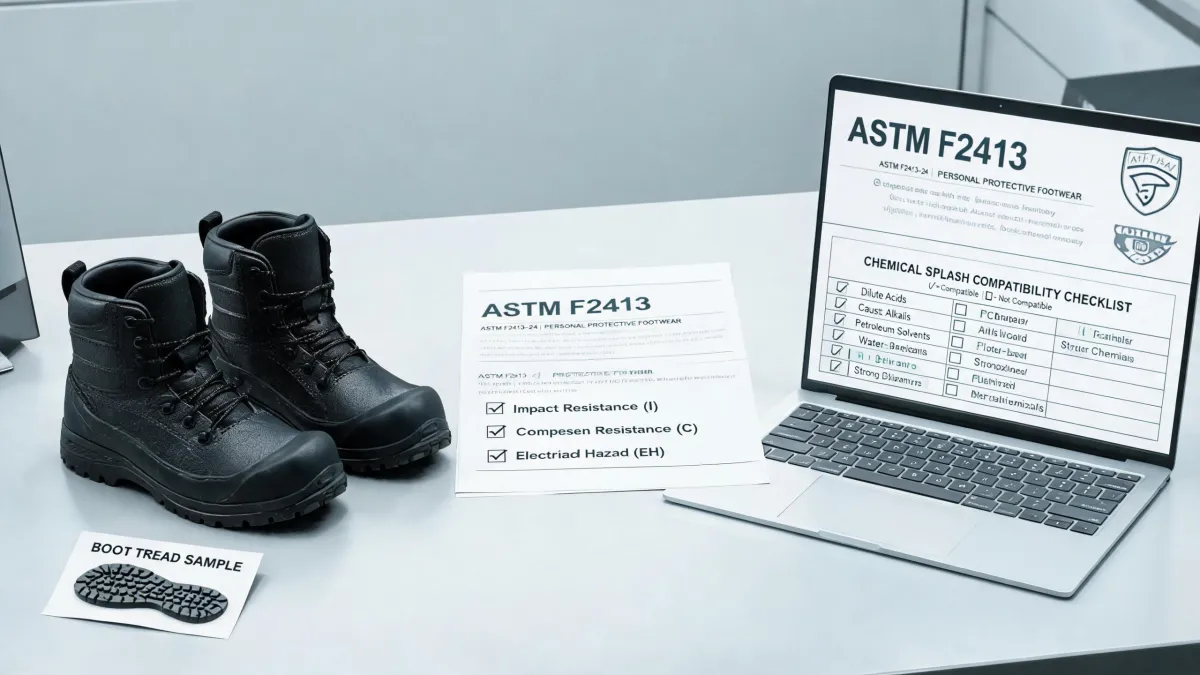
This one bit me. I bought a batch of safety work boots from a discount catalog—great price, except the sizes ran narrow and the return window was 14 days with a restocking fee. Our crew was stuck waiting on refunds while a couple of guys worked in old boots that should have been retired.
Now "where to buy work boots" comes down to return policy first, price second. My short list:
- Specialty safety footwear retailers with free exchanges (they exist—use them)
- Large industrial distributors like Grainger or Fastenal—higher unit price but returns run on a predictable system
- Local safety shoe stores if your crew can try on in person (worth the trip if you're near one)
- Online marketplaces—but verify the seller actually stocks the boots, not drop-ships in six weeks
When you search "where to buy work boots for industrial work," you'll get a wall of ads. Filter for return policy and real size charts, not the lowest price on the page. I should add that we're near a metro area with multiple safety shoe retailers—if you're rural, the local store option might not exist, and that changes the decision.
How do I know if a vendor's pricing is actually transparent?
Ask "what's not included" before you ask "what's the price." I learned that one after about $4,000 in surprise line items over two years.
My first year managing purchases, I got a quote of $480 for a fall protection kit. The invoice came in at $612—shipping, a documentation fee for the certification binder, and a rush charge because "standard lead time was extended."
Now I ask two questions upfront:
- What's the all-in total on this order, including shipping and documentation?
- Which compliance documents are included, and which are billed separately?
A vendor who answers those clearly—even if the number looks higher at first—usually ends up costing less. The one who dodges the question is the one who adds the fees later. If you ask me, the vendor's answer to "what's not included" tells you more than the quote sheet ever will.
That's the part nobody puts on a spec sheet. But it's the line item I check every time now.