-
Is Ariat worth it for our safety footwear budget—or are we paying for the label?
-
Do Ariat women's steel toe boots fit the same as men's sizes?
-
Prescription safety glasses—are they actually worth the hassle and cost?
-
What are latex gloves—and should we even be buying them?
-
Why is "black iron fence" on my safety procurement list?
-
How do I spot hidden costs before I sign anything?
Quick context: I'm the office administrator for a 200-person company. I've been managing safety gear procurement since 2021—roughly $180K annually across six vendors. This FAQ covers the questions I actually get from coworkers, new hires, and occasionally my own boss. No fluff.
Is Ariat worth it for our safety footwear budget—or are we paying for the label?
Short answer: for us, yes—but not for the reason I expected. I ran a cost-per-wear comparison in Q3 2024 across three tiers. A $75 house brand, a $140 Ariat work boot, and a $220 premium option. Eight months in, the Ariat pair lasted roughly 40% longer than the house brand and cost less per month of service. The $220 boot performed about the same as the Ariat. So Ariat sat in the efficient middle.
The bigger insight: the Ariat products our crew actually wears are the ones that last. Sounds obvious. But I've bought plenty of "durable" gear that sat in a locker because it was miserable to wear. Durability means nothing if nobody puts it on.
Do Ariat women's steel toe boots fit the same as men's sizes?
No. This is one of those things I wish someone had told me sooner. Ariat women's steel toe boots use a different last—the foot shape the boot is built on—than the men's line. Female employees who tried to size down in men's boots ended up with fit complaints. We had two returns in 2023 before I switched to ordering the women's-specific models.
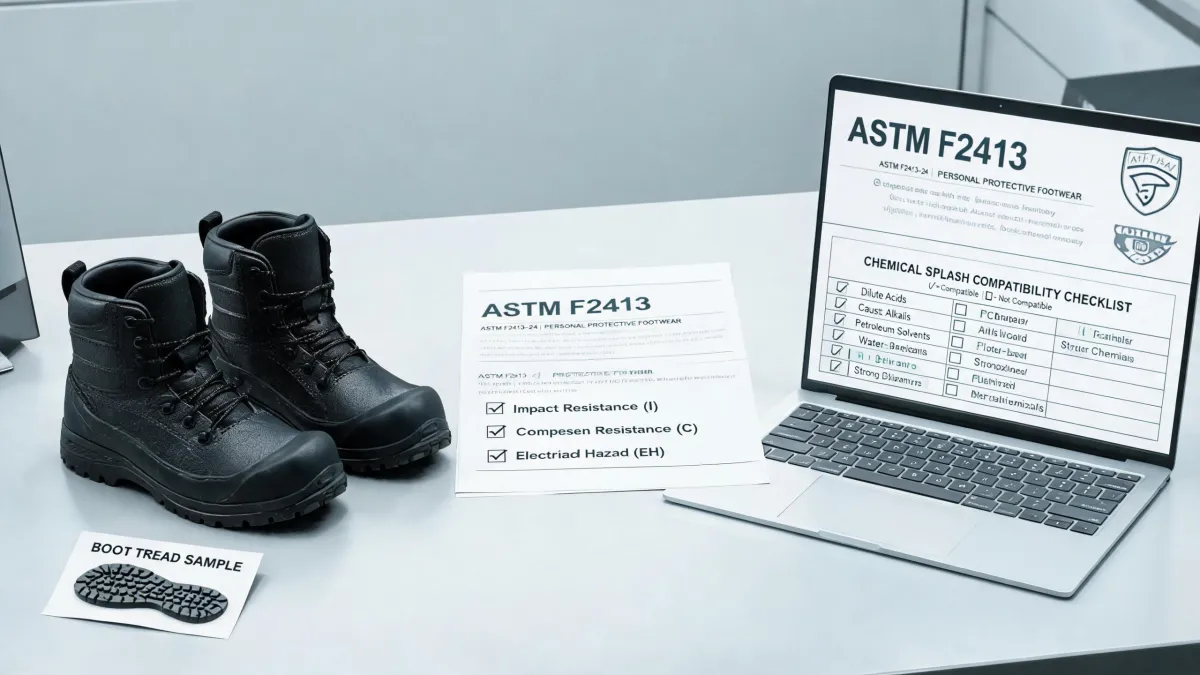
If you're buying for a mixed workforce, check the safety certification on the specific model. Most Ariat safety toe styles meet ASTM F2413-18, which covers impact and compression resistance. But the standard applies per style—not per brand. I verify the labeling on every model we order.
Worth noting: the women's Ariat steel toe boots we've ordered run true to size for most people, but width options are limited compared to the men's line. If someone has wide feet, they may need to size up or look at a different style.
Prescription safety glasses—are they actually worth the hassle and cost?
If your employees need vision correction, yes. Not optional. Here's why: standard safety glasses worn over prescription frames rarely seal properly, and the combination often fails impact testing at the sides. Prescription safety glasses are designed and tested as a unit.
"ANSI Z87.1-2020 is the current standard for eye and face protection in the US. Look for the Z87+ marking on the lens—that indicates high-impact rating."
Cost runs about $85–$150 per pair depending on frame and lens coating, as of January 2025. That sounds steep until you compare it to a single eye injury claim. We budget $2,500 annually for prescription safety glasses across roughly 25 employees who need them. We treat it as fixed cost, not discretionary.
One practical note: prescription safety glasses take two to three weeks to arrive, sometimes longer if the prescription is complex. Don't order them the week someone starts. Plan ahead or you'll be dealing with a non-compliant employee on day one.
What are latex gloves—and should we even be buying them?
Latex gloves are disposable gloves made from natural rubber latex. They're common in medical, food service, and janitorial settings because they offer good fit, dexterity, and barrier protection. But "common" doesn't mean "always right."
About 1–6% of the general population has a latex allergy, according to OSHA data, and repeated exposure can trigger reactions in people who weren't previously allergic. We switched our janitorial and food service gloves to nitrile in 2022 after an employee reported a reaction. Nitrile costs about 15–25% more per box, but it eliminates the allergy risk entirely and holds up better against oils and chemicals.
If you're buying latex exam gloves specifically, verify they meet ASTM D3578, the standard for rubber examination gloves. For general-purpose cleaning gloves, EN 388 covers mechanical protection. And if you keep latex on hand, label it clearly so people know what they're reaching for.
Why is "black iron fence" on my safety procurement list?
Because "safety" covers more than PPE. In March 2024, our operations manager asked me to source "safety equipment" for the back lot. Turned out he meant a black iron fence to secure the loading area. Completely different category—but the same procurement principle applies.
Here's the lesson from that project: the first quote I got was $8,400 for "supply and install." Sounded reasonable until I asked what wasn't included. Concrete footings? Extra. Permit filing? Extra. Site cleanup? Extra. Final bill would have been closer to $11,500. The second vendor quoted $10,200 all-in. Higher sticker price, lower actual cost.
This is the thing I keep relearning: the transparent quote almost always wins. Not always the lowest number. The number that doesn't move.
How do I spot hidden costs before I sign anything?
Three questions, every time:
- "What's not included in this price?"
- "What could change this number after we start?"
- "Can you put the full scope and fee schedule in writing?"
I learned this the hard way in 2022. A new vendor quoted $2,100 for a bulk order of Ariat FR shirts—about $1,400 cheaper than our regular supplier. I placed the order without checking their invoicing setup. They sent a handwritten receipt. Finance rejected the expense report. I ate the $2,100 out of my department budget while we sorted it out. Now I verify invoicing capability before any first order, regardless of how good the price looks.
The pattern I've seen across footwear, gloves, glasses, and even fencing: vendors who volunteer their exclusions upfront tend to be easier to work with than vendors who make you dig. Not always. But often enough that I've stopped treating the lowest bid as the starting point for negotiation.
That's the whole philosophy, really. Ask what's missing before you ask what it costs. The answer tells you more about the vendor than the price ever will.