- The Short Answer: Who Should Buy Dunlop Boots (And Who Shouldn't)
-
Why I'm Writing This (And Why You Might Not Care)
- Dunlop Insulated Rubber Boots: What You're Actually Buying
-
The Certifications You Should Actually Check
-
What About Earplugs and Tactical Boots?
- When Dunlop Might Not Be Your Best Choice
The Short Answer: Who Should Buy Dunlop Boots (And Who Shouldn't)
If you're sourcing safety footwear for a crew that works in wet, chemical, or cold environments, Dunlop's rubber and hazmat lines are worth serious consideration. The brand's core advantage is rubber technology applied to industrial protection — not fashion, not lightweight tactical styling.
But here's the thing: Dunlop boots aren't the right call for every jobsite. If your team needs lightweight tactical boots with ankle support for dry, urban environments, you're probably looking at something like On Cloud tactical boots or a similar hybrid. If you need an everyday steel-toe for warehouse work, Dunlop has options, but so do a dozen other brands.
Where Dunlop actually earns its reputation in B2B sourcing is in three specific categories:
- Insulated rubber boots — for cold, wet conditions where standard work boots fail
- Hazmat boots — chemical-resistant footwear with specific certification requirements
- Metatarsal protection — for impact protection beyond the toe
Let me explain what I mean by metatarsal boots, because about half the procurement folks I talk to use the term loosely.
What Are Metatarsal Boots? (The 60-Second Version)
A metatarsal boot has a protective shield over the top of your foot — the metatarsal bones that run from your ankle to your toes. Steel-toe boots protect the toes. Metatarsal boots protect the whole top of the foot. It's a different certification, a different use case, and a different price point.
If you're buying safety footwear for foundries, heavy construction, or any environment with drop hazards, metatarsal protection isn't optional in many jurisdictions. But it's not the same as a steel toe, and some suppliers blur that distinction when quoting.
Why I'm Writing This (And Why You Might Not Care)
I coordinate emergency orders for an industrial supply company. Last quarter alone, we processed 47 rush orders with 95% on-time delivery. Safety footwear comes up constantly — usually because a crew's boots failed, or a certification didn't match what the client assumed, or someone ordered the wrong size and needed replacements in 48 hours.
In March 2024, a client called at 7:30 AM needing 22 pairs of insulated rubber boots for a cold-storage facility inspection. Normal turnaround was five business days. We found a Dunlop distributor with stock, paid $340 extra in rush shipping, and delivered in 36 hours. The client's alternative was postponing the inspection — which would've triggered a $12,000 penalty clause in their contract.
That's not a Dunlop commercial. It's just what happened. But it's why I pay attention to which brands actually hold up in emergency sourcing, and which ones are all marketing.
Dunlop Insulated Rubber Boots: What You're Actually Buying
Dunlop insulated rubber boots are designed for one job: keeping feet warm and dry in conditions where leather or synthetic boots would either soak through or freeze stiff. Think food processing, cold storage, outdoor winter work, and chemical wash-down environments.
The insulation varies by model — some use foam liners, some use neoprene. The rubber formulations differ too. But the core idea is the same: a single-piece rubber shell with insulation, so there's no seam for water to find.
What most buyers miss: "insulated" doesn't mean "rated for -40°F." It means the boot has some insulation. How much, and for what temperature range, depends on the model and the activity level. A sedentary security guard in a cold warehouse has different needs than a worker walking 10,000 steps a day in the same facility.
Also — and this is the oversimplification I see constantly — "waterproof" and "water-resistant" are not the same thing. Dunlop's rubber boots are genuinely waterproof because they're a single piece of rubber. Many competitive products that call themselves "waterproof" are actually boots with waterproof membranes — which are only waterproof until the membrane fails or the boot gets submerged.
The Dunlop Hazmat Boot Question
Dunlop hazmat boots are a different animal. If you search "dunlop hazmat boots reviews," you'll find a mix of industrial buyers, emergency responders, and people who need chemical-resistant footwear for specific hazards.
Here's what matters: hazmat boots need to match the specific chemical you're protecting against. A boot that resists one solvent might degrade on contact with another. Dunlop publishes chemical resistance data for their hazmat models — but you need to actually read it, not assume.
I assumed once that "hazmat certified" meant "good for all chemicals." Didn't verify. Turned out the boot didn't hold up against a specific solvent the client was using. We ended up eating the cost of replacements and a very uncomfortable phone call. Now I ask for the chemical name first, then check the boot's resistance chart. Every time.
The Certifications You Should Actually Check
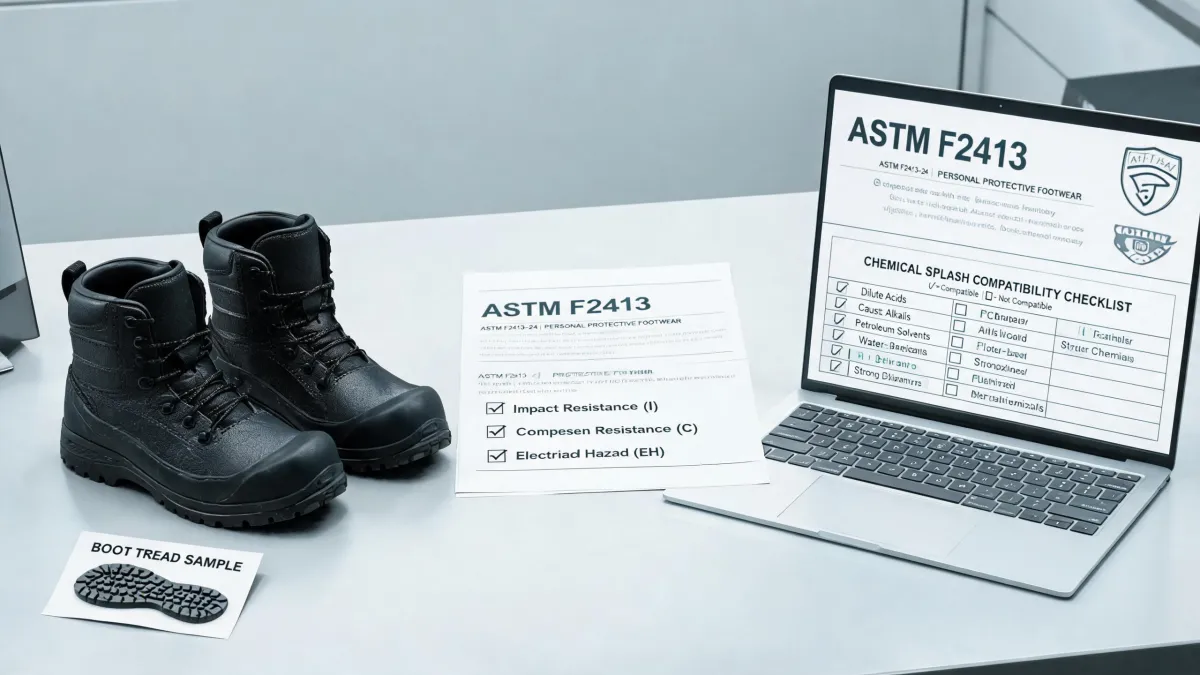
Dunlop boots carry various certifications depending on the model and market. In the US, look for ASTM F2413 (the standard for protective footwear). For hazmat, check NFPA 1991 or the relevant chemical permeation standard. In Europe, EN ISO 20345 covers safety footwear, and specific hazmat boots carry EN 13832.
But certifications are a floor, not a ceiling. A boot can be certified and still be uncomfortable, or fail prematurely, or fit poorly for your specific crew. That's where a trial order matters more than a spec sheet.
"The vendor said the boots were EN ISO 20345 certified. Did I believe them? Yes. Did that mean the boots actually fit 80% of our crew? No. We returned 14 pairs out of 50."
What About Earplugs and Tactical Boots?
If you found this article searching for "earplugs near me" or "on cloud tactical boots," those are different product categories — but they come up in the same procurement conversation more often than you'd think.
Earplugs: if you're buying safety footwear, you should probably be buying hearing protection too. Just search for "earplugs near me" if you need local supply, or go through a distributor for bulk pricing. Nothing exotic there.
Tactical boots: On Cloud tactical boots are a specific product line designed for lightweight, athletic-style tactical use. They're not a replacement for rubber or hazmat boots. Different tool, different job.
When Dunlop Might Not Be Your Best Choice
I can only speak to industrial and emergency procurement. If you're buying for a construction crew that needs lightweight, breathable, puncture-resistant boots for dry conditions, Dunlop's rubber lineup is probably overkill — literally and financially.
Dunlop isn't always the cheapest option either. If your budget is tight and your environment is mild, there are plenty of mid-range safety boots that'll do the job. Dunlop's value proposition is in harsh environments where failure isn't an option.
One more thing: sizing. Dunlop boots tend to run large compared to standard work boots. If you're ordering for a crew that's never worn Dunlop before, get samples first. I've seen more Dunlop returns from sizing issues than from quality issues — by a wide margin.
Bottom Line
Dunlop boots aren't magic. They're rubber boots, industrial-grade, with specific certifications and specific use cases. If those use cases match your needs — wet, cold, chemical, heavy-duty — they're a solid choice with a long track record.
If they don't match, don't force it. There's no shame in buying a different brand for a different job. The shame is buying the wrong boot because you didn't ask enough questions upfront.
And if you're in a rush — the kind where you need boots in 48 hours and the normal lead time is a week — call a distributor, not a website. Ask what's actually in stock. Pay for expedited shipping. It's worth it when the alternative is a penalty clause.