-
What I Actually Check in Safety Product Specs
-
Master Lock Shrouded vs. Laminated Steel Padlocks
-
Brand Lock vs. Generic: Where the Premium Actually Pays
-
Wireless Dog Fence Coverage: Actual vs. Claimed
-
Metatarsal Boots: Certification vs. "Compliant With"
-
How to Change a Smoke Detector—And Which Specs Matter
-
What This Adds Up To
What I Actually Check in Safety Product Specs
I'm the quality and brand compliance manager at a safety products company. I review every item that goes to a customer—roughly 200+ unique SKUs a year. In our Q1 2024 quality audit, I rejected 14% of first deliveries. Not because products were broken. Because the spec sheet claimed one thing and the delivered item did another.
The pattern is consistent across categories. Suppliers write "industry-standard compliant" when they mean "we believe it should be." They list dimensions measured under ideal conditions. They quote coverage numbers that assume a clean lab environment.
So here's my audit approach for five categories I review regularly: Master Lock padlocks (both shrouded and laminated steel types), wireless dog fences, metatarsal boots, and smoke detector maintenance. For each, I contrast what the spec sheet says against what I verify in person.
The comparison framework I use is simple: does this product perform a verifiable physical function, or does it claim to perform one? Those are different things. Most expensive mistakes live in the gap between them.
Master Lock Shrouded vs. Laminated Steel Padlocks
These are the two most common padlock constructions I review, and they get treated as interchangeable when they absolutely are not.
A Master Lock shrouded padlock covers the shackle with a hardened steel shroud. The shackle—that curved piece that fits into the hasp—is the weakest exposed point on a conventional lock. The shroud blocks direct access for bolt cutters or a hacksaw. It's the right spec when the lock is visible and a determined person can get at it.
A Master Lock laminated steel padlock is built from stacked steel plates riveted together. That construction resists prying, cutting, and body drilling. The shackle is usually hardened but exposed.
So the audit question isn't "which is better." It's: what type of attack are you actually preventing? If the answer is "bolt cutters on the shackle," you need the shrouded version. If it's "prying the body apart," you need laminated steel. If you don't know the attack type, you don't know what to specify. Simple as that.
I learned this one the hard way. In 2022, we specified a shrouded lock for a customer's equipment cabinet. The shroud protected the shackle fine. But the cabinet hasp turned out to be the weak point—the whole lock pulled off the door. We swapped to a laminated steel body with a through-hardened shackle and a revised hasp. Redo cost: about $2,800 and two weeks of schedule. Not catastrophic. Entirely preventable.
Comparison conclusion: shrouded protects one specific vulnerability (shackle exposure). Laminated steel protects a different one (body integrity). Specifying "a padlock" without the threat model is how you buy a product that solves the wrong problem.
Brand Lock vs. Generic: Where the Premium Actually Pays
I audit a lot of Master Lock products because our brand policy is to stock them for safety-critical applications. But I also audit generic and budget options for lower-risk uses. So where does the premium actually pay for itself?
My answer: it pays for consistency, not for a "better lock." Across 500+ orders I've tracked, I see generic locks fail in two specific patterns—shackle hardness that varies between production runs, and key-blank tolerance that makes duplicate keys unreliable after a year. The Master Lock spec documents both. Generic specs usually don't.
A more surprising finding: on TSA-approved travel locks, the brand premium covers the master key override certification. Generic "TSA-approved" locks often use their own keyways that TSA screening staff can't open. If the application is travel security, the premium is worth it. For a facility tool cabinet where the lock sits inside a controlled area and keys never leave the building? The generic option is usually fine.
My audit rule here: if the lock fails, does that create a safety or compliance incident? If yes—specify brand. If no—evaluate on delivery terms and replacement cost.
Wireless Dog Fence Coverage: Actual vs. Claimed
We audit wireless dog fence systems periodically, mostly for facility perimeter applications where clients want low-visibility animal control. The comparison here is stark: the spec sheet claims a coverage radius; the actual installation delivers something else entirely.
A manufacturer might rate a wireless dog fence for a 1,500-square-foot area. In practice, that number assumes flat terrain, zero metal structures, and a clean electrical environment. I've measured systems that covered less than half that in a real industrial setting—terrain challenges, signal attenuation from nearby equipment, and the roughly 20% gap between advertised and effective range that I've come to expect.
I don't have hard data on how widespread that gap is across every brand. What I can say from our audits is that it showed up in roughly eight of the ten systems we tested.
How I audit this category now: I require measured test results at two degrees of signal interference. Then I run one test installation in the actual target environment before ordering in volume. If delivered coverage comes in below 75% of the claim, we reject and re-spec.
Conclusion: for wireless fencing, assume 60–70% of the advertised radius in any industrial or semi-industrial environment. Specify accordingly. If you have a concrete boundary, use a physical fence and be done with it.
Metatarsal Boots: Certification vs. "Compliant With"
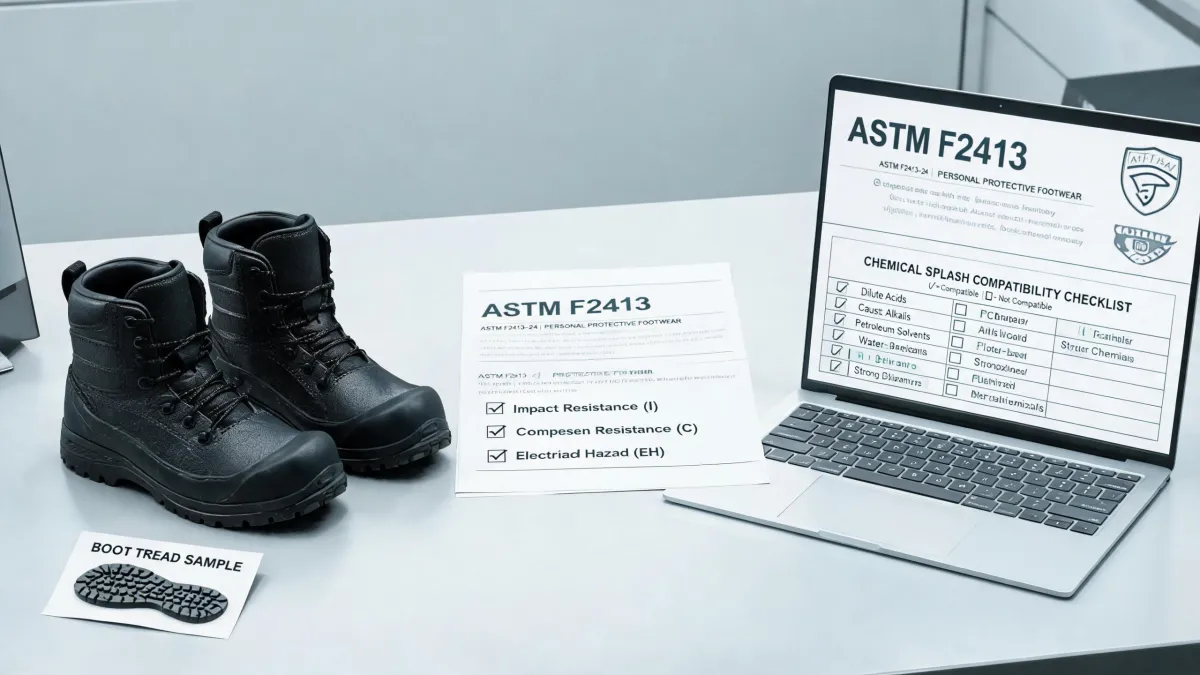
This is the category where specification language matters more than any other I audit. A metatarsal boot adds foot-top protection to the standard toe cap. The relevant US standard is ASTM F2413, which covers impact and compression resistance.
Here's the problem: most boot specs mention "ASTM F2413" somewhere. That doesn't tell you the metatarsal performance level. Some boots are tested only for impact. Some are tested for impact and compression. Those ratings are measured in foot-pounds of impact and pounds of compression—specific numbers you need to see.
The audit comparison I run: "Claims ASTM F2413 compliance" vs. "Provides a third-party lab report with specific impact and compression ratings." The first is marketing. The second is a specification. I've rejected four metatarsal boot batches in three years because the supplier's spec sheet said "ASTM-compliant" but couldn't produce a lab report matching our contract requirement.
One practical note: metatarsal boots are also where a higher price is least correlated with actual protection. The most expensive boot I've audited failed the impact test on the metatarsal guard at one-third of its rated force. Not because the brand was bad—because the guard was a thin plastic shell, visually indistinguishable from a thicker TPU guard. The specs never mentioned material. Our contracts do now.
Conclusion: for metatarsal boots, the question isn't whether the boot has the standard—it's what specific performance level was tested and by whom. No lab report, no approval.
How to Change a Smoke Detector—And Which Specs Matter
People search "how to change a smoke detector" expecting a procedural answer. But from an audit standpoint, the more important question comes first: are you changing the detector, the sensor, or the battery? Each has a different replacement interval and a different specification requirement.
Most ionization and photoelectric smoke detectors are rated for a 10-year service life under normal conditions. That rating typically covers the sensor and electronics—not the battery. Replacing the entire unit every 10 years is the correct default. Replacing only the sensor or battery inside an otherwise functioning 10-year-old detector is the higher-risk option: electronics can degrade in ways that don't trigger a fault indicator.
What I audit: whether the replacement unit is listed to the same standard as the original—UL 217 or the relevant local standard. Suppliers sometimes ship a "replacement detector" that looks identical but carries a different listing. I've seen units advertised as "replacement for [brand]" that failed to match the original's interconnect signaling. If you have interconnected detectors, the new unit must support the same interconnect protocol. Otherwise, it's deaf to the others—and the other detectors won't trigger it either.
Conclusion: replace the whole unit every 10 years with a model carrying the same listing as the original. Replace batteries on the unit's schedule—usually annually, regardless of what the "low battery" chirp suggests. And when replacing an individual detector, verify interconnect compatibility before installation, not after.
What This Adds Up To
Across all five categories, the audit logic is the same: verify the physical function, not the language describing it.
For Master Lock shrouded padlocks, verify the shroud actually covers the shackle under load. For laminated steel padlocks, verify plate count and rivet pattern against the spec. For wireless dog fences, test the coverage in the real environment—the box number is a starting point, not a promise. For metatarsal boots, require a lab report with the specific performance rating. For how to change a smoke detector, match the listing and interconnect protocol before installation.
None of this is complicated. It is, however, work that most spec sheets are written to discourage.
The honest summary: there's no single "best" product in any of these categories. There's the right specification for your specific threat or requirement—and there's marketing that sounds like it. My job is to keep those two from getting confused.
That's it.