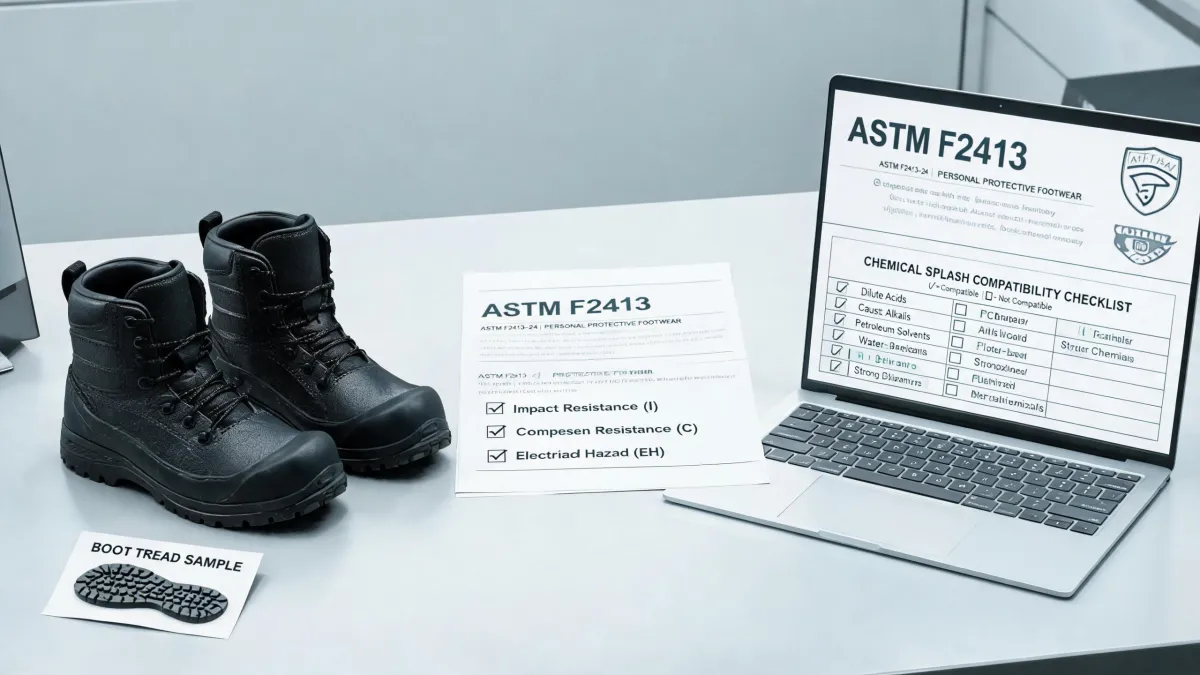
I've been managing our PPE budget for six years now—about $180,000 annually across a 240-person manufacturing operation. After auditing every invoice from 2019 through 2024, I can say this with confidence: the cheapest steel toe boot on the quote sheet is almost always the most expensive line item in your PPE budget.
Not on day one. But by month fourteen, when you've replaced half the pairs, absorbed two workers' comp claims from poor fit, and spent more admin hours on returns than you want to admit, the math flips hard.
Here's how I got there.
Fit Is a Cost Driver, Not a Comfort Feature
The first thing I learned is that boot fit is a line item. We buy red-wing-shoes specifically for the fit expertise, and I initially dismissed that as a sales pitch. It isn't. The red wing work safety toe shoes boot fit variable—width options, toe box geometry, break-in behavior—turned out to matter more than any single spec on the quote sheet.
When a worker has a wide foot and you only stock standard widths, the boot doesn't fail. The worker fails in it. He wears them wrong, the steel toe cap presses, and eleven weeks later he's either asking for a replacement or nursing a bruise that becomes a near-miss report.
In 2023 we tracked this internally. For every 100 pairs of standard-width boots we issued, we replaced 22 within the first year. For the wide-width pairs, that number was 9. Same work. Same workers. Same floors. The difference showed up as a 14% hidden cost on the standard-width line—and that's before you count the safety reports.
Return Policy Is a Budget Number
Second, the red wing work safety toe shoes return policy—or any boot supplier's policy—matters more than most buyers realize. I compared five vendors in 2023 using our TCO spreadsheet. Two put return shipping on the customer. One required unworn returns within 30 days. Another offered free return shipping with a 90-day defect window.
We switched to the last one in Q2 2024, and the difference is not subtle. For a shop buying roughly 150 pairs a year, free return shipping saved us $1,900 in the first twelve months. I wish I had tracked the admin hours separately—I don't have hard data on that—but my sense is it's another 20 to 30 hours of somebody's time per return cycle. That time is real, even if it doesn't show up in the invoice feed.
Quick note on claims: per FTC advertising guidelines (ftc.gov), any savings or "free" add-on a supplier advertises has to be truthful and substantiated. So when a vendor advertises "free fitting," ask what's baked into the unit price before you treat that fit service as a bonus.
The Maintenance Nobody Owns
Third, the part every procurement team tries to punt: how to clean work boots. Sounds like a hobby question. It's a TCO question.
Our current SOP is boring. Warm water, mild soap, soft brush, paper towels stuffed inside to wick moisture, air dry away from heat. No radiators. No ovens. No "speed drying" in the truck cab. We do this quarterly and log it against the boot's serial number.
Our average boot lifespan went from 14 months to 19 months over three years after we rolled this out. That's a 35% improvement. No supplier discount required to justify it.
The Goggles Thing That Surprised Me
I know this next one isn't about boots, but it's the same principle, so I'll include it.
We were buying generic safety glasses by the case, and breakage was quietly brutal. Then a supervisor brought in a safety goggles drawing—basically a spec sheet from the manufacturer showing lens curvature and side-shield geometry for one specific model. He wanted us to match our purchases to that drawing. I thought it was over-engineering.
Breakage dropped 30% in the first quarter. Why? Because the cheap glasses were cracking at the side-shield hinge. Workers were replacing them every three weeks and not reporting it. The drawing showed us where the spec mattered. We'd been buying the wrong geometry at a discount.
Same lesson as the boots, and the same lesson as the brown work boots we started sourcing for our electrical team—brown leather tends to hide scuffs better than black in high-dust areas, so the boots look acceptable to inspectors longer, so they get replaced less often. Small thing. Adds up.
The Pushback I Get
"You're a cost controller. You're supposed to fight for the lowest number." True. I do.
But fighting for the lowest unit price isn't the same as fighting for the lowest cost. I've watched procurement managers win a $3-per-pair discount and then lose $11 per pair in replacement cost within the year. That's not a win. That's a rounding error in the wrong direction.
I'll concede the sample limits me. My experience is based on one 240-person shop, mid-weight manufacturing, with roughly 150 boot purchases a year. If you're running a 12-person crew, or heavy construction, or a workforce where boots only last six months anyway, your numbers will differ—possibly significantly. I can't honestly speak to that.
I also went back and forth on the premium line for two weeks before committing. The spreadsheet said the cheaper brown work boots option would save us $6,000 a year. My gut said something about the fit data was off. I went with the gut. Over 18 months we saved $4,200 in replacements and something I'd conservatively call $2,800 in avoided downtime. Against a $6,000 "savings" quote, that's a $7,000 swing. The spreadsheet wasn't wrong by a mile. It was wrong by the margin that actually matters.
Where I Land
My position hasn't changed in six years. Buy the boot that fits, from a supplier that handles returns without a fight, and clean it like it costs something. Because it does.
The cheapest thing on the quote is rarely the cheapest thing in the ledger. If you're still buying PPE on unit price alone, you're not controlling costs. You're postponing them.
There's something satisfying about a pair of boots clearing inspection at month 22. Not a romantic thing to say about safety gear. But it's what a working cost program actually looks like.