-
The Cheapest PPE Quote Is a Lie You Tell Yourself
-
Evidence #1: The $3,200 Rush Order That Almost Cost Us a Client
-
Evidence #2: Overalls vs. Coveralls (Or: Why "Close Enough" Costs More)
-
Evidence #3: The Counterintuitive Math on Work Boots
-
"But We Can't Afford Premium Pricing" — Actually, You Can't Afford Not To
-
What "Paying for Certainty" Actually Looks Like
-
Bottom Line: Stop Buying Quotes, Start Buying Outcomes
The Cheapest PPE Quote Is a Lie You Tell Yourself
I've spent 11 years in procurement and facilities roles, and I've personally made about 23 documented buying mistakes totaling roughly $14,000 in wasted budget. The worst one wasn't a pricing error. It wasn't a spec mistake either (though I've made plenty of those). It was a timing error.
Here's what I believe now, and I'll defend it: In PPE procurement, paying a premium for guaranteed delivery isn't a luxury—it's risk management. "Probably on time" is the most expensive promise in this industry.
That's not a popular position in a procurement meeting. The person holding the cheaper quote often wins the room. I've been that person. I've fought for the bottom line and lost sleep over it later. What changed my mind wasn't a conference talk or a vendor pitch—it was three specific disasters that I still carry around like bad souvenirs.
Evidence #1: The $3,200 Rush Order That Almost Cost Us a Client
In September 2022, we needed 400 pairs of cut-resistant gloves and 60 coveralls for a plant shutdown at a client's food processing facility. The shutdown window was locked: seven days, starting Monday at 6 AM. If we started late, the client lost production days worth roughly $15,000 each.
I got quotes from three suppliers. Two were within 4% of each other. The third was 18% cheaper but couldn't guarantee a delivery date beyond "approximately 5-7 business days."
I went with the third one. Of course I did. The savings were $3,200. My manager was pleased. I remember feeling clever.
The gloves arrived on day eight. Three days late. We scrambled—borrowed stock from another site, paid a $900 expedited fee from a local distributor on top of everything else. The plant started Tuesday instead of Monday.
Here's the part that stings: the 18% cheaper supplier wasn't lying. They said "approximately." I just heard what I wanted to hear. That $3,200 savings turned into roughly $11,000 in real costs between the borrowed stock, the expedited fee, and the client's displeasure (which, mercifully, they didn't fully invoice us for).
I still kick myself for not writing "guaranteed delivery by Friday EOD" into that PO. If I had, I'd have had leverage. Instead, I had apologetic emails and a very uncomfortable meeting.
Evidence #2: Overalls vs. Coveralls (Or: Why "Close Enough" Costs More)
I once ordered 60 pairs of overalls for a job that actually required coveralls. Yes, there's a difference (overalls are the bib-and-brace style; coveralls are the full-body suit with arms and legs). Our regular supplier's rep even flagged it: "Just confirming—these are the bibs, not the full suits, right?" I said yes because I'd already placed the order and didn't want to look incompetent.
The foreman called me at 6:15 AM the day they arrived. Not happy is an understatement.
The reorder was expedited (that word keeps showing up in my worst stories), and we ate the cost of the wrong 60 pairs because we'd already had them printed with site numbers. Total damage: about $1,900 plus two lost production hours.
That's when I learned my lesson about specification certainty. A guaranteed delivery date on the wrong product is still a disaster. Both sides matter. Now every PO has a "spec verification" line that someone else on my team signs off on—coveralls vs. overalls, glove size, cuff type, that sort of thing. It takes 90 seconds and has caught four potential errors in the past year alone.
Evidence #3: The Counterintuitive Math on Work Boots
This one isn't about late delivery—it's about why the "cheap but fast" option is often a false economy.
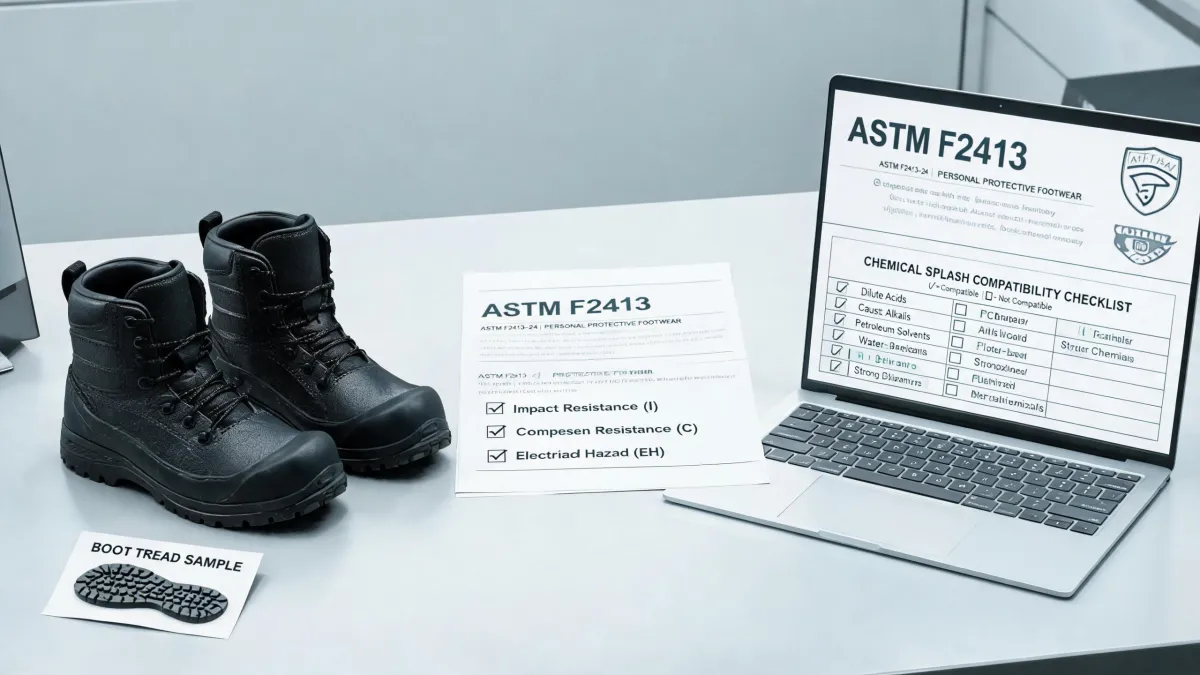
We used to buy no-name safety boots at roughly $45 a pair. They were in stock, always available, ships in two days. Great, right? Except the soles started delaminating around week six. We weren't just replacing boots; we were pulling workers off the floor for replacement appointments and eating the payroll cost of downtime.
I ran the math in Q1 2024. A pair of Keen work boots (or similar quality brands—we've tested a few) runs about $140. A cheap pair runs $45. But the cheap pair gets replaced 3-4 times a year. The Keen pair, we've seen 14-18 months of consistent use. Do the math: $45 × 3.5 replacements = $157.50, plus the admin cost of chasing replacements and the safety risk of a boot failing mid-shift.
The premium option wasn't more expensive. It was cheaper. And it was available when we needed it, which is a form of certainty I didn't appreciate until I'd been burned by the alternative.
"But We Can't Afford Premium Pricing" — Actually, You Can't Afford Not To
The obvious pushback: budgets are tight, every dollar counts, procurement is supposed to save money, not spend it on fancy delivery guarantees.
I get it. I lived in that spreadsheet for years. But here's what the spreadsheet doesn't show: the cost of the scramble. The borrowed stock. The expedited reorders. The client conversation. The foreman who now trusts you a little less. The worker standing in ill-fitting boots because the replacement shipment is "approximately" arriving.
When we started sourcing our core PPE items through Magid Glove & Safety Manufacturing Company LLC, the thing that changed wasn't the product quality (though that's been solid—they run their own manufacturing, which I now look for after too many branded-but-outsourced failures). It was the delivery commitments. When their team says a shipment leaves Tuesday, it leaves Tuesday. I've tested it. Four times in the past 18 months. Every time, on time.
Is that worth a 6-9% premium on the invoice? For our high-turnover items—gloves, safety glasses, the stuff that stops production if it runs out—absolutely. We now budget for it explicitly. My boss signs off on the line item "guaranteed delivery premium" without blinking, because she remembers the September 2022 shutdown too.
What "Paying for Certainty" Actually Looks Like
I'm not saying "always buy the most expensive option." That's just swapping one lazy heuristic for another. Here's the checklist I actually use now, refined across about 150 orders:
- Flag the critical items. What stops operations if it's late or wrong? Those get the guaranteed-delivery premium. Everything else can chase the cheaper quote.
- Get the delivery commitment in writing. "Ships by Friday" is not the same as "delivered by Friday." Ask which one the supplier means. Watch them squirm. The ones who answer clearly are the ones worth keeping.
- Do the total-cost math on consumables. Cheap gloves that rip weekly are more expensive than mid-range gloves that last a month. Cheap boots that fail in six weeks cost more than quality boots that last a year.
- Separate your PPE orders from your facilities orders. This is the vinyl porch railing lesson. Last spring, I bundled a PPE restock with a facilities request (some vinyl porch railing for the site office trailer—don't ask). The railing came in fine. The gloves came in the wrong size. Nothing sharpens your attention like splitting an order across two completely unrelated product categories and getting burned on both. Now they're separate POs, separate approvals, separate follow-ups.
Simple? Yes. But simple isn't easy. It means slowing down the initial order to prevent the slow, expensive unravelling later. It means admitting that "approximately 5-7 days" is not a delivery date. It means telling your CFO that paying more upfront for certainty is a strategy, not a splurge.
Bottom Line: Stop Buying Quotes, Start Buying Outcomes
If you take one thing from a guy who's made every mistake in this particular book: stop optimizing the invoice and start optimizing the outcome. The cheapest PPE quote is a number. The most reliable delivery is a promise—and the good suppliers keep it.
Pay for the promise. Your sleep will thank you. So will the foreman.
Pricing references in this article are approximate and based on our team's order records from 2022–2025. Actual market rates vary by volume, spec, and supplier—verify current quotes before committing budget. For current PPE standards and requirements, check OSHA (osha.gov) and ANSI/ISEA guidance.