The Day I Learned Cheap Boots Aren't Cheap
If you've ever had a delivery arrive damaged, you know that sinking feeling. But what about when the damage isn't to the package—it's to your employee?
I still kick myself for that order back in 2021. I was the office administrator for a mid-sized chemical distribution company, managing all our PPE purchasing. When our operations manager asked for a new batch of safety boots, I thought I'd found a deal. A new vendor offered steel toe boots at $45 a pair—almost half what we were paying our regular supplier.
Trust me on this one: that decision cost us way more than the money I saved.
The Beginning of the Story
When I took over purchasing in 2020, I inherited a system that worked, but seemed expensive. We were ordering Dunlop safety boots for our warehouse crew, specifically the Dunlop Chesapeake rubber boots for the wet areas ($75-90 a pair from our regular distributor based on pricing as of Q4 2024; verify current rates).
I thought, "There's got to be a way to cut this cost." So in early 2021, I found a supplier offering "industrial-grade" steel toe boots for much less. They looked decent in the photos (ugh).
Our team of 12 needed new boots. I ordered 15 pairs at $45 each—a $675 order. Our regular Dunlop order would have been about $1,200 for the same quantity. I felt pretty smart.
Here's what you need to know: the quoted price is rarely the final price.
The Reality Check
Within one month, three things happened:
- The waterproofing failed. Seriously, the first puddle soaked through.
- The sole separated from the upper on a pair used in our chemical storage area.
- A worker complained of foot pain—the "comfort insole" was basically cardboard.
Now, I'm not a safety engineer, so I can't speak to the specific ASTM standards for chemical permeation. What I can tell you from a procurement perspective is that I had 12 very unhappy workers and an operations manager asking why I switched vendors.
People think expensive boots are overpriced. Actually, boots that protect cost more to make. The causation runs the other way: cheap materials lead to cheap performance.
I learned this the hard way. The vendor who couldn't provide proper safety certification cost us in ways I didn't anticipate: lost work time, unhappy employees, and my own credibility with the team.
What I Should Have Done Differently
After that mess, I went back to our regular supplier and placed a proper order for Dunlop boots. We got:
- Dunlop Chesapeake Rubber Boots for the wet process areas—these are designed for chemical splash protection and have proper slip-resistant soles.
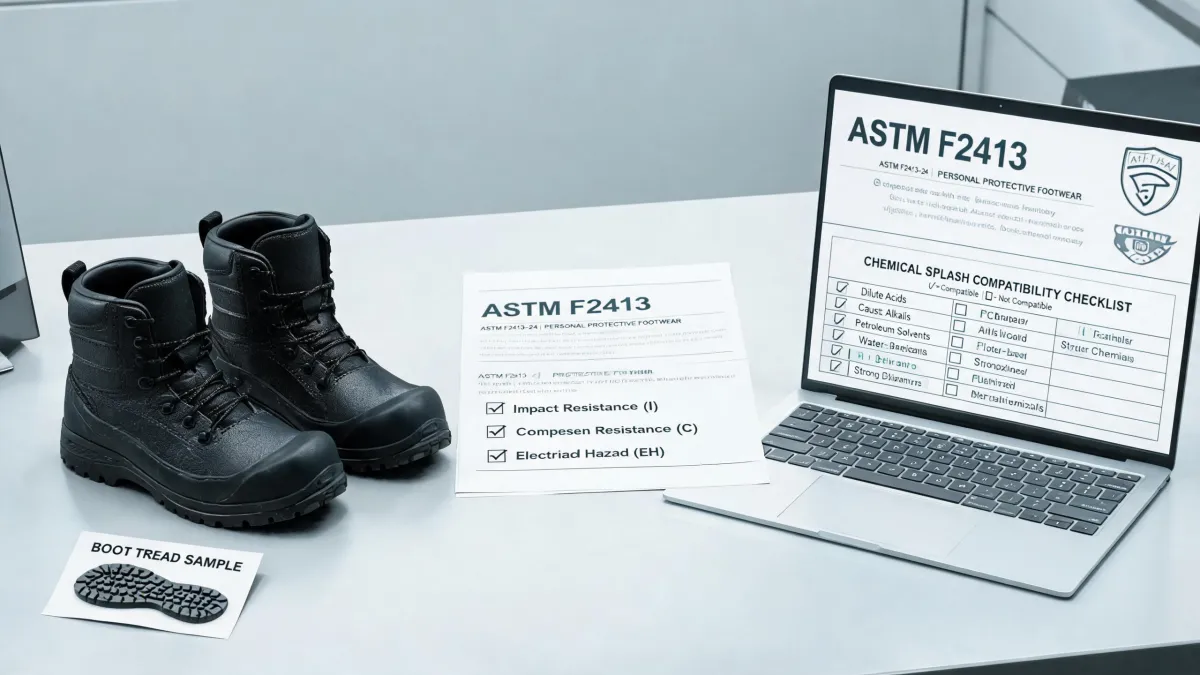
- Dunlop Steel Toe Boots for general warehouse work—ASTM F2413 certified for impact and compression.
- Specific models for specific risks (like the Hazmat series for our most dangerous chemicals).
The total came to about $95 per pair for the Chesapeakes, and $110 for the steel toe models (based on our 2024 supplier quote; verify current pricing). That's double the cheap boots, but here's the math that matters:
- The cheap boots lasted 3 months average before complaints started.
- The Dunlop boots last 18-24 months with proper care.
- Cost per month: $45 for cheap / 3 months = $15/month. $110 for Dunlop / 18 months = $6.1/month.
Bottom line: the "expensive" boots saved us over 50% per month of use. Plus zero safety incidents related to footwear.
What I Learned About Buying Safety Boots
This gets into PPE regulation territory, which isn't my expertise. But from a procurement perspective, here's my checklist now:
1. Certification Comes First
Before asking "what's the price?" I now ask "what's the certification?" For safety boots, that means:
- ASTM F2413 for impact and compression resistance (steel toe)
- ASTM F2913 for slip resistance
- Specific chemical resistance for Hazmat applications
I've learned to ask 'what's NOT included' before 'what's the price.'
2. Know Your Risk
Not all safety boots are created equal. A boot that's fine for a construction site might be dangerous near wet chemicals. We need different boots for:
- Wet/chemical environments (like Dunlop's rubber boots)
- General industrial work (steel toe required)
- Electrical hazard protection (insulated boots with EH rating)
- Extreme cold (insulated, waterproof models)
3. Don't Cut Corners on Comfort
The workers who wear these boots 8-10 hours a day will let you know if they're uncomfortable. And uncomfortable workers find ways around PPE requirements. Our team actually wears their Dunlop boots on their own time for outdoor work—that's how you know they're comfortable.
My Advice to Other Admin Buyers
I learned this in 2021. The market may have evolved, but the principles haven't changed. If you're responsible for ordering safety boots for your team:
The vendor who lists all requirements upfront—even if the total looks higher—usually costs less in the end.
I still kick myself for that $45 boot order. If I'd spent the extra money upfront, I'd have saved three months of employee complaints. The cost of cheap boots wasn't $675—it was $675 plus lost trust, plus my time managing complaints, plus a re-order at full price anyway.
Take it from someone who learned this lesson the hard way: invest in quality safety boots. Your team (and your budget) will thank you.
Pricing as of Q4 2024 from our regular supplier; verify current rates before purchasing.