-
Who This Checklist Is For
-
Step 1: Match the Boot to the Hazard, Not the Trend
-
Step 2: Calculate Total Cost of Ownership (Not Just the Unit Price)
-
Step 3: Verify Certifications – Don’t Assume They’re All the Same
-
Step 4: Don’t Forget Fit and Comfort – It Affects Retention
-
Step 5: Choose a Supplier – What to Look For in Terms of Service and Availability
-
Common Pitfalls (And How to Avoid Them)
Who This Checklist Is For
If you manage a budget for safety gear and need to pick work boots that won’t blow your annual spend or leave your team unprotected, this is for you. I’ve been a procurement manager at a 150‑person industrial services company for six years, handling about $30,000 a year in PPE. Over that time I’ve compared quotes from eight vendors, tracked every invoice, and made enough mistakes to know what actually matters. This checklist works whether you’re buying Dunlop, Brunt, or any other brand – but I’ll use Dunlop boots as the reference because that’s what I standardized on after the last big audit.
There are five steps. Do them in order, and you’ll avoid the two things that eat budgets: buying too cheap (and replacing twice) or buying overengineered boots nobody wants to wear.
Step 1: Match the Boot to the Hazard, Not the Trend
Most buyers start with price. The smarter question is: what’s the actual hazard your crew faces? If they’re around water, chemicals, or mud all day, a basic leather boot won’t cut it – you need waterproof rubber. Dunlop safety boots are known for this. Their “FieldPro” line, for example, is a rubber boot with steel toe and metatarsal guard. If the risk is chemical splash, you’ll want the Hazmat series. If it’s electrical work, insulated boots.
Why does this matter? Because the most expensive boot is the one that fails on the job. (unfortunately) I once saw a site supervisor order cheap steel‑toed sneakers because they were $30 cheaper per pair. Two months later, a worker dropped a valve on his foot – the composite plate cracked. That “savings” turned into a $1,200 claim and a lost‑time injury.
Checklist item: Get a written hazard assessment from your safety officer before looking at a single price list.
Step 2: Calculate Total Cost of Ownership (Not Just the Unit Price)
“The question everyone asks is ‘what’s your best price?’ The question they should ask is ‘what’s included in that price?’”
I’ve only worked with domestic vendors, so I can’t speak to international shipping. But in my experience, the “cheap” boot almost always costs more over a year. Let me give you a concrete example. When I compared Dunlop metatarsal boots against three alternatives in 2023, Vendor A quoted $89/pair. Vendor B quoted $72/pair. I almost went with B until I calculated total cost. They charged $15/pair for shipping (instead of free), had no warranty replacements, and the soles wore out after 4 months – requiring another purchase. Vendor A’s $89 included free shipping, a 6‑month outsole warranty, and the boots lasted 9 months. The annual cost per worker: Vendor A = $119; Vendor B = $152. That’s a 28% difference hidden in fine print.
My experience is based on about 200 mid‑range orders. If you’re working with luxury or ultra‑budget segments, your experience might differ. But the principle holds: track replacement frequency, shipping, warranty, and admin costs. I built a simple spreadsheet after getting burned twice – you can do the same.
Step 3: Verify Certifications – Don’t Assume They’re All the Same
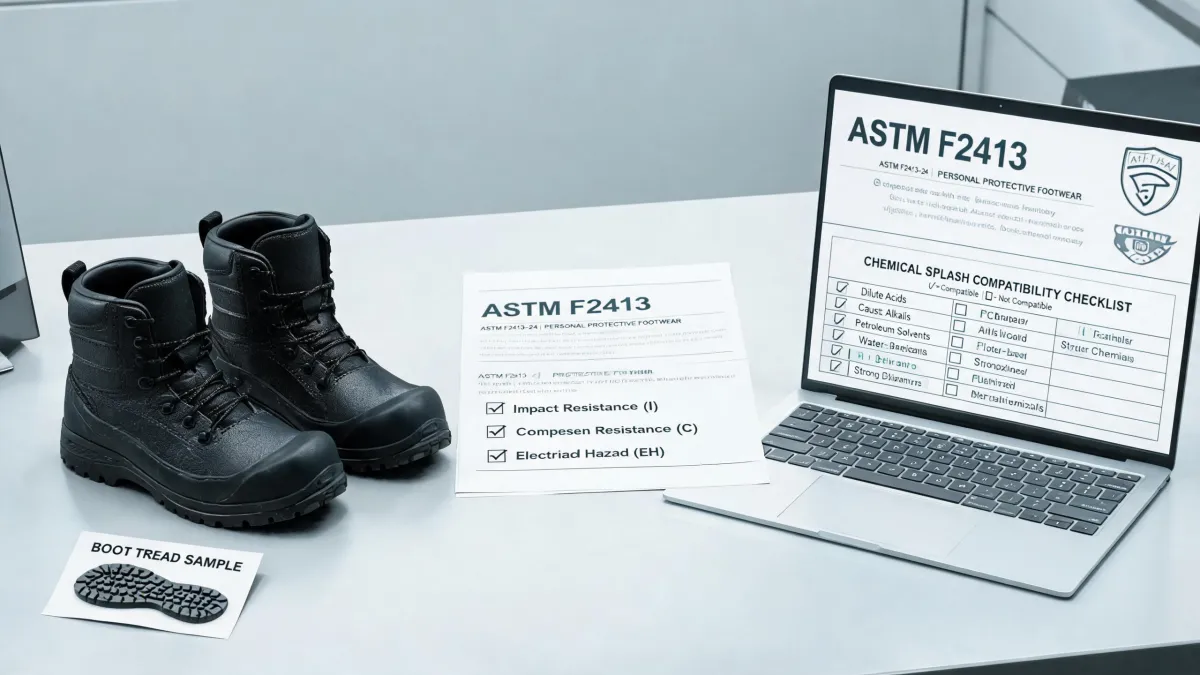
This is the one most people overlook. Every safety boot sold in North America should meet ASTM F2413‑18, but not all boots are tested for metatarsal protection, electrical hazard, or puncture resistance. Dunlop boots – especially the steel‑toe and metatarsal models – come with clear labeling. But if you’re buying from a generic supplier who says “meets standards,” ask for the test report. (seriously, ask) I once had a vendor tell me a boot was “OSHA approved” – OSHA doesn’t approve products. That was a red flag.
What to check on the boot tag:
- ASTM F2413‑18 (or latest) – must be marked on the boot
- M for metatarsal, I for impact, C for compression, EH for electrical hazard
- If waterproof is required, look for “waterproof” testing, not just “water resistant”
Dunlop’s waterproof safety boots are tested to keep feet dry in standing water. That’s a real difference from a boot that just repels light rain.
Step 4: Don’t Forget Fit and Comfort – It Affects Retention
If your crew hates wearing the boots, they’ll find ways to avoid them. (or they’ll take them off on the job, which is worse) I learned this the hard way when we bought a “great value” all‑rubber boot that had zero arch support. After two weeks, three guys called in sick with foot pain. The hidden cost of discomfort: lost labor hours and turnover.
So here’s a practical tip that covers one of your keywords: how to tie work boots with hooks. Most lace‑up safety boots (like Dunlop’s steel‑toe leather models) have speed hooks at the top. Don’t just criss‑cross the laces the same way all the way up. Instead:
- Lace tightly through the bottom eyelets for a secure heel lock.
- Use the speed hooks to create a quick release: wrap the lace around each hook in a figure‑eight, then pull up to cinch.
- Double‑knot if you’re in mud – but leave enough slack so you can pull them off quickly in an emergency (fire, chemical spill).
Taking the extra minute to lace properly keeps the boot comfortable all day, which means your crew actually wears them.
Step 5: Choose a Supplier – What to Look For in Terms of Service and Availability
Now you know the boot you want; where to buy? The search term “work boots near me” or even “brunt work boots near me” might bring up local retailers. That’s fine – but don’t stop there. I’ve found that online distributors often have better pricing and more sizes in stock. However, if you need a physical try‑on, find a local safety supply shop that carries multiple brands so you can compare Dunlop against Brunt or Keen in person.
One more thing that often gets separated from boot decisions: fire extinguisher recharge near me. It sounds unrelated, but I bundle my safety equipment procurement. When I order a batch of Dunlop boots, I also check the service schedule for our fire extinguishers. A good one‑stop safety supplier can coordinate both – boots get delivered, extinguishers get inspected, and I get one invoice instead of five. (peace of mind)
Ask potential suppliers:
- Do they offer a volume discount if you commit to a full year?
- Can they provide samples for fit testing before a large order?
- What’s their return policy on defective boots? (Dunlop normally has a solid warranty, but verify)
Common Pitfalls (And How to Avoid Them)
1. Buying too many sizes. You don’t need every half‑size – most boot models are “unisex” and come in whole sizes only. Check the sizing chart. Dunlop often runs a half‑size large. Order one sample pair in your most common foot size to verify.
2. Ignoring the “metatarsal” difference. A plain steel‑toe boot won’t protect the top of the foot from impact. If your crew works with heavy pipes or dropping items, metatarsal boots (like the Dunlop FieldPro Met Guard) are worth the extra $15–25 per pair. The cost of one metatarsal injury will buy 50 pairs of met‑guard boots.
3. Forgetting to train the team on lacing and care. You spent the money on quality boots; make sure they last. Teach the lace‑up hook technique I described earlier, and tell them to rinse rubber boots after exposure to chemicals or salt water. (sand your life)
Bottom line: Use this checklist every time you reorder. Write your actual numbers into a spreadsheet, track replacements by model, and you’ll quickly see which boot – like the Dunlop waterproof safety boots I’ve standardized on – gives you the lowest total cost over a year. And while you’re at it, remember to schedule that fire extinguisher recharge. (finally!)