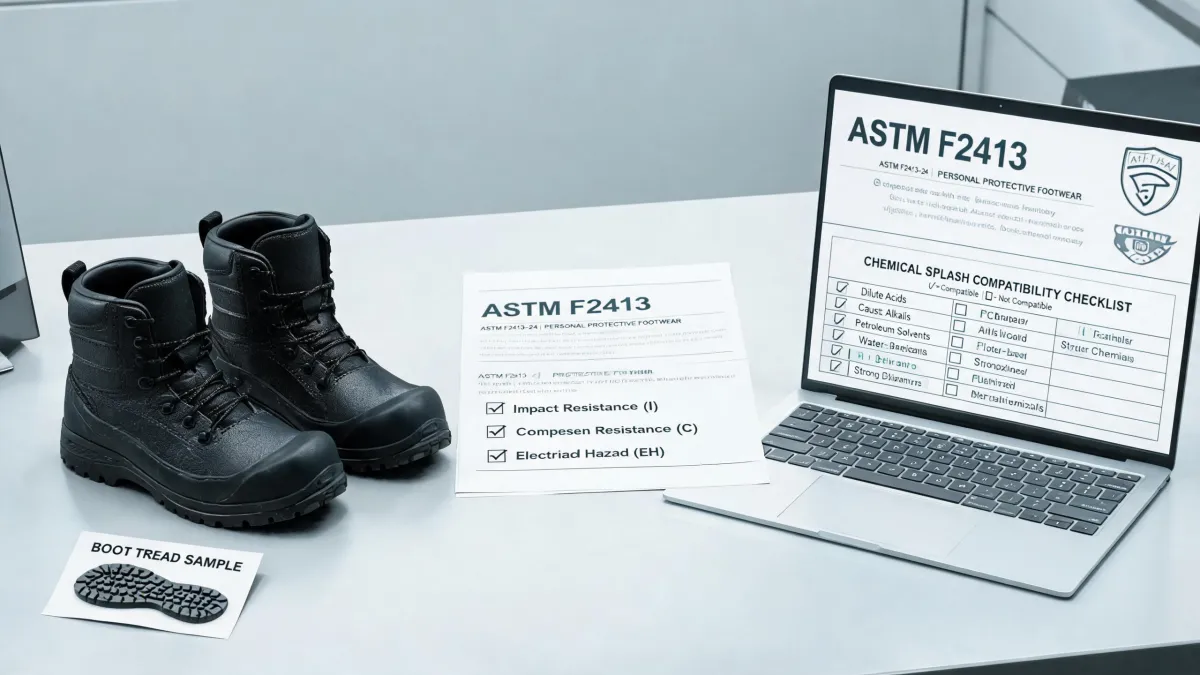
If you're sourcing safety boots for a crew, here's the short version: Dunlop boots are overkill for 40% of jobs where they're used, and not enough for 20% of the jobs where they're not. I landed on this number after spending about $45,000 on work footwear over four years for a mid-sized industrial services company. Most buyers get this wrong because they think "hazmat" means one thing, when it actually means about six different things.
I'm an office administrator for a 140-person company. I handle all PPE ordering—roughly $35,000 annually across 9 vendors. When I took over purchasing in 2021, our safety manager had a simple rule: if it's wet or chemical-adjacent, buy Dunlop. That seemed straightforward until I started digging into the invoices.
Why I Started Questioning the Default Buy
In my first year, I made the classic specification error: I assumed "hazmat boot" meant the same thing to every distributor. Turned out each one had a slightly different interpretation. One vendor sent us a boot rated for splash resistance. Another sent fully liquid-tight gear. Same purchase order number, different products.
Cost me about $1,400 in returns and a very annoyed warehouse foreman. That's when I realized that the problem isn't Dunlop—it's that people buy the wrong Dunlop for the job.
The assumption most procurement people make is that hazard rating determines the boot. Actually, the boot should determine the hazard rating you accept. If you start with the boot, you end up over-specifying. If you start with the actual exposure level, you can often dial back to something lighter and cheaper.
People think expensive boots deliver better protection. Actually, boots that offer specific protection can charge more. The causation runs the other way. A $300 hazmat boot is not "better" than a $120 steel toe if your crew is just walking through wet concrete residue.
The Dunlop Lineup: What Actually Matters
Here's what I learned breaking down our orders over 60-80 purchase orders annually:
Dunlop Steel Toe Boots
These are the workhorses. For general construction, warehouse, and light industrial, they're hard to beat. The Purofort material holds up better than PVC in cold weather. We used to buy cheap PVC boots that cracked at -10°C. Dunlop didn't crack. But they cost 2x upfront.
The real math: buy cheap boots at $60 each, replace every 4 months. Buy Dunlop at $130, replace every 12-14 months. Over three years, the cheap option costs $450 vs. $315. Plus less administrative headache. But you have to actually track the replacement cycles—most people don't, so they think the expensive boot is the wasteful choice.
This was true 10 years ago when cheap boots lasted 6 months and Dunlop lasted 12. Today, materials have improved across the board. Cheap boots last maybe 8 months now. The gap has narrowed. But the emotional memory persists.
Dunlop Hazmat Boots
Here's where it gets tricky. The term "hazmat" conjures images of full chemical suits. In practice, for most of our work, it meant splash exposure to diluted acids and solvents.
We bought Dunlop Hazmat boots for a crew cleaning industrial tanks. Cost: around $220 per pair (though I might be misremembering the exact price—it was $197 or $217 depending on the distributor). Six months in, I realized we were over-specifying. The actual work involved low-pressure splash, not immersion. A mid-range rubber boot with chemical resistance would have sufficed.
I went back and forth between downgrading the spec and keeping the high protection for two weeks. The safety team wanted max protection. The finance team wanted cost savings. Ultimately, we split the difference: hazmat boots for the tank crew, heavy-duty rubber for everyone else. Saved about $4,200 annually. (Note to self: document the split decision process for next year's budget review.)
Insulated and Metatarsal Models
Don't buy insulated boots unless your crew works outdoors in freezing conditions for extended periods. The insulation adds weight and reduces flexibility. We bought insulated for a yard crew. They complained. Switched to non-insulated with wool socks. Problem solved.
Metatarsal guards: required by a few job sites, but the bolt-on type is cheaper than integrated. If less than 10% of your work requires it, buy the add-on kind. If over 50%, get the built-in version. The breakpoint is around $6,000 annual spend, based on our math.
The Under Armour and Nike Question
I get asked this a lot: "What about Under Armour tactical boots or Nike work boots?"
Here's my honest take: they're fine for administrative roles and light duty. The UA Valsetz Retribution and the Nike Manoa are comfortable, look decent, and work for about 60% of what people call "work." But if you need a true safety boot—steel toe, puncture plate, chemical resistance—these are lifestyle boots with work styling.
The marketing wants you to think they're work boots. The safety ratings tell a different story. I've seen people show up wearing UA tactical boots to a site that required ASTM F2413-18 rated footwear. They got sent home. That's a lost day of labor and a safety violation.
Under Armour and Nike make excellent footwear for what they're designed for—tactical training, casual wear, light duty. But if you need actual protection, stick with the brands that prioritize function over fashion.
According to OSHA guidelines (osha.gov, 29 CFR 1910.136), employers must ensure that employees use protective footwear when exposed to hazards. The standard doesn't name brands, but it does require certification. Nike and UA don't typically carry ASTM steel toe ratings. Verify before buying.
The Construction Site Fence Connection
You might wonder what a construction site fence has to do with boots. Fair question. The answer: the purpose of a construction site fence is exactly the same as the purpose of a safety boot—containment and protection.
A fence keeps hazards in and unauthorized people out. A safety boot does the same for the worker's feet. Both are secondary protection that people undervalue because the primary hazard isn't immediately visible. That's why both get under-specified until someone gets hurt.
Per OSHA standards (29 CFR 1926.202), construction site fences must be solid and at least six feet tall with support posts no more than six feet apart. Same thinking applies to boots: the protection has to be continuous and properly rated. A gap in the fence is a risk. A gap in the boot's protection is also a risk.
I know that's a stretch. But it helped me explain to my team why specification details matter—whether it's a fence height or a steel toe rating.
What I'd Do Differently
If I could go back to 2021 and redo the footwear procurement: I'd run a three-month trial with different boot types across different crews. Track actual lifespan, comfort ratings, and job site requirements. Then make the spec decisions based on data instead of assumptions.
We did that in 2024 for a consolidated order of 400 pairs across three locations. Using a simple spreadsheet tracking system, we cut ordering time from about 8 hours per quarter to 2.5 hours. And we eliminated the problem of over-specifying hazmat boots for jobs that needed rubber boots.
Also, I'd stop buying from 9 vendors. Consolidating to 4 main suppliers cut our accounting reconciliation time by 6 hours monthly. The vendor who couldn't provide proper invoicing cost us $2,400 in rejected expenses before we dropped them.
When My Advice Doesn't Apply
If you're buying for a chemical plant with full immersion risks, ignore everything I said about hazmat boots being over-specified. That's the 20% exception. Also, if your crew works in extreme cold for entire shifts, the insulated models are necessary.
And if comfort is the absolute priority—like for workers who stand 10-hour shifts—the UA or Nike options might work better for non-hazard environments. Just check the actual ratings before assuming they're safety boots.
Standard disclaimer: regulations and prices change. Verify current OSHA requirements and boot specifications at official sources. As of March 2025, ASTM F2413-18 is the current standard for safety footwear.
Bottom line: Dunlop makes excellent boots. But the best safety boot is the one that matches the actual risk, not the one with the highest rating. Spend the time upfront to match the boot to the job, and you'll save money, reduce injuries, and keep your crew working.