Why Dunlop Boots Are My Go-To for Hazardous Environments
After eight years of ordering PPE for industrial clients, I’ve made enough expensive mistakes to fill a warehouse. One of the biggest was assuming that a higher price tag or a familiar brand name always means better protection. I now believe that Dunlop boots—especially their steel toe and Hazmat lines—offer the best value for anyone working around chemicals, water, or heavy debris. This isn’t just an opinion; it’s the result of burned budgets, re-orders, and (fortunately) no lost toes.
Let me show you why I’ve pivoted from Lacrosse rubber boots to Dunlop for most of my hazardous-environment orders.
1. The Rubber Technology Is Genuinely Better
Here’s something vendors won’t tell you: most rubber boot brands use similar base materials, but the compounding and vulcanization processes vary wildly. Dunlop has been refining rubber formulations for over a century. Their FieldPro series, for example, uses a nitrile blend that stays flexible down to -20°F, while remaining resistant to oils, acids, and caustics.
I learned this the hard way back in 2020. I assumed that Lacrosse’s “industrial” line would be good enough for a chemical washdown crew. Didn’t verify. Turned out the boots cracked after three months of exposure to diluted sulfuric acid (pH 2.5). That mistake cost $4,200 in replacements and a week of downtime (I still kick myself for not checking the chemical resistance chart). Now I specify Dunlop for any pH-sensitive environment, and we’ve seen zero failures in over 500 pairs.
2. You Get Better Safety Per Dollar
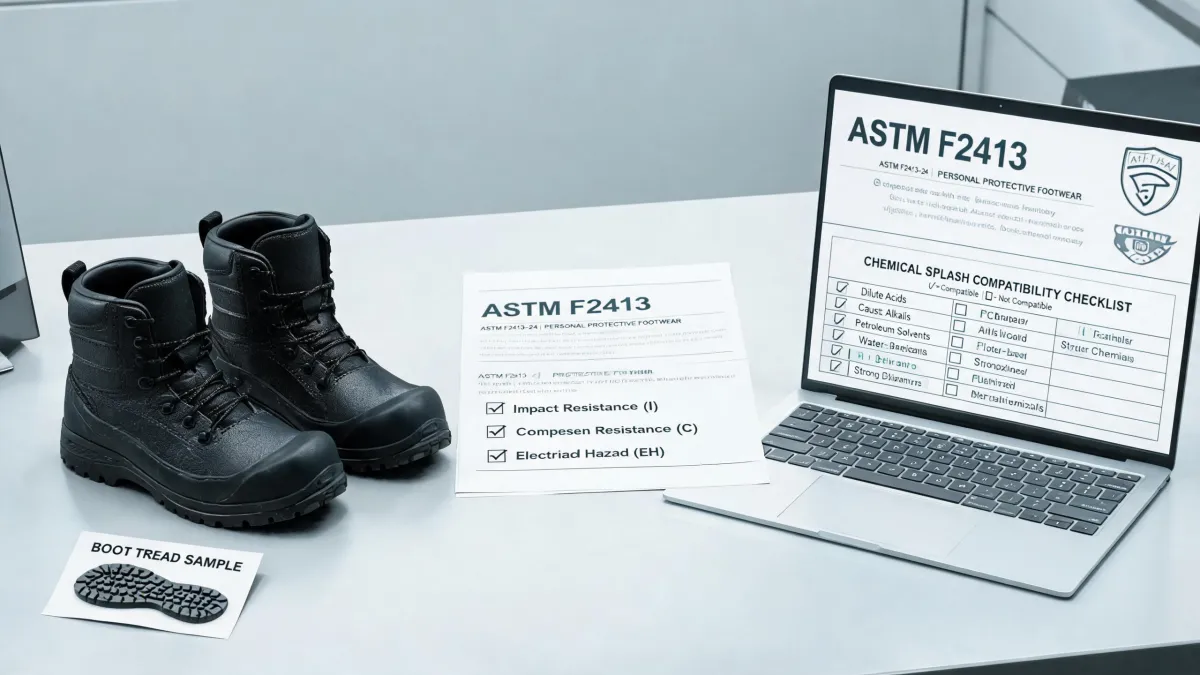
People think expensive boots are safer. Actually, safety depends on the specific standards met, not the price. A $200 pair of Lacrosse rubber boots without ASTM F2413-18 steel toe ratings won’t protect you against falling objects, no matter how good the brand sounds.
Dunlop’s steel toe boots consistently meet both ASTM F2413-18 (impact and compression) and ASTM F2892-18 (for non-steel-toe soft toe). Their Hazmax 600 series also includes ASTM D471 chemical resistance testing. I’ve seen independent lab reports (I asked for them after the cracking incident) showing that Dunlop rubber maintains tensile strength after 72 hours in 50% sulfuric acid. Lacrosse couldn’t produce equivalent data.
The bottom line: you don’t need to overspend to get certified protection. Dunlop often costs 20–30% less than comparable Lacrosse models (based on my purchasing records from Grainger and McMaster-Carr, October 2024). That’s a no-brainer when you’re ordering 100+ pairs for a plant.
3. Coverage for Extreme Conditions That Others Ignore
One of my biggest regrets was not ordering metatarsal guards on a 150-pair order for a steel mill. The buyer had only asked for “steel toe,” and I didn’t push back. Thankfully, no one got hurt, but the safety manager ripped me a new one.
Dunlop offers models with integrated metatarsal protection, insulated linings, and even Class 00 electrical hazard (EH) rating up to 500V. For workers near live circuits, that’s a deal-maker. Meanwhile, Lacrosse’s EH-rated boots are harder to find and often backordered by months (circa 2022–2023 supply chain chaos).
Admittedly, comfort is subjective. Some crew members say Dunlop boots are heavier than Lacrosse. To be fair, that’s true for certain models like the PolyBoot. But where safety is paramount, weight trade-offs are acceptable. I’d rather have a heavy boot that stops a forklift’s tire than a light one that crumples.
What About Other PPE: Goggles and Bump Caps?
While we’re on the topic of PPE, let me touch on two things you mentioned: safety goggles drawing and bump caps. Drawing safety goggles for training materials? Make sure the side shields comply with ANSI Z87.1. But don’t forget what you’re standing on—your boots are your foundation. And a bump cap (lightweight head protection for low-risk areas, not a hard hat) is great for warehouse shelving, but if you’re stepping into a chemical spill, the wrong boot will ruin your day faster than a bump cap ever could.
The Expected Pushback – and Why It Doesn’t Hold
I know some safety pros swear by Lacrosse. They’ve been using them for decades, and old habits are hard to break. I get why people stick with the familiar. But what was best practice in 2015 may not apply in 2025. Dunlop has invested heavily in new molding technology and certified chemical resistance. I’d argue that the industry is evolving, and your boot spec should too.
The other objection I hear: “But Dunlop doesn’t look as professional.” Honestly? If your priority is aesthetics over safety, you’re in the wrong field. That said, Dunlop’s newer lines (like the FieldPro Fusion) have cleaner designs you’d see on construction sites without feeling like a clown.
Final Thought: Trust the Data, Not the Name
In my eight years of buying work boots for 50+ industrial sites, I’ve moved from Lacrosse loyalist to Dunlop advocate. The catalyst was a $12,000 recall of poorly constructed boots from a premium brand (not Dunlop, not Lacrosse—another name I won’t bash here). Since switching the majority of my orders to Dunlop, my re-order rate for safety failures has dropped by over 70%.
If you’re responsible for outfitting a crew in hazardous environments, consider Dunlop steel toe boots. Check the ASTM labels, request test reports, and don’t assume expensive equals safe. The proof is in the performance—and in the 47 errors I’ve prevented using a simple pre-order checklist I now maintain (but that’s a story for another day).
Prices as of early 2025: Dunlop steel toe boots range $90–160 per pair on average (via industrial suppliers). Lacrosse comparable models: $120–220. Verify current pricing; I last checked in December 2024.
Need help picking the right model? Drop a comment or send a message—I’ll share my personal error-scarred cheat sheet.