-
The order that looked too good to be wrong
-
The first sign that something was off
-
What the $3,200 mistake actually looked like
-
The hard lesson about PPE and liquid chemicals
-
What I order now: Dunlop FieldPro, Dakota, and a clear separation of jobs
-
The checklist that saved us the second time
-
Bottom line: don’t learn this the way I did
There is a dented metal shelf in our PPE room that still holds a stack of cardboard training cards. A marker note reads: “Check chemical compatibility before choosing a boot.” I put it there in March 2023, after I made the mistake that cost us about $3,200 in footwear and two weeks of lost field time. This is the story of how I stopped guessing and started reading spec sheets—and why I now tell every new hire the same thing about Dunlop boots and liquid chemical PPE.
The order that looked too good to be wrong
In late 2022, I was managing safety equipment orders for a mid-sized industrial services company. We do a lot of work around degreasers, diesel, hydraulic oil, and a bunch of alkaline cleaners. My background was in procurement, not chemistry, which is the first problem. I knew the phrase “chemical resistant” was printed on a lot of product pages, but I assumed that meant “resistant to chemicals, period.” It doesn’t.
I needed to replace a set of worn rubber boots for a crew. The request said “waterproof, rubber, comfortable for all-day wear.” So I did a quick search and ordered 80 pairs of Dunlop Dakota safety boots. If I remember correctly, they arrived about 11 days later, and they felt heavy and solid. I put a pair on, walked around the warehouse, and thought, “These are fine.” The steel toe felt right. The soles had good grip. They looked like exactly what the crew needed.
I was wrong. Not about the boots being good boots—they are. I was wrong about why we needed them.
The first sign that something was off
Two field crews wore the Dunlop Dakotas for about three weeks. Then one of the supervisors sent me a photo of a boot with a crack running along the side, near the heel. At first I thought it was a defect. I almost filed a warranty claim. But the rubber didn’t split like a normal manufacturing issue—it looked swollen, then wrinkled, then torn, like something had attacked it chemically.
That’s when I learned something I should have known before: “chemical resistant” is not a universal rating. It’s a chemical-specific list. A boot that shrugs off water and mud can break down fast when exposed to certain solvents. The Dakotas are great work boots for wet, rough, cold conditions. But the specific degreaser that crew used—I won’t name it because it varies by job site—was more than the standard rubber could handle day after day.
It took me one bad order and one long afternoon with a supplier to understand that. I still kick myself for this: I never checked the manufacturer’s chemical compatibility chart before ordering. I relied on the words “safety boots” and “rubber” and my own assumption that heavy rubber equals chemical proof. If I’d taken twenty minutes to compare the boot material against the chemical list, I would have seen the warning signs.
What the $3,200 mistake actually looked like
The financial damage wasn’t just the boots. Let me break that down:
- 80 pairs of boots: roughly $2,600 (this was before some of the 2023 price jumps; verify current pricing).
- Shipping and special handling: about $240.
- Two weeks of “temporary” replacement boots from a local supplier: about $360.
- Lost productivity from the crew being pulled back to the yard for boot swaps: harder to calculate, but it was at least a day of work across six people.
So the real cost was closer to $3,200, plus a serious dent in my credibility as the guy in charge of PPE. The worst part? If I had asked the crew one question—“what liquids are these boots going to touch?”—the answer would have taken 30 seconds. (Surprise, surprise: procurement and field operations don’t always talk enough.)
The hard lesson about PPE and liquid chemicals
People often ask me, “Which PPE can protect you from liquid chemicals?” The honest answer is: it depends on the chemical and the exposure. There is no single boot, glove, or coverall that handles every liquid safely. The right choice comes from matching the PPE material to the chemical, the concentration, the temperature, and how long the liquid stays in contact with the material.
According to OSHA’s PPE standard (29 CFR 1910.132), employers must perform a hazard assessment before selecting PPE. In plain English: you can’t just buy “chemical-resistant” from a catalog and call it a day. You need to know what you’re protecting against. The same principle applies to gloves, aprons, face shields, and boots. And it’s exactly why I now keep a binder (yes, a paper binder) with the current chemical compatibility pages and safety data sheets for every chemical we use.
I also learned that PPE selection has changed over the years. What was best practice in 2020 may not be best in 2025. Manufacturers now publish much more detailed compatibility and testing data online. But that only helps if you actually read it. The fundamentals haven’t changed—match the material to the hazard—but the execution has transformed. You can pull up a spec sheet on your phone in the warehouse. No more excuses.
What I order now: Dunlop FieldPro, Dakota, and a clear separation of jobs
I’m not anti-Dunlop. In fact, Dunlop boots are still one of the first options I consider for wet, muddy, and cold work environments. The issue wasn’t the brand; it was my selection process. Now I split my PPE requests into categories, and I make the decision tree visible to the whole team.
For general wet and rough terrain work, the Dunlop Dakota safety boots are still on my list. They’re tough, reasonably priced, and the crew likes the grip and the waterproofing. I just make sure they’re not being used as chemical-splash boots. For jobs that need a steel toe and more all-around work boot support, I look at the Dunlop FieldPro steel toe boots. They hold up well on construction sites and outdoor work, and they give the crew the toe protection they need.
But here’s the part that felt uncomfortable at first: not every situation calls for a rubber work boot. I’ve caught myself reaching for the same boot for everything because it’s comfortable. That’s backwards. I now tell new hires, “The boot is a tool, and the tool has a job. If the job involves liquid chemicals, you get the chemical-specific boot. If the job is just muddy and wet, you get the waterproof boot. They are not the same object.”
And while we’re on the subject of “other stuff in the PPE catalog”: Danner tactical boots and Carhartt coveralls insulated have their place in a well-rounded safety closet. Danner boots are excellent for lighter tactical or patrol-style work. Carhartt coveralls insulated are great for cold weather comfort. But unless the specific fabric and coating are rated for the chemical you’re handling, insulation alone won’t protect you. A tactical boot supports your ankle, not your chemical compatibility chart.
If someone asks me directly, “Which PPE can protect you from liquid chemicals?” I walk them through the layers:
- Hands: nitrile, neoprene, butyl, or other chemical-specific gloves—never assume one glove covers all.
- Face and eyes: chemical splash goggles plus a face shield if splashing is likely.
- Body: chemical-resistant coveralls or aprons based on the chemical class.
- Feet: a boot that lists the specific chemical on its compatibility chart, not just “chemical-resistant” marketing language.
I also add the annoying but necessary caveat: PPE is the last line of defense, not the first. Engineering controls, ventilation, and safer chemical substitutes come first. That’s not me being preachy; that’s me explaining why a shelf full of boots doesn’t mean a safe job site.
The checklist that saved us the second time
So glad I built a pre-order checklist before we had another big purchase. Almost went back to the same catalog shortcut after a busy quarter—which would have been a $3,200 déjà vu. The checklist caught us in February 2024, when a supervisor requested “rubber boots” for a crew that was going to be working with a new acidic cleaning solution. The initial order form didn’t mention any chemical exposure. The old me would have bought the usual Dunlop Dakotas or FieldPro boots and moved on.
Instead, I pulled up the safety data sheet, saw the phrase “strong acid,” and sent the supervisor a message: “Do we have a chemical compatibility page for these boots?” He hadn’t thought about it. Nobody on the crew had thought about it. We ended up ordering a different model with the right chemical resistance, and it cost about $24 more per pair. That was a relief. A $24 difference is nothing when the alternative is cracked boots, exposed feet, and another field delay.
The checklist now lives on a whiteboard in the PPE room, and it’s painfully simple:
- Write down the actual chemicals and exposure conditions.
- Look up the PPE manufacturer’s chemical compatibility chart.
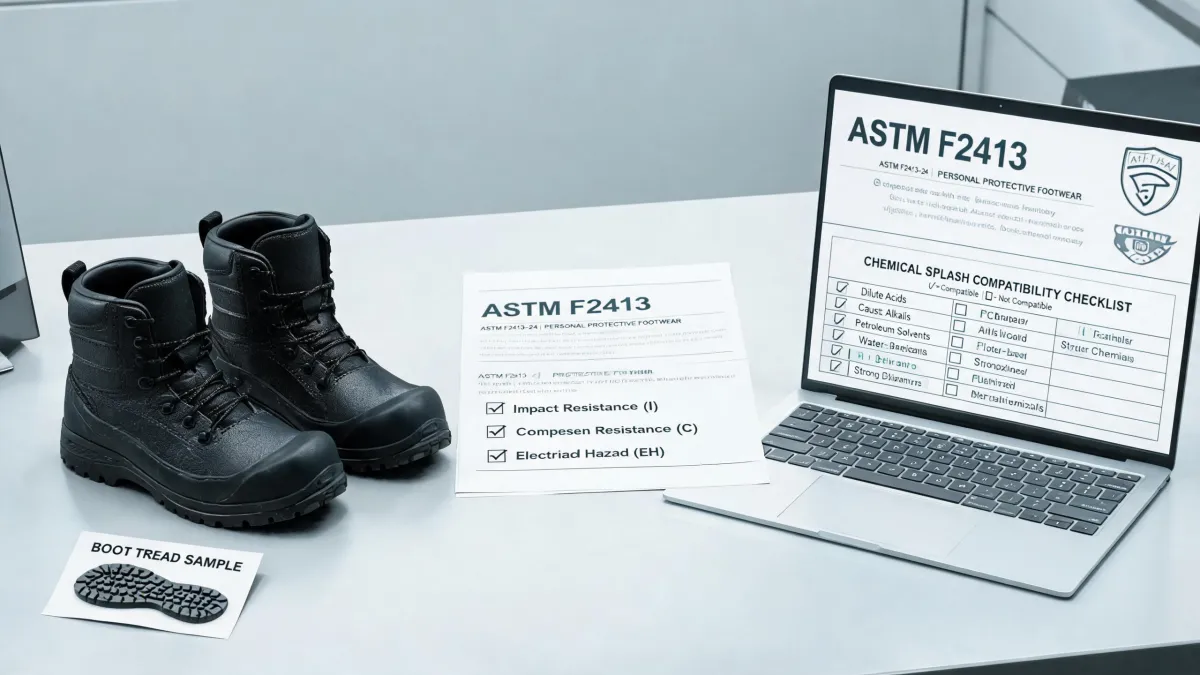
- Verify the standard or certification (for boots, check impact/compression ratings and any chemical-specific tests).
- Buy a small test pair? For chemical boots, yes. Send a sample to the field for a week before buying 80.
- Document the choice and the date so you can revisit after the product changes.
That last step matters more than you’d think. Manufacturers change materials and formulations. A model that was fine in 2021 may not be identical in 2025. I don’t assume the old spec sheet is still accurate. I verify it. (This is the part I would have called overkill three years ago. Three years ago I was the guy ordering 80 pairs based on a gut feeling.)
Bottom line: don’t learn this the way I did
Dunlop makes good boots. I’ll keep ordering Dunlop Dakota safety boots for wet work and Dunlop FieldPro steel toe boots for impact-heavy outdoor jobs. But I will never again claim a boot is “chemical-resistant” without checking what it’s actually resistant to. If you’re in charge of PPE, prove your point with a hazard assessment, not a hero story.
People sometimes assume a more expensive boot is automatically safer. That’s backwards: the safer boot is the one matched to the actual chemical, not the one with the higher price tag. The higher price might mean better materials or more comfort, but “better” only matters if the chemical compatibility is right.
That shelf in our PPE room still has the marker note. It’s a little faded, but the message is still clear. The cost of that note was $3,200 and a few weeks of embarrassment. The benefit of that note has been almost 18 months of clean boot audits and zero cracked-boot incidents. I’ll take that trade.
Prices in this article are from my own order history and local supplier quotes in 2022–2024. Always verify current pricing and product specs before buying. For current OSHA requirements, check osha.gov. For chemical-specific PPE guidance, consult the manufacturer’s compatibility data and the NIOSH PPE selection resources at cdc.gov.