I've been handling PPE orders for a mid-sized industrial contractor for eight years. I've personally made—and documented—six significant buying mistakes, totaling roughly $18,000 in wasted budget. Now I maintain our team's PPE checklist, and I have one simple rule: the cheapest safety boot is almost never the cheapest option.
This isn't a sermon about spending more. It's about spending smarter. For most of our crews, I spec Dunlop boots now—specifically Dunlop FieldPro steel toe boots when there's an impact hazard. Here's why.
The mistake that changed my spreadsheet
In 2018, I went back and forth between a budget import pair and Dunlop FieldPro steel toe boots for two days. The budget pair was roughly $38 a pair cheaper. On a 20-pair order, that was a real number. We saved about $760 on paper. (Which, honestly, should have been my first red flag. Forty percent below a known brand in safety gear isn't a discount. It's a clue.)
The first sole separation showed up in week three. By week six, two more pairs had the rubber pulling away from the upper. One worker reported that the 'waterproof' boot squelched on a wet deck. And then we caught the problem that mattered most: the tread on one pair was already smooth on the heel. On a muddy slope, that's not a nuisance. That's a fall risk.
Looking back, I should have bought the Dunlop pair from the start. At the time, I thought I was being responsible with the budget. I wasn't. I was transferring the cost to the crew—and to my maintenance calendar.
The supplier refunded $14 a pair. The rest of the cycle cost us $1,250 in replacement boots, three days of admin time, and a loss of confidence from the crew. That $760 savings turned into a $3,200 problem. I don't remember the exact line items—that part I might be misremembering—but the lesson stayed with me: a safety product that fails early isn't a safety product.
Why I keep specifying Dunlop FieldPro steel toe boots
Dunlop's whole history is rooted in rubber. That's why their wet-weather boots are a reference point for a lot of site managers. For our sites, the FieldPro steel toe line gets specified because it takes the two biggest complaints off the table: it's actually waterproof, and the outsole grip holds up in mud and wet concrete.
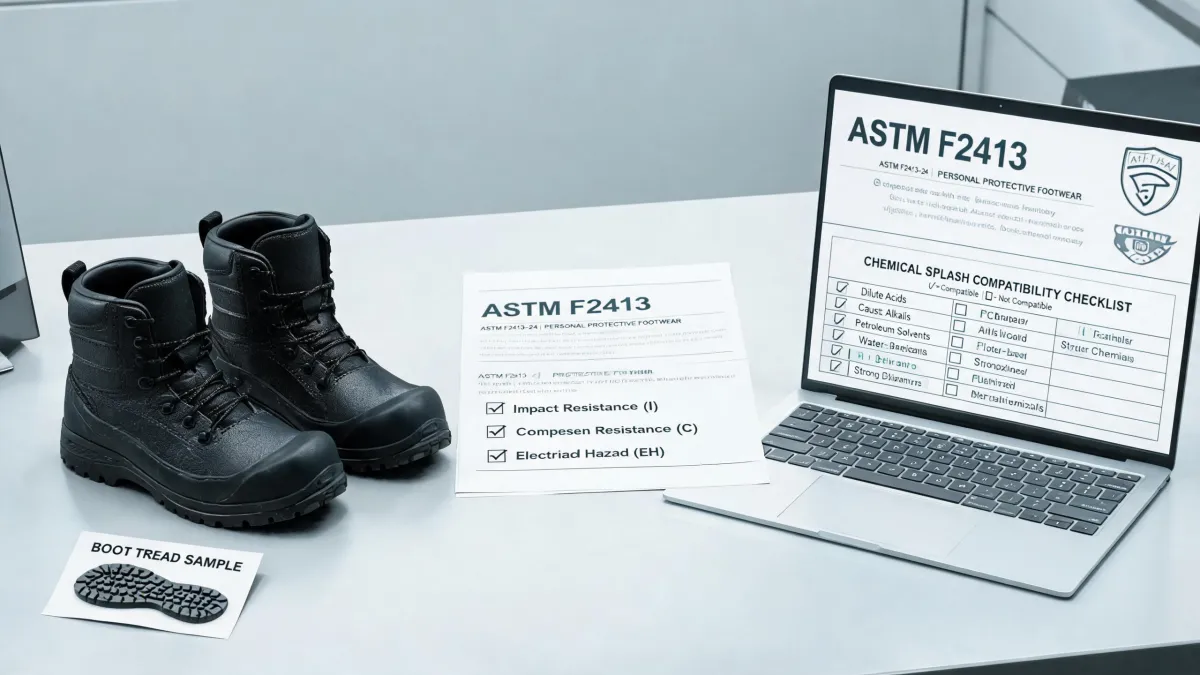
The safety rating matters too. OSHA's foot protection standard (29 CFR 1910.136) requires employers to ensure workers wear protective footwear when they're exposed to falling objects, rolling objects, objects piercing the sole, or electrical hazards. Most compliant boots are tested to ASTM F2413, which covers impact, compression, and—when applicable—metatarsal protection. Dunlop FieldPro steel toe boots carry that rating. The cheap pair I bought in 2018 didn't even claim one.
Let's do the math the way I do it now. A $60 boot that lasts four months costs $15 per month. A $150 Dunlop FieldPro steel toe boot that lasts 14 months costs about $10.71 per month. The cheaper boot loses on cost per month before you even factor in the risk of an injury or a footnote in an OSHA inspection.
Not every site needs the same boot. At least, that's been my experience. But if the hazard exists, trying to save $200 on a 20-pair order is a bad tradeoff.
The Hoka work boots question, and a note on comfort
I hear about Hoka work boots from crew members pretty often. The cushioning is popular, especially for people on concrete all day. I get it. I don't have anything against Hoka as a brand. But I need to be clear: if your job requires a steel toe or a compliant safety boot, Hoka work boots—at least the ones I've seen—are not a substitute. They're a different category.
Don't get me wrong. Comfort is part of PPE retention. If boots hurt, workers will find ways not to wear them. That's why we allow different approved models, and why insoles are on the supply list. But comfort has to work around the hazard, not instead of it. You can add a liner to a safety boot. You can't add a steel toe to a running-shoe-style boot.
I should add that the same mistake shows up in head protection. A Milwaukee bump cap is a useful product for low-clearance areas where someone might hit their head against a pipe or a beam. It is not a hard hat. A bump cap is designed to protect against minor bumps and lacerations, not falling objects. I've seen an order for Milwaukee bump caps show up on a site where the safety plan called for hard hats. That's a false savings, and it's an OSHA citation waiting to happen.
Same logic, different hazard: metatarsal boots and fire extinguishers
We also order Dunlop metatarsal boots for jobs where something heavy could roll or fall onto the top of the foot. A standard steel toe covers the toes. It doesn't cover the metatarsal bones. If the risk assessment says metatarsal protection is required, that's the spec. Trying to avoid the cost because 'the steel toe is right there' is the same trap.
Then there's the fire extinguisher situation. I've seen site managers type 'where to refill fire extinguisher near me' into a search engine two days before an insurance audit. The extinguishers had been expired for weeks. The work order kept getting bumped in favor of 'more urgent' tasks. The last-minute refill call cost double the normal service visit, plus the stress, plus the near-miss on compliance.
A fire extinguisher and a pair of boots are not the same product. But the logic is identical: deferring a safety purchase doesn't make it smaller. It makes it bigger.
Stop pricing safety at the cash register
I know the pushback: 'We can't afford premium options on every order.' You're right. You shouldn't buy premium just because it has a famous name. You should buy the right spec for the hazard. If the work is dry warehouse picking, you don't need a $150 FieldPro boot. Buy according to the risk assessment and the actual job conditions.
But if your decision rule is 'lowest quote wins,' you're not doing procurement. You're gambling. And the house always wins—through replacements, lost time, compliance findings, or an injury that costs a lot more than a pair of boots.
Price is a fact. Cost is a consequence. A cheap boot that fails is not a bargain. It's an expensive lesson.
So I'll keep specifying Dunlop boots where our risk assessments require them. I'll keep buying Dunlop metatarsal boots when the top of the foot is exposed. I'll keep explaining the difference between a bump cap and a hard hat. And I'll schedule the fire extinguisher recharge before the audit, not after.
I didn't learn this from a textbook. I learned it from a stack of failed boots and a spreadsheet that made me wince. Save money where it's safe to save. But never let the unit price be the only number in the conversation.