-
Dunlop Boots FAQ
-
1. What's the difference between Dunlop metatarsal boots and regular steel toe boots?
-
2. How do I pick the best Dunlop hazmat boots?
-
3. Are Dunlop rubber boots really hazmat boots?
-
4. Can crew members wear Doc Martens work boots instead of the approved boots?
-
5. What's the deal with safety glasses side shields, and why do they show up in boot orders?
-
6. Where to buy Timberland work boots—and why does that keep coming up?
-
7. What's the worst mistake you've made as a PPE buyer?
-
8. How do I choose between Dunlop insulated boots and regular rubber boots for winter work?
-
1. What's the difference between Dunlop metatarsal boots and regular steel toe boots?
I'm the office administrator for a 140-person manufacturing and field service company. I've managed PPE purchasing for six years—that's roughly $90,000 a year spread across seven vendors, and I report to both operations and finance. So when a safety manager asks for 'Dunlop boots,' I don't just send a PO. I ask what hazard we're actually trying to solve. There are dozens of Dunlop models, and the cheapest one isn't always the right one. Here are the questions I hear most, plus the answers I learned the hard way.
Dunlop Boots FAQ
1. What's the difference between Dunlop metatarsal boots and regular steel toe boots?
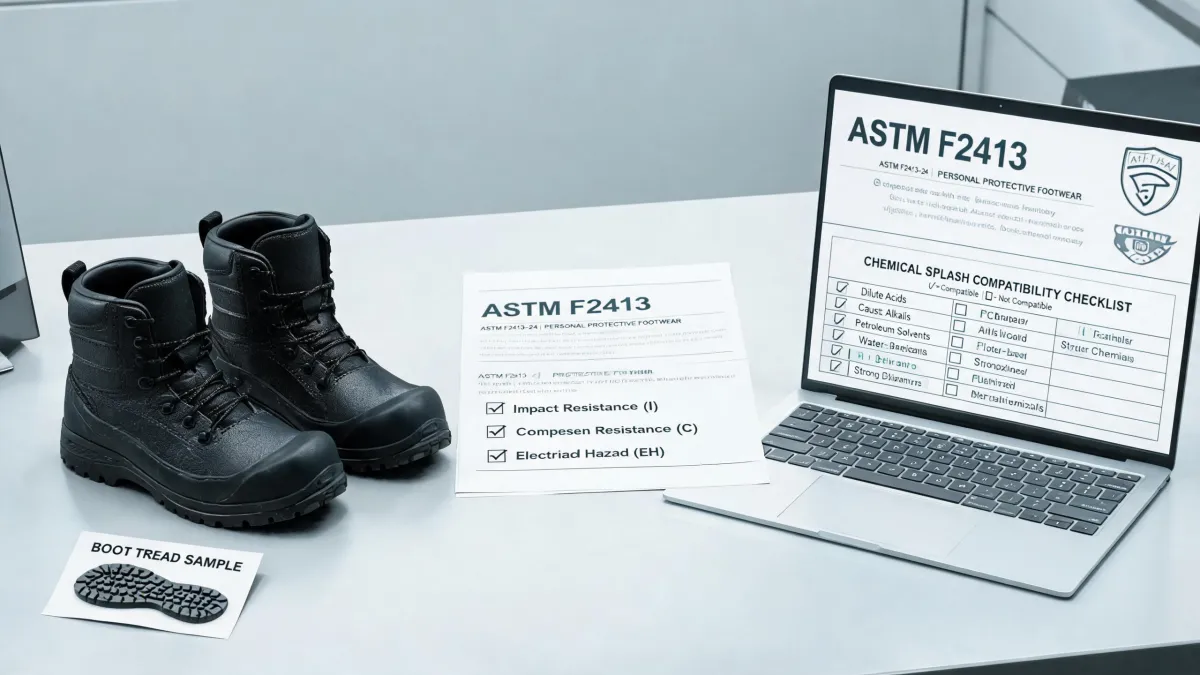
Steel toe boots protect the toes only. Metatarsal boots add a guard over the top of the foot—the metatarsal bones. That matters if crew handles heavy pipes, pallet jacks, or anything that can land across the foot (think falling parts on a loading dock). According to OSHA (29 CFR 1910.136), foot protection is required when there is a risk of falling, rolling, or crushing objects. In ASTM F2413-18, the Mt rating means the boot has been tested for metatarsal impact. If your hazard assessment says metatarsal protection is needed, a regular steel toe leaves a gap.
Dunlop metatarsal boots use a rubber upper with a hardened instep guard. They're heavier, and the guard feels stiff for the first week. Expect some crew complaints. That's normal—and it's not a reason to downgrade the requirement.
2. How do I pick the best Dunlop hazmat boots?
'Best' is a dangerous word in PPE (personal protective equipment). I say that after learning the hard way that 'hazmat' does not mean 'all chemicals.' Dunlop hazmat boots are made for specific liquid-resistant and chemical-resistant jobs. The rubber compound, thickness, and seam construction all affect what a boot can withstand. A boot that handles an acid splash can break down quickly in a different solvent. So the process is: list the chemicals your crew actually touches, then match those to the chemical resistance data for the exact model. If a supplier can't provide data for the model, that's a red flag. I'd rather spend ten minutes explaining options than deal with mismatched expectations later. That's the real answer to 'best Dunlop hazmat boots'—the one that fits the hazard, not the one with the most impressive label.
Based on quotes I received in January 2025, Dunlop hazmat models generally run $100 to $180 per pair. General-purpose Dunlop rubber boots are closer to $50 to $90. Verify current pricing before you budget.
3. Are Dunlop rubber boots really hazmat boots?
Not all rubber is the same. I once assumed all rubber boots were waterproof and chemical-resistant. Turned out the boot was waterproof but not rated for continuous immersion in the solvent our crew used. We were using the same word—'hazmat'—but meaning different things. Communication failure: I said 'hazmat-rated.' They heard 'chemical-resistant.' Result: a batch of boots that had to go back. The label Dunlop hazmat boots is a product category, not a guarantee. Check the spec sheet for the exact standard and the list of test liquids. If it doesn't list the chemical, don't trust the label. You don't want to find out the limitations on a job site.
4. Can crew members wear Doc Martens work boots instead of the approved boots?
I understand why people ask. Doc Martens work boots are comfortable, and they have a loyal following. If the boots have a steel or composite toe and meet ASTM F2413 for impact and compression, they can be considered for some roles. But 'some roles' is doing a lot of work here. In wet, cold, or chemical environments, a leather work boot is not a substitute for a rubber PPE boot. The issue isn't the brand. It's whether the boot matches your hazard assessment. According to OSHA, the employer is responsible for selecting the right foot protection. That's a risk decision, not a fashion decision.
5. What's the deal with safety glasses side shields, and why do they show up in boot orders?
They show up because I started adding an eyewear check to every footwear order. ANSI Z87.1 is the standard for eye and face protection. Safety glasses with side shields are required when there is a risk of flying particles, sparks, or chemical splash. Last year I processed a boot order that saved us about $3,000 on volume pricing. A week later, a worker got metal shavings in his eye because his old side shields had loosened. The $4 replacement became a $1,800 clinic visit. They're cheap. The injury is not. So now every boot order triggers a quick look at our eyewear inventory.
6. Where to buy Timberland work boots—and why does that keep coming up?
It comes up because not everyone on payroll needs a heavy PPE boot. Some light-duty staff want a boot that works in the office and on a short site visit. I get asked where to buy Timberland work boots fairly often. My answer: buy from an authorized dealer. That goes for Dunlop too. Authorized distributors can provide product documentation and handle warranty issues. A lower price from an unfamiliar marketplace seller might look like a win, but if you can't verify the standards or return a defective pair, it's not a savings. We learned that with a counterfeit lot of 'industrial' boots, and it cost us a lot more than the discount.
7. What's the worst mistake you've made as a PPE buyer?
Ordering on reputation. My first year, I assumed a well-known brand meant the same quality across every line. It doesn't. For Dunlop boots, the right model depends on the hazard, the fit, and the environment. I also should have asked employees for feedback before placing a 36-pair order. A boot that is technically compliant but uncomfortable will end up in a locker, and then you have a safety problem. There is something satisfying about finally getting that process right—when the safety audit passes and the crew stops complaining. But it took a few mistakes to get there. Trust me on this one: verify the spec sheet, test a sample, then order big.
8. How do I choose between Dunlop insulated boots and regular rubber boots for winter work?
Insulated Dunlop boots are not just for comfort. They're for keeping workers safe when cold affects dexterity and judgment. If crews stand on wet concrete or work outdoors at freezing temperatures, an insulated rubber boot keeps feet dry and warm. But insulation changes the fit, too. A boot that fits comfortably in June may feel snug with a thermal sock in January. We learned that after ordering regular sizes for an outdoor crew and getting complaints within two days. Now I order one pair in a half-size up for workers who need cold-weather fit. It's a small adjustment that prevents big resistance to wearing the boot.