I'm the quality/compliance manager at an industrial contracting company. I review roughly 2,000 PPE items per year before they get issued to our crews—work boots included—and I've rejected more first deliveries than I can count. In 2024 alone, 9% of our initial PPE shipments failed spec review.
Here's the conclusion I've landed on after four years of that work: Dunlop boots are the lowest total-cost option for most of our job sites, even though they're rarely the cheapest line item on a quote. That's not brand loyalty. It's arithmetic.
The $84 boot that fails mid-season—leaks, delaminated sole, cracked insulation—costs more than the $140 boot that survives two winters. The math gets even uglier when you add the downtime, the replacement paperwork, the supervisor's lost hour, and a crew member standing in a cold puddle wondering why you bought trash.
Why I Trust My Own Numbers
When I implemented our PPE verification protocol in 2022, I started tracking every boot order by SKU, season, and failure mode. I've now got three full years of data on roughly 850 pairs of safety footwear—what each pair cost, how long it actually lasted, how many days it was worn (that's the metric most procurement folks skip), and what failed when it failed.
I didn't start out as a "total cost" person. I was the lowest-bid guy, and it took me about 150 orders—or rather, 150 cycles of reordering the same cheap boots—to understand that the lowest bid is almost never the lowest cost. The moment that finally broke the habit was 2021: we received a batch of substandard insulated coveralls that fell apart in the first wash cycle, right before a major winter shutdown. That quality issue cost us a $22,000 redo and delayed the project by a week. (The invoice still makes me wince.)
I don't have hard data on industry-wide boot failure rates—that's not something anyone tracks publicly. What I can say anecdotally is that across our fleet, the budget-tier rubber boots failed at more than three times the rate of the Dunlop pairs over the same twelve-month period.
The Total Cost of a Work Boot, Line by Line
Here's the framework I use for every PPE purchase now, and I've pushed our procurement team to adopt it too:
- Purchase price — the only number most quotes show you. It's also the least informative number on the page.
- Replacement frequency — how often the boot actually needs to be swapped out in the field.
- Downtime cost — every hour a crew member loses to a boot failure is an hour you're paying for with zero production.
- Compliance risk — if a boot doesn't meet OSHA 29 CFR 1910.136, the whole crew can get sent back to staging. That's a billable-hour disaster no purchase-price spreadsheet will ever capture.
- Wear-through — the "cheap" boots that get replaced twice a year vs. the pair that lasts two winters.
Do the math: a $79 rubber boot that lasts one season is a $158-per-year cost. A $135 pair of Dunlop insulated rubber boots running two seasons is $67.50 per year. Even if the Dunlops only last a season and a half, they're still cheaper by the calendar.
Put another way: the most expensive boots are always the ones you buy twice.
What I've Actually Seen With Dunlop Boots
Rubber Boots: Waterproofing Is a Gasket, Not a Feature
Here's a thing I learned by doing: when I sat a Dunlop rubber boot and a cheap house-brand pair side by side in the same bucket of water—same depth, same weight, same soak duration—the cheap one was damp inside after about forty minutes. The Dunlop was still dry after eight hours. That's not a controlled lab test, but we've repeated it informally enough times on muddy job sites that I trust the pattern. Rubber compounding is material science, and it shows up in the only place that matters: whether your crew's socks are dry by noon.
Wet feet aren't a comfort issue. They're a productivity issue, a morale issue, and in cold weather, a genuine safety issue. So when I spec rubber boots, I'm not buying "footwear." I'm buying the seal between the ground and my crew. (And yes, I know other brands make waterproof boots—Dunlop just happens to be the one that delivers it consistently in our order history.)
Steel Toe: The Spec Sheet Can Deceive You
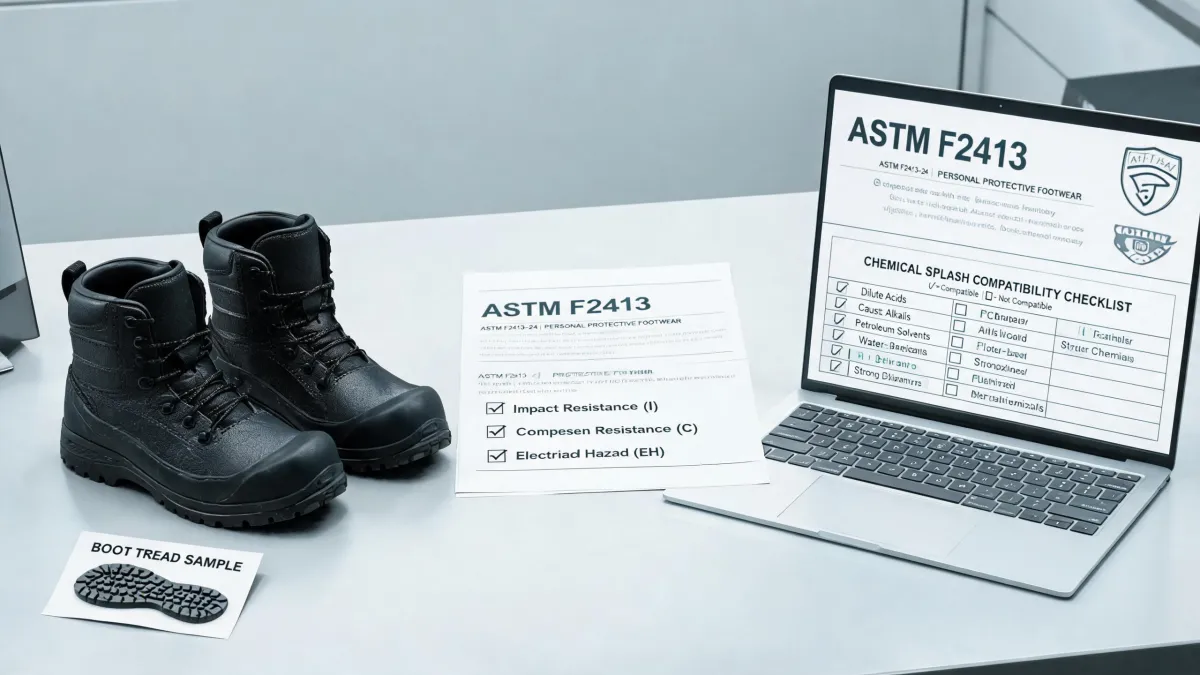
There's a difference between a boot that passes ASTM F2413 in a lab and a boot that still protects a foot after eight months on gravel. The steel toe itself rarely fails—what fails is everything around it. When the midsole collapses, the toe cap shifts, and the protection becomes theoretical. This is where I've seen Dunlop steel toe boots hold up better than any of the six brands we've field-tested since 2022: the cap stays seated because the boot is built as a single molded unit rather than glued pieces waiting to separate.
I'd also like to say I always caught the bad ones in time. The truth is, I almost didn't. In 2023, I was one approval away from sending a "steel toe" shipment out without the right impact rating on the label. The boots looked fine. The tongue tag said "protective footwear." But the ASTM F2413 marking wasn't there. Dodged a bullet on that one—now every contract includes the specific standard, not just the words "steel toe."
Insulated Rubber Boots: The Lesson I Shouldn't Have Needed
I still kick myself for the winter of 2022. We ordered insulated boots for a December shutdown without checking the insulation rating—just grabbed the cheapest insulated-looking option from a catalog. The crew's feet were cold by mid-morning, every day, for a week. Our safety officer flagged it, which meant a compliance problem, which meant we pulled the whole team off site and re-issued boots from a supplier who could deliver overnight (thankfully, one could). That one week cost us roughly $8,000 in expedited shipping, lost billable hours, and the goodwill of a crew working in miserable conditions.
Now I spec Dunlop insulated rubber boots for winter work and verify the lining and temperature rating in writing before I sign. The $30 upcharge per pair is the cheapest part of the whole equation.
Hazmat and Specialty Boots: When the Stakes Change
If your crew handles chemicals, oils, or hazmat cleanup, this is where Dunlop's specific models earn their keep. Chemical resistance is about polymer formulation, not branding. I've watched cheap rubber boots swell and crack after repeated solvent exposure on what looked like a straightforward job. The right hazmat-rated boot doesn't do that.
That said, if you don't need hazmat boots, don't buy them. Over-specifying protection is its own form of wasted budget.
Boots Don't Work in a Vacuum: The Whole-System View
I review more than footwear—welding safety glasses, insulated coveralls for men and women on the same purchase orders, high-vis, gloves, everything. And the same total-cost logic applies to all of it. A $12 pair of welding safety glasses that fog up and end up sitting in a truck cupholder costs more than the $25 pair your crew actually wears, because a pair of glasses that isn't on somebody's face isn't protecting anyone. The same goes for insulated coveralls: the "value" option that's cut too thin or insulated unevenly gets replaced mid-season, at full price plus another round of shipping.
When I build a purchase order, I build the entire PPE system at once—footwear, eye protection, outerwear—and run the same total-cost pass over every line. That's how I caught a $3,200 annual overspend in 2023: we were re-buying boots and coveralls so often that the cheap options were costing more than the premium gear we'd been avoiding.
Where to Buy Work Boots Near You (And What to Check When You Get There)
If you're searching "where to buy work boots near me," I get it—you probably need them for tomorrow morning. Here's the advice I give our site supervisors:
Buy from a local industrial safety supplier that actually stocks Dunlop, rather than a big-box retailer or an online marketplace listing that could be gray market. Yes, that happens: we've caught "new in box" boots with manufacturing dates over two years old. That's rust waiting to happen on a steel toe. When you pick a pair up in person, check three things: the manufacturing date, the ASTM rating stamped on the tongue label, and the sole flex. If any of those look wrong, walk away.
Ordering online instead? Use a Dunlop-authorized distributor, not the cheapest listing on a price-comparison site. The $15 you save isn't worth a structural failure on a live site.
When I Don't Spec Dunlop
For honesty: Dunlop is not the default answer for every trade. If your crew does chain saw work, you need dedicated cut-resistant leg protection that isn't on an off-the-shelf rubber boot. If you're in deep mining or a specialty chemical plant, the boot spec may be driven by site-specific certifications that override any brand preference. And some crew members simply won't wear a boot that doesn't fit their foot shape, no matter how good the material science is—comfort and fit are part of total cost too. I'd rather have someone in a different compliant boot than walking around with blisters in a "better" one that doesn't fit.
The point isn't the logo. It's the arithmetic.
This pricing was accurate as of early 2025, and the market changes fast—verify current rates before you build a budget. And if your safety officer says your boot spec doesn't match the site hazard assessment? They're right. Fix that first.