-
1. Start With a Hazard Matrix, Not a Brochure
-
2. Separate a Real Requirement From a 'Nice to Have'
-
3. Compare Cost by Wearing Day, Not by Sticker Price
-
4. Check the Rest of the PPE List Before You Sign Off
-
5. Use the Same Logic for Services Like Fire Extinguisher Inspections
- Common Mistakes I Still See in Purchase Reviews
-
Bottom Line
I manage procurement for a 60-person utility contractor, and our annual PPE budget is about $42,000. When I first started, I treated work boots like a commodity: find the size, check the price, move on. Then I audited our 2023 spending and found that nearly 18% of our boot budget went to replacements for boots that were never right for the job.
This is the checklist I use now. It isn't a pitch for one brand. It's a practical way to make sure the gear you buy does the job, passes the safety review, and doesn't surprise you with hidden costs.
1. Start With a Hazard Matrix, Not a Brochure
Before I open a catalog, I ask crew leads one question: What are you walking in, exactly?
The answer changes everything.
For wet and chemical-heavy work, I usually start with Dunlop boots. Their waterproof models are built as a rubber boot, not as a leather boot with a waterproof lining. That difference matters when someone is standing in water or slurry for hours.
One question I still get from new supervisors is, 'are Timberlands good work boots?' On dry sites, yes. I know plenty of people who wear them and like them. But when someone is standing in slurry for six hours, a rubber boot is a more defensible choice. Timberlands solve a different problem.
So, build a short hazard matrix before you look at prices:
- Wet/damp environment – Dunlop safety boots waterproof models or equivalent rubber boots.
- Chemical exposure – confirm the boot material is rated for the specific chemical.
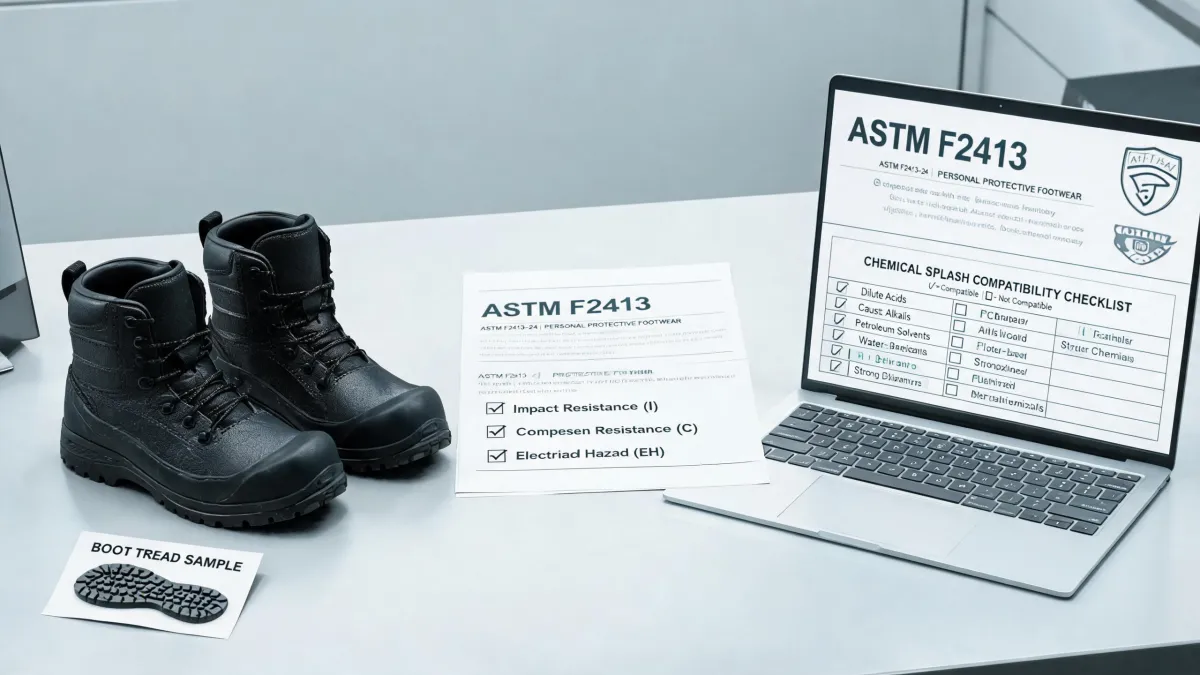
- Impact or compression hazard – require protective toe coverage that meets ASTM F2413.
This step takes about 20 minutes. Skipping it can cost you months of replacements and safety headaches.
2. Separate a Real Requirement From a 'Nice to Have'
I'm a big fan of Dunlop insulated rubber boots. On cold, wet jobs, they're almost a superpower. But I've also ordered insulated boots when the site was actually a heated warehouse. That mistake adds cost and makes feet sweat.
Here's something vendors won't tell you: insulation is a feature, not an upgrade. It only earns its place if the work environment demands it.
Before you put 'insulated' on the spec, ask:
- How cold does it get where the crew works?
- Do workers stand still for long stretches or keep moving?
- Are they handling wet, cold materials all shift?
If the answer to all three is yes, Dunlop insulated rubber boots are worth the expense. If not, skip the insulation and spend the savings on a better-fitting waterproof boot.
3. Compare Cost by Wearing Day, Not by Sticker Price
This part sounds like a finance lecture, but it's where the money actually goes.
I track every boot order in a cost spreadsheet. When I audited our 2023 orders, I found a cheaper boot that looked great on paper. It cost about $12 less per pair. Then the sole separated at month four. The replacement ate the savings. The Dunlop boots on the same audit were still going at month eight. That made the 'cheaper' boot more expensive by about $0.16 per wearing day.
That's the danger of comparing only quote prices.
So, ask every supplier what is not included before you ask what is. Real talk: the first quote is almost never the final price for ongoing purchases. Shipping, size exchanges, warranty claims, and restocking fees all count. A supplier that lists those fees upfront is usually less painful than one that hides them in the fine print.
I built a simple total-cost column for every boot style:
- Unit price
- Expected life in months
- Replacement rate per year
- Shipping and restocking fees
- Warranty handling effort
Bottom line: a $90 boot that lasts three months is often more expensive than a $140 boot that lasts nine. That's not complicated math, but it's easy to ignore when someone is pushing a discount.
4. Check the Rest of the PPE List Before You Sign Off
Boots take up the biggest part of the budget, but they're not the only part. Eye protection is a regular line item for us, and it's where style can override common sense.
Pit Viper safety glasses have become popular with our crews. I get it. They look better than the old wraparound styles. But when I approve eyewear, the lens marking matters more than the logo. Look for Z87 or Z87+ on the lens or frame. If it isn't marked, it doesn't belong on a job site, no matter how good it looks.
That's not a complaint about a specific brand. It's a rule. Style gets people to wear PPE; certification is what makes it PPE.
5. Use the Same Logic for Services Like Fire Extinguisher Inspections
This checklist doesn't stop at physical products. Services follow the same rules, and they eat budget just as quickly.
Let's say you type 'fire extinguisher service near me' into a search engine. You get a list of local providers. The temptation is to go with whoever replies first with the lowest number. But if the quote only covers tagging and inspection, you may still be on the hook for hydrostatic testing, replacement parts, and travel time.
A few years ago, I approved a service quote that looked about $300 cheaper than the next one. The first surprise came when they charged extra to place the extinguishers back in their cabinets. The second surprise came when our compliance audit flagged missing inspection tags. Not ideal.
Now I ask every service provider for a scope of work listing exactly what is and isn't included. It's the same question I ask for boots, eyewear, and every other purchase: What is not included?
Common Mistakes I Still See in Purchase Reviews
Even with a checklist, three mistakes keep showing up in my review notes.
Mistake 1: Buying one boot model for the whole team
Different jobs create different hazards. A single boot style will never fit everyone. Give supervisors a budget and let them choose from approved models based on the work they actually do.
Mistake 2: Treating certification wording as optional
ASTM F2413 for impact-resistant toes. ANSI Z87.1 for eye protection. Ask for the standard on the label or in the spec sheet. Verbal assurances don't hold up in an audit.
Mistake 3: Forgetting that services and PPE both fail silently
Fire extinguishers can lose pressure. Boots can lose their waterproof seal. Set reminders in your procurement system so maintenance doesn't depend on someone remembering it.
Bottom Line
Dunlop boots solve a specific problem. Timberlands solve a different one. A pair of Pit Viper safety glasses belongs on the order only if it carries the right impact rating. And fire extinguisher service is only as good as the scope behind the quote.
The common thread is simple: ask what's not included, track what you buy, and check the standard before you check the price. It won't make procurement exciting. It will make it defensible when the budget review comes around.