The Dunlop boots questions I wish someone had answered in 2017
I've been ordering safety footwear for an industrial remediation crew since 2017. Around 40 people, most of them on sites where the right Dunlop boots are the difference between a normal day and a bad day. I've made the classic buying mistakes, paid for them, and kept notes so our team doesn't repeat them. If you're shopping for Dunlop boots, start with the spec sheet, not the price.
Here are the questions I hear most often from other safety managers and buyers, in the order of how much they cost me when I got them wrong.
- Are Dunlop boots still worth the reputation?
- What are the best Dunlop hazmat boots?
- Are square toe work boots safer or just more comfortable?
- Is steel toe enough, or do I need metatarsal protection?
- How do you clean work boots without ruining them?
- Why did my cheap boot order cost more than Dunlop boots?
- What about the rest of the PPE, like heat wave safety glasses?
Getting the spec right the first time
1. Are Dunlop boots still worth the reputation?
Dunlop started as a rubber company, and rubber is still the main reason I buy them. For wet work, the waterproofing isn't a coating; it's the material itself. That's a real advantage. But Dunlop boots aren't one product. The line includes pull-on rubber boots, steel toe models, insulated models, hazmat styles, and specialty overshoes. A pair that's perfect for a concrete plant can be wrong for a chemical site. The brand is a starting point, not the whole answer.
Put another way: the logo doesn't protect your crew. The right model and the right specification do.
2. What are the best Dunlop hazmat boots?
The honest answer is that the best Dunlop hazmat boots are the ones whose chemical resistance chart matches the substances on your SDS sheets. No single model handles every chemical. If someone tells you otherwise, ask for the test data. Per FTC advertising guidelines (ftc.gov), performance claims have to be truthful and substantiated. A vendor who shrugs when you ask for a chemical chart is giving you a marketing word, not a specification.
I learned that the expensive way. In spring 2019, I ordered 12 pairs of standard rubber boots for a solvent cleanup job because the listing called them chemical resistant. I remember saving roughly $75 a pair and feeling smart about it. Within two weeks, the soles were hardening and starting to crack. It failed. Simple as that.
We pulled the crew, placed an emergency order for the proper Dunlop hazmat boots, and paid a freight bill that hurt. The initial savings turned into roughly $2,300 in replacement cost, shipping, and downtime. Now I check the chemical resistance table first, then the toe rating, then the shaft height. If splash or immersion is part of the job, the boot height is a safety feature, not a style option.
3. Are square toe work boots safer or just more comfortable?
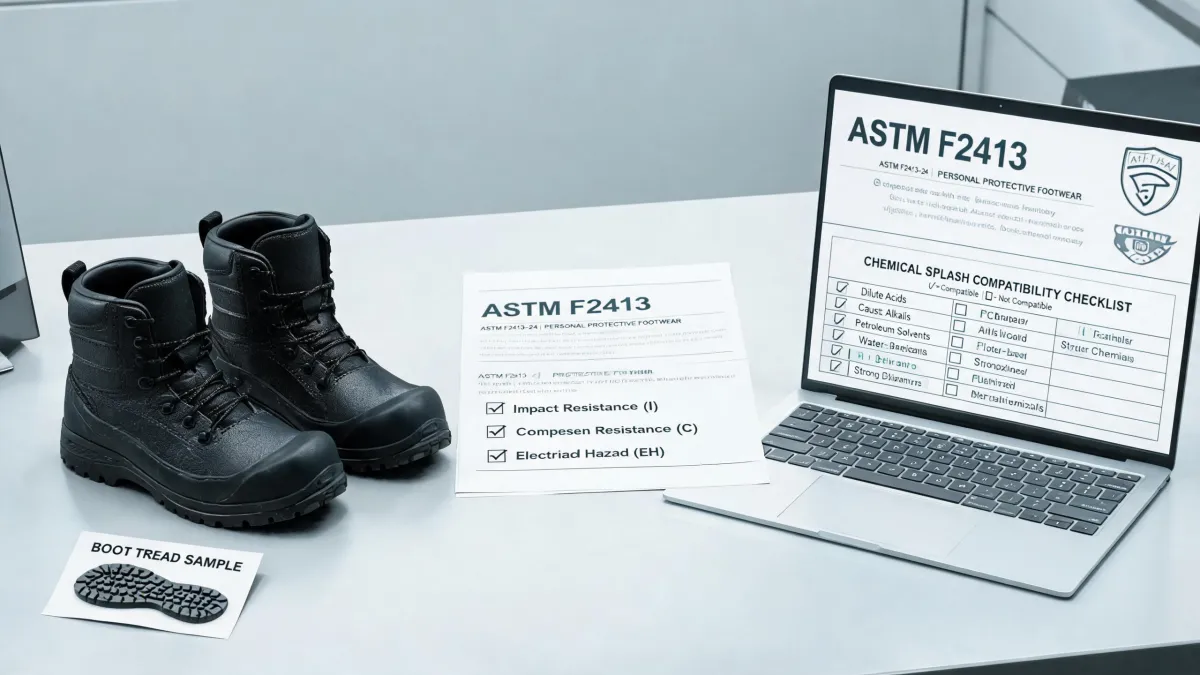
Square toe work boots are popular because they give toes more room to sit flat. For some foot shapes, that means less pressure and less fatigue on a long shift. I get the appeal. But the square shape is not the safety feature. The safety feature is the toe cap, and it should be rated under ASTM F2413 for impact and compression.
What I mean is this: a square toe box can be part of a good fit, and fit is a safety issue in its own right. If a boot squeezes a worker's toes, they will find another boot to wear, and it might not be the rated one. So choose square toe work boots for comfort if that's what your crew needs, but verify the protection rating just as carefully as you would with any round toe model.
4. Is steel toe enough, or do I need metatarsal protection?
A steel toe protects the toes. It does not protect the top of the foot or the instep. If something heavy can roll or fall onto the middle of the foot, steel toe alone leaves that area exposed. That distinction cost me an awkward conversation with a site safety supervisor.
I had ordered a full set of steel toe Dunlop boots for a drum handling job. The supervisor asked where the metatarsal guard was. I didn't have a good answer. Nobody got hurt that time, but the question exposed a gap in my thinking. The common advice says steel toe equals safety. The reality is that your hazard assessment should tell you where the impact could hit, and the boot spec should match that point of impact.
If falling or rolling objects are possible above the toe line, metatarsal protection isn't an upgrade. It's the requirement.
Cleaning, cost, and the rest of the safety system
5. How do you clean work boots without ruining them?
Most of the early boot failures I've seen weren't caused by the job. They were caused by bad cleaning habits. For rubber and steel toe rubber boots, the routine is simple:
- Rinse off heavy mud and debris before it dries, especially around the sole and heel.
- Wash with warm water and mild soap. A soft brush works well for textured soles.
- Never use gasoline, diesel, or paint thinner to clean rubber. Petroleum solvents can soften and swell the material, which shortens boot life and can compromise protection.
- Dry boots away from direct heat. Park them next to a heater or in the sun and you're asking the rubber to crack.
- If the boots are leather work boots, clean and condition the leather separately and keep laces and insoles dry.
There's also a safety side to cleaning that people miss. If a boot has been exposed to a chemical, cleaning is part of decontamination. Check the chemical resistance chart for the right cleaning method before you wash a contaminated boot and then wear it again on a clean site.
6. Why did my cheap boot order cost more than Dunlop boots?
Because price shows up on the invoice, while cost shows up over time. The cheapest option often wins on the purchase order and loses on the total cost of ownership.
Here's the rough math I use now. A budget boot at $50 per pair might last six months on a heavy site. A more durable Dunlop model at $120 per pair might last eighteen months. Over that eighteen-month period, the budget boot costs $150 per worker and requires two extra reorders. The Dunlop boot costs $120 and requires none.
Then add the hidden costs: freight, procurement time, and the shift where a worker ends up wearing mismatched leftover footwear because the replacement order didn't arrive. If I remember the numbers correctly, the emergency freight on the failed solvent job was about $178. That bill hurt more than the boots did.
Since 2022, I've asked vendors for a simple cost per worker-day before comparing quotes. It filters out the false savings faster than any price list.
7. What about the rest of the PPE, like heat wave safety glasses?
Boots are the most expensive part of the PPE program, so they get the most attention. But an audit doesn't care which item was your favorite. One missing layer can stop the whole job. That's it.
If your crew works around radiant heat, welding, or bright process environments, heat wave safety glasses belong on the same purchase order as the boots. Look for impact-rated eyewear with the right lens for the specific hazard, and don't buy eyewear just to check a box. A scratched lens or the wrong shade can create a new hazard while pretending to solve an old one.
The question isn't whether Dunlop boots are worth it. The question is whether your whole PPE system is matched to the hazards on site. Boots are a big part of that system, but they're still just one part.