Why “Just Get Me a Steel-Toe Boot” Is Never Enough
I coordinate emergency PPE orders for industrial facilities. In the last six years, I’ve handled 200+ rush orders—from a single missing glove to a $15,000 hazmat boot order that had to land in 36 hours. Almost every urgent request starts the same way: someone bought a boot because it looked tough, and only discovered later that tough is not the same as tested.
In March 2024, a maintenance manager called at 4:30 p.m. A chemical spill had shut down a line. He needed rubber boots for the cleanup crew by 6 a.m. “Just get me ten pairs of the cheap steel-toe boots,” he said.
That request isn’t wrong. It’s just incomplete. Steel toe helps with impact and compression. It does not tell you whether the boot’s rubber can survive the chemical, whether the sole is skid-resistant on that spill, or if the worker will last through the shift. We had to make another call the next morning because the first answer was incomplete.
Looking Tough and Being Safe Are Two Different Things
Most people type “where to buy steel toe boots” and start scanning images. A pair of moc toe work boots looks comfortable. A heavy rubber boot looks indestructible. They both look like something a worker should be wearing. But a work boot is not automatically a safety boot, and a safety boot is not necessarily the right one for every hazard.
Take the Dunlop Chesapeake men's rubber boots plain toe. For wet grounds, marine work, or general maintenance, it’s a solid rubber boot. It keeps water out, it’s easy to clean, and a plain toe gives your toes room. But if a drum rolls off a dock board and lands across the foot, that plain toe does not absorb much. It’s a good boot for a job without impact hazards. It is not a stand-in for impact protection.
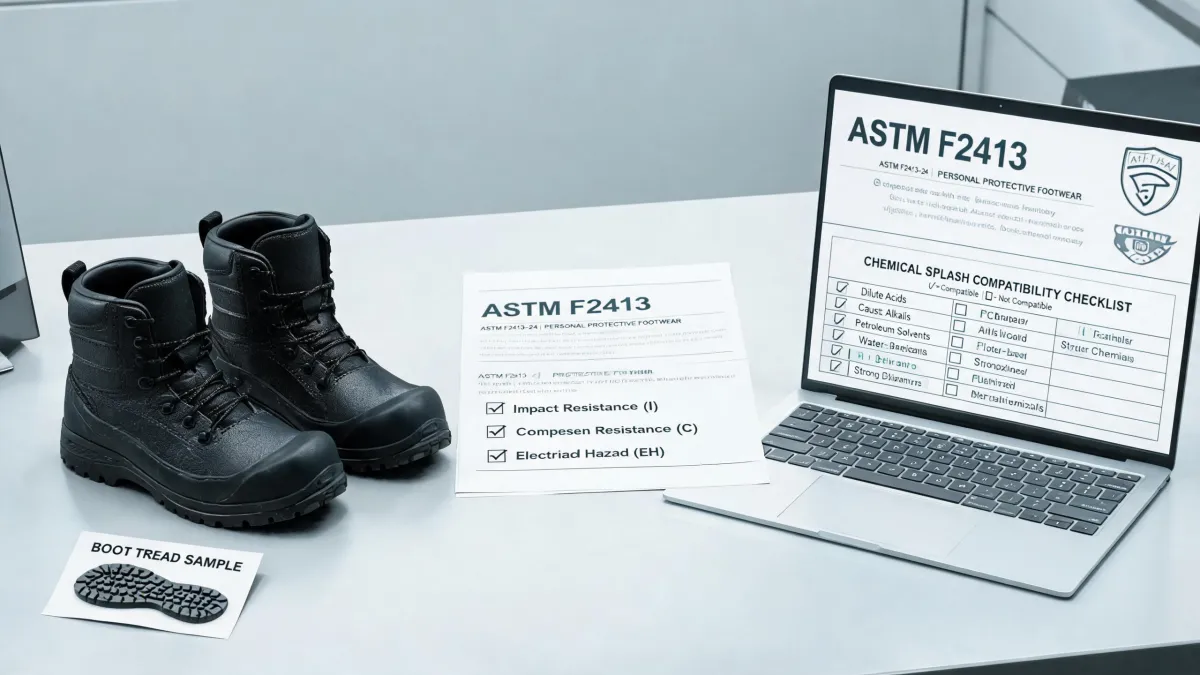
The same is true with a soft moc toe work boot. I get the appeal. Moc toes look better with jeans; they break in softer. But the toe style doesn’t change the physics of a falling object. If a boot lacks an ASTM F2413 safety-toe rating, it hasn’t been tested for impact or compression. It’s footwear, not PPE.
Steel Toe Is a Feature, Not a Whole Safety Strategy
The deeper issue is that we tend to collapse “safety boots” into one feature. When I see an injury or an audit finding, the root cause is rarely a missing steel toe. More often it’s a mismatch: a worker wore a steel toe boot into a chemical environment, or a waterproof boot on a job with puncture hazards, or a non-rated rubber boot around electrical equipment.
It’s tempting to think the choice is “steel toe or no steel toe.” That simplicity misses the complexity of real workplaces. A steel toe does not protect against caustic splash. A rubber boot that handles rainwater may soften when it meets a solvent. An electrical-hazard rated boot is different from an impact-rated boot. And puncture protection lives in the sole, not the toe. You can’t buy a single feature and check a box.
This is why I read Dunlop hazmat boots reviews differently now. When an operator says the boot lasted through eight-hour shifts in a specific chemical, that’s hazard intelligence. If a review only says “good rubber boot,” it doesn’t tell you whether the rubber was tested for what the job contains. The product name helps you narrow it: Hazmat, Chesapeake, steel toe, FieldPro—each is a different answer to a different question. The review and the data sheet have to line up with the exposure.
Boots are also part of a larger PPE system. I’ve seen organizations carefully select coveralls for men based on chemical compatibility, then choose the boots underneath based on price. That gap doesn’t make sense. If the coverall is the first line of defense, the boot is the one standing in the spill. It needs the same level of scrutiny.
The Real Cost of a Price-Based Purchase
I still kick myself for a decommissioning project in 2023. A customer needed rubber boots quickly. I found a pair, the price was good, the boots were in our warehouse. But I didn't ask what chemicals the crew would be standing in. Halfway through the first shift, the sludge started attacking the soles. They softened, then cracked. No one was hurt, but the job stopped, and we had to overnight the correct boots at nearly twice the cost. If I’d asked one extra question, the project would have stayed on schedule.
The price tag only tells you what leaves your bank account that day. The total cost includes what happens later: replacement frequency, compliance risk, foot injuries, workers’ comp, lost time, and whether a worker will actually wear the boot at the end of a long shift. An uncomfortable boot gets left in the truck. A boot that isn’t rated can become an OSHA violation. A boot that fails under the wrong chemical can send someone to the clinic. Unit price is the smallest part of that equation.
Last quarter, our team handled 47 rush orders—maybe 48, I’d have to check the spreadsheet—and eleven were replacements because the original boot was selected on price or appearance rather than hazard. The replacements were faster than the first order, but still more expensive than asking the right question upfront.
Hazard First. Brand Second. Price Last.
When someone asks me “Are Dunlop boots any good?” I usually answer: which one? Dunlop makes plain-toe rubber boots, steel-toe boots, Hazmat boots, and specialty models. The brand is not a spec. The model is.
If you need boots and you need them now, the answer is not to skip the analysis. It’s to do a faster version of it. Write down what the foot could actually contact. Is it a falling or rolling object? A nail? A caustic puddle? A live electrical part? Ice? Then let the hazard narrow the choices.
If the work is wet but has no significant impact hazard, the Dunlop Chesapeake men's rubber boots plain toe can be a reasonable call. If the work involves chemical exposure, go straight to the Hazmat category and read Dunlop hazmat boots reviews together with the manufacturer’s chemical resistance chart. If you’re in a warehouse, plant, or loading dock with moving loads, pick safety toe boots marked ASTM F2413 and choose steel toe or composite toe based on your other needs. And if you begin with “where to buy steel toe boots,” that’s fine—just add the hazard to the search and verify the rating before you order.
What about the style? Keep it. If you like a moc toe work boot and it carries the right safety rating, it can do both jobs: comfort and protection. If it doesn't carry a rating, don't let the name convince you it belongs around heavy hazards.
If the rest of the job calls for coveralls for men, choose them from the same hazard list and give the boots equal attention. A worker in a chemically resistant coverall and a non-compatible boot is still exposed. The weakest link in the PPE chain defines the protection, and too often that link is ground level.
Good boot buying is not about finding the cheapest pair. It’s about finding the boot that costs the least over the full life of the hazard: no early reorder, no OSHA citation, no emergency room visit, no worker who hides the toe cap in the trash. That boot may cost more at checkout. It will almost always save more later.