Conclusion first: if you need work boots that hold up to water, grease, mud, and the occasional chemical splash, start with Dunlop rubber boots. For steel-toe jobs that don't require a tall rubber shaft, the Dunlop Avenger work boots are the pair I order when someone says I just want something comfortable that doesn't fall apart. Since I took over purchasing in 2020, I've processed probably 300 boot orders for our crews—maybe 280, I'd have to check the system—and Dunlop has the lowest return rate out of any brand we've used.
That's not because they're the fanciest or the most expensive. It's that the failure points that usually cause boots to be sent back—splitting seams, delaminated soles, eyelets pulling out—just don't show up as often.
Why I have an opinion on boots
I'm the office administrator for a mid-size environmental services company. I manage all PPE ordering—roughly $120,000 a year across seven vendors. I report to both operations and finance, which is a polite way of saying I answer to the safety manager and the controller.
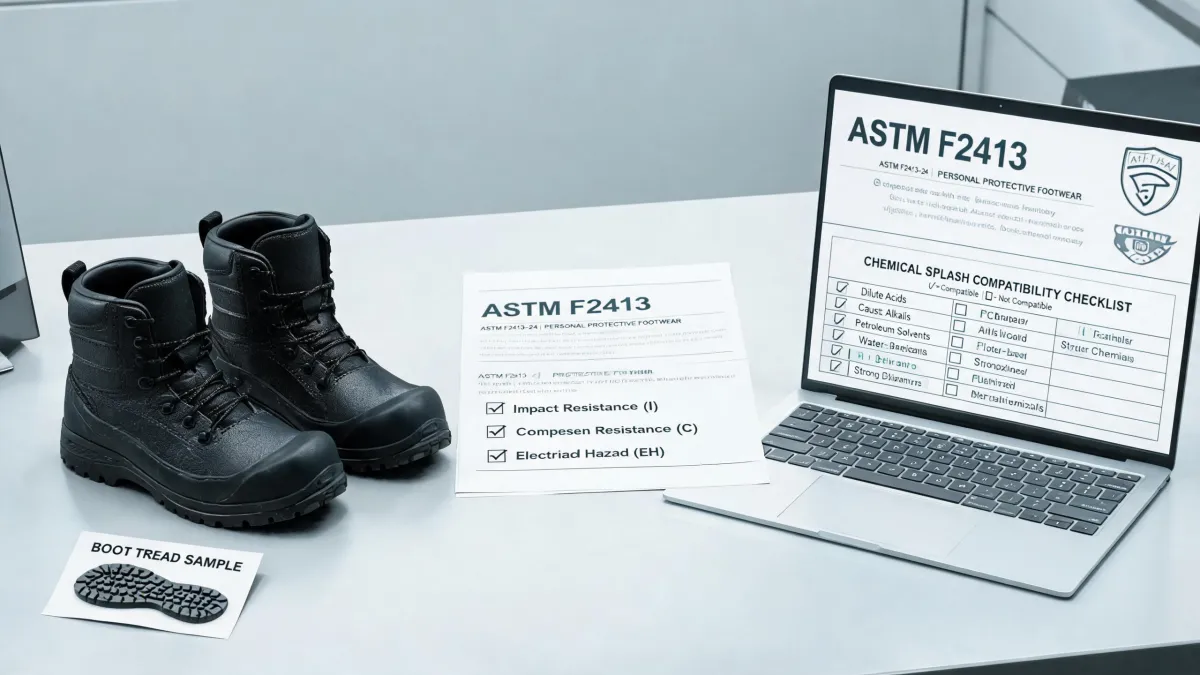
One thing I learned the hard way: not all steel toe boots are equal. I assumed the term steel toe meant the same level of protection across brands. Didn't verify. Turned out the budget model we used had a toe cap that ended noticeably earlier than the same-size Dunlop. Since then, I check every boot for the ASTM F2413-18 label (Source: OSHA 29 CFR 1910.136) before I approve it. That standard is the one referenced by OSHA's personal protective equipment rules.
The bigger lesson came in 2024 during our vendor consolidation project. I cut the approved boot list from five vendors to two—Dunlop for rubber and waterproof gear, plus one domestic boot maker for custom wide sizes. Comparing the specs side by side made me realize the cheap options weren't actually cheap. Their return rate was triple the Dunlop rate, and every return created unpaid invoice hours. In the long run, the best price boot is usually the one that doesn't come back.
Which Dunlop boots do I actually order?
It depends on the task, but here's the short version:
1. Dunlop rubber boots: the everyday workhorse
If your crew works around standing water, mud, or washes down equipment, the Dunlop rubber boots are the ones to start with. This is the line behind most dunlop rubber boots near me searches. They come in insulated and uninsulated versions, with and without safety toe. The rubber compound grips wet concrete better than the generic brands we've tried, and the boot doesn't stiffen up in cold weather as fast.
We order the steel-toe version for field workers, but the non-steel-toe is lighter for people who never work near heavy objects. My advice is to pay for the safety toe anyway, because the day a pipe rolls onto a foot is usually the day nobody expected it.
2. Dunlop Avenger work boots: the dry-site pickup
The Avenger line is the one to choose for people who need ankle support without the tall rubber boot. Dunlop Avenger work boots are waterproof enough for typical outside work, and the outsole holds up on wet concrete. In our company, drivers, supervisors, and shop mechanics wear these. They don't offer the same chemical resistance as a dedicated hazmat boot, and they're not meant to. They are a more normal fit, which makes them popular for all-day wear.
If you're comparing avenger work boots online, pay attention to the toe material. Composite and alloy toes are lighter than steel, but the boot must still show the ASTM rating. Don't choose the lightest option first. Choose the rating that matches your hazard list.
3. Dunlop hazmat boots: the buy-by-the-chart option
When I first searched for dunlop hazmat boots for sale, I made an assumption: they were just taller industrial rubber boots with a cool name. That assumption cost us about $800 in restocking fees. The first pair I ordered didn't come with a chemical-resistance chart, which meant the safety manager rejected them on-site. The real hazmat boot has a chart that lists specific chemicals and exposure durations. That chart isn't marketing. It tells you what the boot can handle before you let a worker step into a spill.
Now when I look at dunlop hazmat boots for sale, I enter the chemical names first. If a vendor can't show a compatibility chart for those chemicals, I move on.
For reference, based on our recent quotes in 2025, standard Dunlop rubber boots run about $55 to $85 depending on lining and toe, Avenger work boots usually fall in the $100 to $150 range, and hazmat models can go from $130 to $240. Prices shift by region and distributor, so verify before setting a PO.
What fence staining has to do with boots
One unexpected request came from a technician who does fence staining near me on weekends. He asked if he could buy a second pair of the Dunlop rubber boots from our supplier. At first I thought it was random, but then I watched him work: the rubber shaft shrugs off fence stain—oil-based and water-based—and a quick wash leaves it clean. Workers aren't the only ones who need that. If you search for fence staining near me and want a cheap answer to the which boots can I ruin? question, Dunlop rubber boots are it. No need to buy a specialty painting boot.
How to tie work boots with hooks
One question I get more than you'd expect is how to tie work boots with hooks. Many Dunlop boot models use speed hooks at the top instead of eyelets. A normal bow won't hold well because the lace angle changes.
Once you reach the hooks, pull the lace crosswise like you normally would. Before moving to the next hook, wrap the lace around the hook one full turn, then move to the opposite side. This creates friction and stops the lace from sliding back. At the top, pull both ends outward and down to lock the heel, then tie a bow. It adds about five seconds, but it keeps the boot snug for a full shift.
(Note to myself: I should film this so I don't have to explain it at the safety desk every time a new pair of Avenger boots gets issued.)
When Dunlop isn't the right call
My experience here is based on roughly 300 boot orders for crews working in warm-climate industrial and environmental jobs. If your team works in extreme cold, needs an electrical-hazard rated logger boot, or requires a specific international chemical resistance rating, Dunlop may have an option, but I can't promise it. I can't even speak to all Dunlop models from personal experience. And I'm not saying Dunlop is always the cheapest on a purchase order—it's often not. But we calculate cost per month of use, not cost per boot. That changes the math.
Also, quality of gear affects how clients see us. When crews arrive on a site with matching, serviceable boots, it tells the customer we pay attention to details. A worker with cracked rubber and duct tape looks like the start of a liability story. We order Dunlop because the boots reflect the way we want our teams to show up.
If you're making a buying decision, start with the work environment and the hazard list. Then find a boot that matches both. For most of what we do, that boot is a Dunlop.