-
What Makes Dunlop Hazmat Boots Different From Regular Rubber Boots?
-
Dunlop Metatarsal Boots vs. Steel Toe Boots: What's the Difference?
-
Do Dunlop Boots Run Big or Small?
-
What About 'On Cloud Work Boots' and Running Shoes on the Jobsite?
-
How to Lace Work Boots So Your Foot Doesn't Slide Inside
-
How Often Should You Replace Dunlop Boots?
-
What's the Most Expensive Mistake in a Bulk Boot Order?
Dunlop Boots: Straight Answers on Hazmat, Metatarsal, Steel Toe & Lacing
I work on the supply side of industrial safety footwear. That means I'm usually the person taking the call when a plant realizes it needs 90 pairs of boots before a shutdown, or when the hazmat boots someone ordered last year turn out to be the wrong spec. After six years and 200+ rush orders, I've heard the same Dunlop boot questions over and over. Here are the answers I'd give you before you order, not after.
What Makes Dunlop Hazmat Boots Different From Regular Rubber Boots?
The confusion that costs the most money is this: waterproof does not mean chemical-proof. A standard Dunlop rubber boot is excellent at keeping rain, mud, and wastewater out. It keeps your feet dry on a wet jobsite. But if you're searching for the best Dunlop hazmat boots, you're looking for something different.
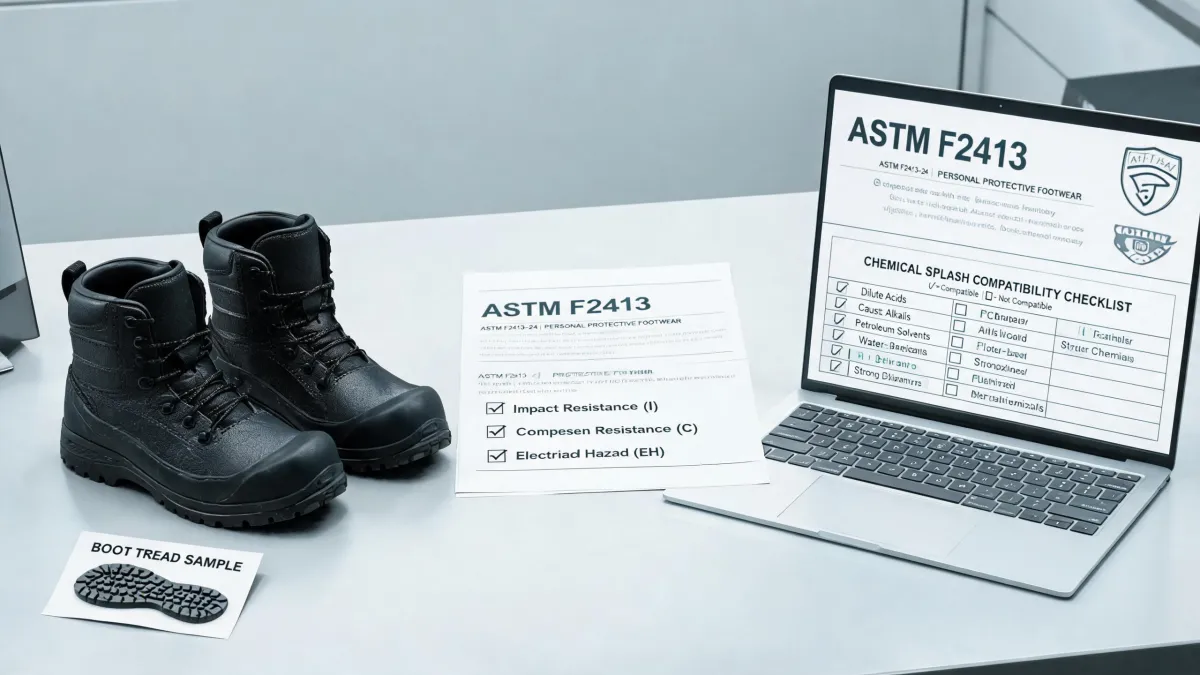
Dunlop hazmat boots are made from specially formulated polymer compounds with documented chemical resistance. The right boot depends on the chemical, its concentration, and the temperature. A boot that handles caustic splash may not handle a petroleum solvent, and vice versa. That's why the first step isn't picking a model. It's pulling the chemical compatibility chart and putting it next to your safety data sheets.
I had a plant manager call me on a Thursday afternoon in March 2024. A shutdown was scheduled for Monday, but the hazmat boots in their inventory had cracked during a fit test. He kept saying, 'just get us the good ones.' We had to stop and ask what chemicals the crew actually touched before placing the order. That twenty-minute conversation saved a five-figure mistake, because 'hazmat' alone doesn't tell anyone which compounds the boots need to resist.
If your crew only deals with water and non-hazardous sludge, you can skip the hazmat spec and save real money. If they're around chemicals, don't rely on the word hazmat. Rely on the chart.
Dunlop Metatarsal Boots vs. Steel Toe Boots: What's the Difference?
Steel toe boots are the most common protective boot for a reason. They protect the toes from impact and compression, and they're required for a huge range of jobs. But a lot of workers assume the toe cap covers more than it actually does.
A steel toe cap ends roughly where the laces start. If something heavy lands on the top of your foot, the metatarsal bones take the hit, and a regular steel toe boot won't do much for that. That's where Dunlop metatarsal boots come in. They extend the protection further back over the instep, which ASTM F2413-18 rates as Mt.
I've seen the real-world version of this: a worker's toes were perfectly safe, but an object dropped on the laces area and caused a serious mid-foot injury. If your people carry pipe, structural steel, lumber, concrete forms, or anything that can land on the top of the foot, do not stop at steel toe. Get the metatarsal model.
My honest opinion? If you've already had one near-miss where something heavy hit a boot near the laces, stop debating the cost difference. A metatarsal boot costs a little more. A metatarsal fracture costs weeks of work and a workers' comp claim.
Do Dunlop Boots Run Big or Small?
Sizing is the quiet killer of bulk boot orders. Dunlop's protective boots typically use European sizing, and many models don't come in half sizes or multiple widths the way running shoes do. They're also designed to be worn with work socks, not thin gym socks.
Trying to convert from the US size you wear in sneakers is how mistakes happen. Instead, do this: measure your foot in centimeters while wearing the socks you'd actually wear on the job. Then compare that number to the boot's insole length, not to the size number on your old athletic shoes.
If your measurement lands between sizes, think about your socks. A thick winter work sock can justify sizing up. But don't size up just for comfort, because a boot that's too long lets your foot slide forward. In a steel toe boot, that means your toes can end up too close to the cap, which causes pinching and reduces the protection you're paying for.
We didn't have a formal size verification process in my first year, and it cost us. The third time a rush order came back because someone ordered by US shoe size instead of centimeters, I stopped assuming and started asking for the measurement in cm. It felt like overkill. It wasn't.
What About 'On Cloud Work Boots' and Running Shoes on the Jobsite?
I hear the phrase 'on cloud work boots' from people who want one thing: a boot that feels as comfortable as a running shoe. I understand that. If your feet hurt all day, you're distracted, and distraction on a jobsite is a safety problem. But comfort is not the same thing as protection.
OSHA 29 CFR 1910.136 requires protective footwear when there is a danger of foot injury from falling or rolling objects, objects piercing the sole, or exposure to electrical hazards. In most cases, that means footwear tested to a standard like ASTM F2413-18. An athletic shoe with a soft foam midsole is not designed to take a 75 ft-lb impact, and it won't stop a nail from coming up through the sole.
To be fair, there are workplaces where running shoes are perfectly fine. If the hazard assessment doesn't identify impact, puncture, chemical, or electrical risks, an employer can decide that athletic shoes are acceptable. But don't substitute a comfort shoe for a real safety boot just because it feels good in the aisle. If a boot is uncomfortable, find a boot that fits better or swap the insole. Don't drop the protection.
How to Lace Work Boots So Your Foot Doesn't Slide Inside
Lacing sounds like a beginner topic. It's not. A steel toe boot only works the way it should if your foot stays in the right position inside the boot.
When laces are too loose, your foot slides forward with every step. Your toes end up pushing toward the front of the toe cap, which can cause blisters, pinched toes, and a false sense of protection. In a metatarsal boot, loose lacing can let the met guard shift, exposing part of your mid-foot.
Here's the lacing method that helps more than any other: the heel lock. Lace the boot normally, but at the top eyelets, thread each lace end through the eyelet on its own side to create a small loop. Then pass the left lace end through the right loop, and the right lace end through the left loop. Pull outward. That locks your heel down into the back of the boot and stops the forward slide.
When the boot is laced correctly, you should be able to wiggle your toes but not lift your heel. If you feel tingling or pressure across the top of your foot, the laces are too tight. Relace from scratch rather than just loosening the knot, because the problem is usually in how the lace sits across the tongue.
How Often Should You Replace Dunlop Boots?
Rubber and polymer boots don't always look dead right before they fail. A boot can look fine from across the room while the sidewall is developing cracks that will turn into leaks, or worse, a sudden loss of grip.
Here's what I tell people to check:
- Cracks in the rubber, especially at the flex points around the ball of the foot and the heel
- Sole separation, where the bottom starts to pull away from the upper
- A steel toe or metatarsal guard that's starting to show through the material
- Swollen, sticky, or unusually hard rubber after chemical exposure
- Heel wear that's so uneven the boot no longer sits flat
There's no single expiration date. A pair of Dunlop boots used every day in rough conditions might need replacing in 6 to 12 months. A boot that's rotated with another pair and cleaned properly can last longer. The important habit is inspecting them on a schedule, not when someone complains.
I'm a believer in prevention over cure, and this is where it pays off. Replacing a questionable pair of boots is cheap. The medical bill, the lost time, and the paperwork from a preventable foot injury are not.
What's the Most Expensive Mistake in a Bulk Boot Order?
Most bulk boot mistakes happen when someone skips the hazard assessment and orders based on price per pair. The cheapest boot that meets 'steel toe' on paper is not the cheapest option if half the crew needs metatarsal protection, puncture-resistant soles, or electrical hazard rating.
A bulk order should start with a simple question per job role: what can actually hit, pierce, or contact this worker's feet? Then match the boot to that answer. That's the part people rush past.
I've made this mistake from my side too. Early on, we didn't have a formal spec-confirmation checklist. We paid for it with a returned order and extra freight. The fix wasn't complicated. It was a checklist with the required safety rating, the chemical exposure, the sole requirement, and the sizing method in centimeters. That checklist has saved us more times than I can count.
So if you take one thing from this: spend five minutes checking the spec before you order. It's the cheapest insurance you'll ever buy.