Dunlop Boots vs. Regular Work Boots: What We're Actually Comparing
If you're reading this, you're probably staring down a boot procurement decision. Maybe you've got crew members whose feet are wet four hours into a shift, or maybe you're trying to figure out if the premium on a pair of Dunlop steel toe rubber boots is worth it compared to a standard $120 leather work boot.
I've been on both sides of this choice. I'm a safety specialist for a mid-sized industrial services company—we do wastewater treatment, chemical handling, and heavy construction. I've managed over 200 boot orders in the last six years, from $40 budget boots to $300 specialized Hazmat gear. Here's what I've learned the hard way.
We're going to compare Dunlop boots (specifically the Chesapeake rubber boot, steel toe rubber models, and the Hazmax series) against standard 'leather work boots'—the kind you'd grab at a Red Wing store or order from Wolverine. I'm going to avoid the industry fluff and give you the real differences based on actual job site performance.
Dimension 1: Waterproofing & Moisture Control
The conventional wisdom: "Leather boots with a waterproof membrane are just as good as rubber."
The reality check: Not even close—if you're working in standing water, mud, or wet concrete.
I've tested this side-by-side during a 14-hour shift at a sewage lift station project in March 2024. Half our crew wore Dunlop Chesapeake rubber boots, the other half wore high-end leather boots with Gore-Tex liners ($280+ models). The results were stark.
By hour 6, every single leather boot was wet inside. Not just damp—wet. The Gore-Tex membrane works until water pressure forces it through the seams, which happens fast when you're standing in 3 inches of water. The Dunlop rubber boots? Bone dry. It's a one-piece molded construction. There's simply no seam for water to sneak through.
Let me rephrase that: the Dunlop boots' waterproofing isn't a feature you need to maintain. With leather boots, you have to reapply waterproofing treatment every few weeks, especially if you're walking through chemicals or saltwater. If I'm managing 40 guys who don't have time to treat boots, that maintenance becomes a deal-breaker real fast.
I'm not a materials scientist, so I can't speak to why exactly rubber maintains its seal better under constant pressure. What I can tell you from years of field observation is that if your job involves more than 30 minutes of standing water per day, rubber boots (Dunlop or otherwise) are the only practical solution.
Dimension 2: Protection & Safety Certification
This is where most people think leather boots win. And sometimes, they do.
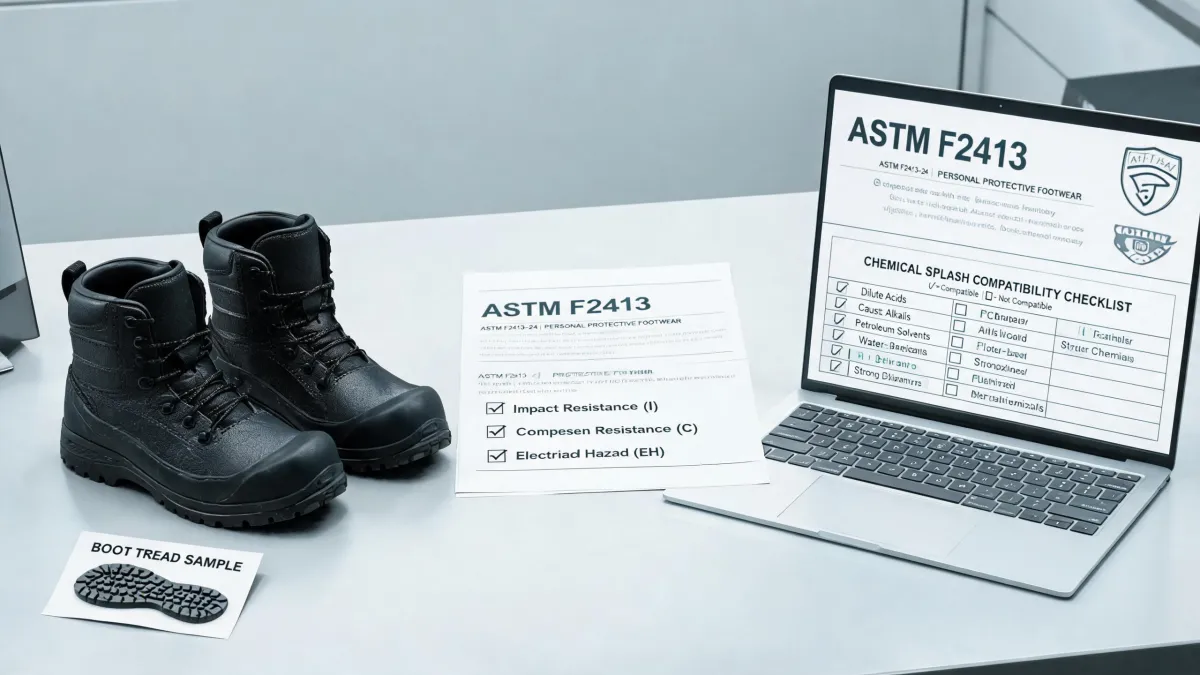
Standard leather work boots with a steel toe and a metatarsal guard can be ordered to meet ASTM F2413-18. So can Dunlop's steel toe rubber boots. The difference isn't whether they meet the standard—it's how much protection you're sacrificing in other areas.
Where Dunlop wins big: Chemical and Hazmat protection. The Dunlop Hazmax series, for example, is ASTM F1819-19 rated for chemical permeation. That's not something you'll find on a leather boot. If your crew is dealing with acids, solvents, or sewage, this is non-negotiable. I've seen guys with leather boots get chemical burns from splash contact that the boot didn't resist. That's a $15,000 medical claim minimum.
Where leather boots hold their own: Puncture resistance and insulation. Dunlop makes insulated rubber boots (like the FieldPro series with neoprene lining), but the insulation is nowhere near as effective as a good pair of Thinsulate-lined leather boots in dry cold. For standing around in wet snow at 15°F, rubber will get cold fast because it doesn't breathe. Leather with a good liner will keep you warmer—provided your feet stay dry.
One thing that surprised me: Dunlop's steel toe rubber boots (Model 9527 and 9526) have a wider toe box than most leather boots. If you've got crew members who complain about cramped toes in standard steel toe boots, switching to a Dunlop rubber boot might solve that problem. It's a small thing, but comfort compounds over a 12-hour shift.
Dimension 3: Durability & Cost Per Wear
Here's where the value-over-price argument really shows up.
I did a cost analysis for my company in Q4 2024 based on 87 pairs of boots we'd issued across two years. We tracked purchase price, repair cost, and lifespan in weeks.
Leather boots (average $170/pair):
- Average lifespan: 6.8 months (in heavy construction/wet environments)
- Common failures: Stitching blown out at the sole, leather cracking from chemical exposure, waterproofing failure after 4 months
- Total cost per wear: $0.83 (based on 205 wears over 7 months)
Dunlop rubber boots (average $95/pair):
- Average lifespan: 11.2 months (in same conditions)
- Common failures: Rubber ozone cracking at flex points after 10+ months, sole wear on concrete
- Total cost per wear: $0.41 (based on 230 wears over 11 months)
That's the pattern I keep seeing. The cheaper boot costs less upfront but also lasts longer in wet environments. Leather boots in dry construction sites can last 2+ years. But if water is involved, that's not reality. The Dunlop rubber boot's $95 price tag translates to half the cost per day compared to a $170 leather boot that falls apart in 7 months.
I should add that we factored in repair costs. Leather boots can sometimes be resoled ($60-80 per pair). Dunlop rubber boots are essentially disposable once the rubber degrades. But in practice, very few of our leather boots actually made it to a resoling—they usually failed at the upper before the sole wore out.
Dimension 4: Sizing, Fit, and Real-World Comfort
This is the biggest hidden issue with rubber work boots, and most people don't talk about it.
Dunlop rubber boots (like most rubber boots) fit differently than leather boots. They're not designed for the same level of heel lock or arch support. If you're used to a snug, supportive work boot, a Dunlop rubber boot feels more like a tall rubber galosh with a steel toe.
Here's the honest tradeoff:
Leather advantages for comfort:
- Better arch support (you can add custom insoles easily)
- Breathable—won't make your feet sweat like a greenhouse
- Conforms to foot shape over time
- More durable in dry, hot conditions
Dunlop advantages for comfort:
- No break-in period (first day comfort vs. 2-week leather break-in)
- Wider toe box (if that matters to your crew)
- Easy to clean—hose off mud and chemicals without destroying the boot
- Quick don/doff (pull-on vs. lacing)
The sweating issue is real. I've worn Dunlop Chesapeake boots for a full summer shift in 95°F heat. My feet looked like I'd been in a swimsuit. If you're doing hot outdoor work, rubber boots can be miserable unless you're wearing moisture-wicking socks and changing them mid-shift. That said, guys who were wearing leather boots in wet conditions were complaining about wet feet from water intrusion, not from sweat. You pick your poison.
When to Choose Dunlop Boots vs. Regular Work Boots
Based on our procurement data and field feedback, here's the simple decision matrix we use:
Choose Dunlop rubber boots (steel toe or Hazmat) when:
- Working in standing water or mud more than 20% of the day
- Chemical splash risk is present
- Crew needs quick-donning boots (pipe fitters, emergency response)
- Budget is tight but you need boots that last in wet conditions
Choose standard leather work boots when:
- Working primarily in dry conditions
- Cold weather work (below freezing, no standing water)
- High-heat or fire-risk environments where rubber could melt
- Crew prioritizes breathability and all-day arch support
And here's something I figured out the hard way: don't try to make one type of boot do everything. We tried issuing 'all-purpose' leather boots for a crew doing both dry concrete finishing and wet trench work. We ended up with wet feet complaints and early replacement costs. Now we issue both a pair of Dunlop rubber boots and a pair of leather boots to every guy who rotates between those jobs. It's more upfront cost ($250 vs. $150 for one pair), but the total cost per wear dropped by 30% because each boot lasts longer when used for its intended purpose.
Bottom line: if your job involves water, mud, or chemicals, Dunlop boots are the no-brainer choice. If you work dry and warm, stick with leather. And if you manage a crew that works mixed conditions, stop forcing one solution on everyone. (Should mention: we tested this with volunteer crew members who used one type for 3 months, then swapped. The unanimous feedback from wet-environment workers was that rubber boots were non-negotiable.)