Buy the specific Dunlop hazmat boots or the specific Dunlop chemical resistant boots if you're working around chemicals. Don't assume a standard Dunlop work boot is the same product. I learned that the expensive way in 2019, when a $3,200 order of what I thought were 'industrial rubber boots' started cracking after seven weeks of chemical exposure.
Core lesson: hazmat and chemical-resistant are not marketing words. They are engineering specifications. The model number, the material compound, and the test standard matter more than the Dunlop logo on the side.
I'm a safety equipment procurement coordinator. I've been handling PPE orders for eight years, and I've made—and documented—14 significant mistakes that cost roughly $23,000 in wasted budget. I now maintain our buying checklist so other people don't have to repeat my errors. If you only read one section, read the checklist below. The rest is context and maybe a little venting.
Dunlop hazmat boots vs. Dunlop work boots: not the same thing
Dunlop makes a lot of footwear. General-purpose rubber boots. Steel-toe boots. Insulated winter boots. And then there's the hazmat and chemical-resistant side of the catalog. The mistake I kept making early on was treating all black rubber boots as interchangeable.
Standard Dunlop boots are waterproof, tough, and decent for mud and rain. But waterproof is not chemical-proof. Some rubber compounds swell, soften, or crack when they hit solvents, oils, and acids. A chemical-resistant boot uses a different compound and sealing process, and it usually comes with a test standard or chemical compatibility chart. That chart tells you which chemicals the boot can handle, and for how long.
When I first started buying PPE, I assumed rubber is rubber. It isn't. The most frustrating part is that the wrong boots look completely fine out of the box. They look like safety boots. They feel like safety boots. Then the first splash of the wrong chemical hits, and within weeks the material starts to break down. You'd think written specs would prevent this, but a lot of buyers don't ask for the chart until after the failure.
What to check before you buy
I don't trust product titles anymore. I verify three things:
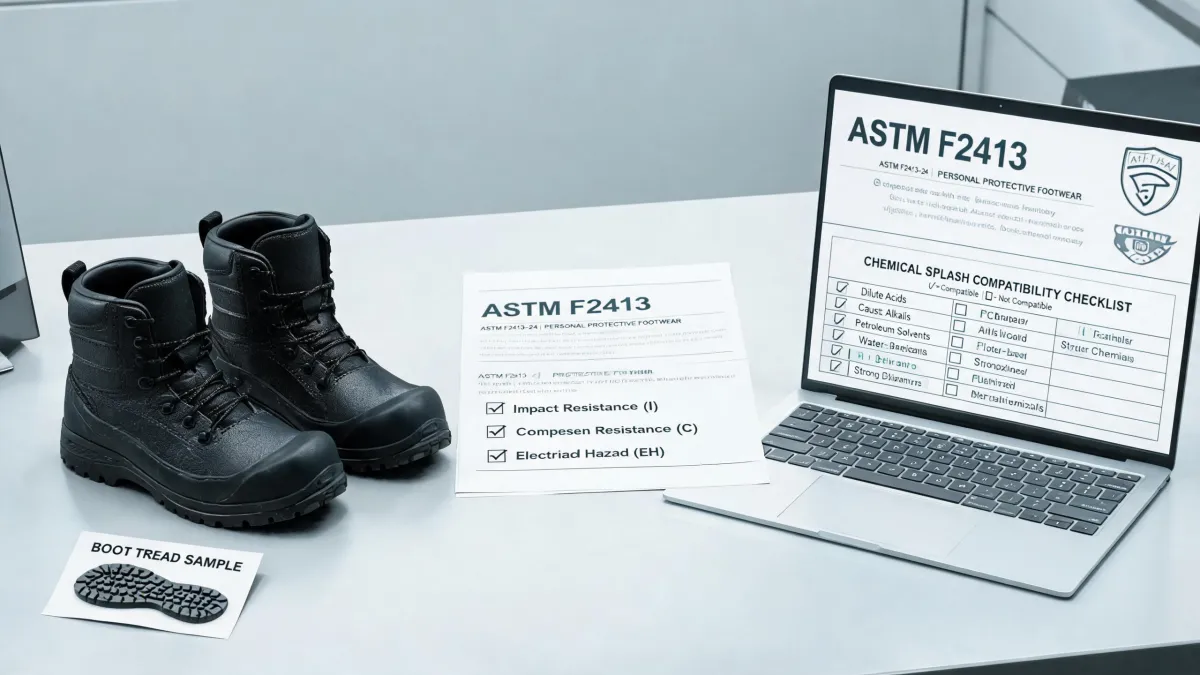
- The exact standard. In the U.S., ASTM F2413 covers impact and compression protection. It does not cover chemical resistance. For chemical hazards, look for a manufacturer-specific chemical compatibility chart. In Europe, check for an EN ISO 20345 safety rating if the boot is sold internationally.
- The chemical list. 'Chemical-resistant' means nothing without the actual list. A boot that's fine for dilute sulfuric acid might fail with acetone or xylene. Ask for the test data before you buy.
- The exposure type. Splash exposure is not immersion. A boot rated for incidental splash might not survive standing in the chemical. Match the boot to the task, not just to the chemical name.
Why does this matter? Because a boot that's fine for one chemical can fail fast in another. Skipping these steps got me again in 2021. I had 48 hours to outfit a crew for a wastewater treatment job. Normally I'd get formal spec sheets and cross-check every chemical on site. But with the client deadline, I went with a popular Dunlop model based on price and availability. They were comfortable. They were the wrong chemical barrier. We reordered five weeks later.
I still kick myself for not checking the compatibility chart before that first big order. If I'd spent 20 minutes reading the spec sheet, I'd have saved $3,200 and avoided a very humbling conversation with the crew.
Small orders should get the same serious advice
If you're a small company ordering two or three pairs, you shouldn't have to beg for decent guidance. When I was starting out, the vendors who treated my $200 orders seriously are the ones I still use for $20,000 orders. Small doesn't mean unimportant. It means potential.
That said, don't expect small-quantity pricing. That's not discrimination; that's math. But you should expect honesty about whether a boot is actually chemical-resistant. If a supplier dismisses your question because you're buying a small order, find another supplier.
Related searches: kids work boots, Skechers work boots, and pepper spray
A lot of people land on this page while researching other safety questions. Let me clear a few up.
Kids work boots are a real category, but not all of them are safety-rated. If you're buying for a young worker, don't buy a miniature fashion boot. Look for the same safety toe, slip-resistant outsole, and protective rating that you'd want in an adult boot. And don't buy oversized boots for them to 'grow into.' That's a trip hazard and a problem on a real work site.
Skechers work boots are generally about comfort and light-duty use. I'm not going to bash them: they're popular for good reason. But I wouldn't use them for chemical handling or hazmat response. Same rule as Dunlop: the hazard defines the boot, not the brand.
Where to buy pepper spray near me is a completely reasonable question if you're a lone worker or doing site visits. But keep it separate from your boot purchase. Pepper spray does not protect your feet from chemicals, and it doesn't replace PPE. Check local laws, buy it from a reputable local or online retailer, and treat it as self-defense—not as part of your chemical protection strategy.
Price and total cost
Based on distributor quotes I've seen in March 2025, basic Dunlop rubber work boots typically run about $50 to $120. Dunlop hazmat boots and chemical-resistant models usually run $120 to $250 depending on the specification. Verify current prices, because rubber prices and freight costs move.
The cheapest option on the quote sheet is rarely the cheapest boot you'll ever buy. A $70 pair that fails in six weeks costs more than a $180 pair that lasts two years once you add in reordering, downtime, and compliance risk. And if you're buying for a regulated workplace, remember that OSHA's PPE standard (29 CFR 1910.132) requires employers to assess hazards and select PPE that fits those hazards. That's not a procurement preference; it's the law.
The checklist I use now
- Write down every chemical workers might contact.
- Get the manufacturer's chemical compatibility chart for the specific boot model.
- Confirm the test standard, not just the marketing description.
- Check the safety-toe and slip-resistance ratings if the job needs them.
- Order one pair first and have a worker test the fit before buying the full quantity.
That last step sounds slow, but it's kinda the one that saves me. It's a lot easier to return one pair than 47.
When Dunlop boots aren't the right answer
I'm not going to pretend Dunlop is right for every situation. If you need heavy metatarsal protection, make sure the model actually includes a met guard. If you're on ice all day, a smooth rubber outsole won't be your best ally. If you need static-dissipative or EH-rated footwear, look for that specific marking. The right Dunlop boots are excellent; the wrong ones are just boots.
One final boundary: my experience is in procurement and safety buying, not in standing in a chemical trench for ten hours a day. I know enough to ask better questions now, but the person wearing the boot always has the final say on fit and comfort. Listen to them.
And if you're still looking at a product page trying to decide between Dunlop boots and another brand, ask one simple question: 'Which specific chemical is this boot certified against?' If the seller can't answer, you're not ready to buy. That's a lesson I had to learn three times before it stuck.