I'll say it plainly: when it comes to safety gear, I would rather pay a $20 premium for something I trust than save $4 on a gamble. That sounds obvious, but it took me six years and a lot of invoices to believe it.
I manage procurement for a 180-person industrial services company. Our annual PPE and work footwear budget is around $120,000. I have tracked every order, compared hundreds of quotes, and built total cost of ownership spreadsheets that are probably too complicated for my own good. After all that, the pattern is clear: the cheapest option is rarely the least expensive one.
The Boots Are Not All the Same
From the outside, a $120 steel toe boot and a $180 Dunlop FieldPro steel toe work boot can look nearly identical. Both have safety toes, both have sturdy soles, both claim to be waterproof. The difference shows up after week ten, when the cheap boot sole starts separating or the waterproof membrane turns into a sponge.
We tested this in 2024. I want to say we tried about 30 pairs across three price points, but don't quote me on the exact number. The cheapest model failed at an average of 11 weeks. The Dunlop boots were still in rotation after 26 weeks. That doesn't make Dunlop magical. It means the materials and construction were fit for our environment, which is mud, concrete, and the occasional chemical splash.
There is an old belief in procurement that all rubber boots are basically rubber. That was probably true 20 years ago. Today, the differences in insulation, toe protection, and chemical resistance are massive. For winter work, we use Dunlop insulated rubber boots because the crew is outside in wet, cold conditions. A cheaper boot may keep your feet dry for a week, but when the insulation collapses, people stop wearing them. Then you have an employee taking shortcuts on a jobsite, and that is a problem no spreadsheet can solve.
Cost Per Wear Beats Sticker Price
Every time a vendor quote comes in, I calculate cost per wear. A boot that costs $180 and lasts 18 months at five wears per week comes out to about $0.46 per wear. A boot that costs $110 and lasts seven months costs about $0.73 per wear. Plus the cheaper boot means more ordering, more sizing returns, and more downtime.
In Q2 2024, we switched a crew from a lower-priced model to Dunlop FieldPro steel toe work boots after a six-month pilot. The pilot showed fewer comfort-related complaints and no toe-area failures. I can only speak to our context: 180 employees, mostly outdoor work, a lot of wet weather. If you run a dry warehouse or an indoor assembly line, a lighter work boot might make more sense. Reebok work boots, for example, have a more athletic fit that some of our indoor crew prefers. Different environments, different math.
Hearing Protection Is Not a Place to Get Clever
Now for the part where people might think I am overreacting: earplugs.
If you have ever typed earplugs near me into your phone on a jobsite, you know what urgency feels like. You are not looking for the best price. You are looking for something rated that will let you finish the shift. That is exactly why I approve those purchases without a second thought. A worker who forgets their earplugs needs a replacement now, not next week. Overpaying $3 at a local store is cheaper than the paperwork, lost time, and possible hearing damage from saying just wait.
I also see a lot of searches for how does Loop earplugs work. Loop earplugs are popular for concerts and focus, but the basic question, how they work, applies to all earplugs. They reduce the sound energy that reaches your inner ear. Some use filters, some use foam, some use a resonant chamber. The important number is the Noise Reduction Rating, not the price tag. For industrial noise, I need an NRR that matches the exposure. A $1.50 foam pair with the right rating is a better buy than a $30 pair with no rating, for the same reason I prefer Dunlop boots with a clear safety toe standard over a lookalike without one.
Claims Need Evidence
One thing that changed how I buy: I stopped trusting marketing pages. If a boot says waterproof or chemical resistant, I ask for the test method. If an earplug claims a certain NRR, I want to see the packaging and the standard. That is not just being difficult. Per FTC guidelines (ftc.gov), advertising claims have to be truthful and substantiated. So when a vendor says guaranteed without a standard behind it, that is a red flag.
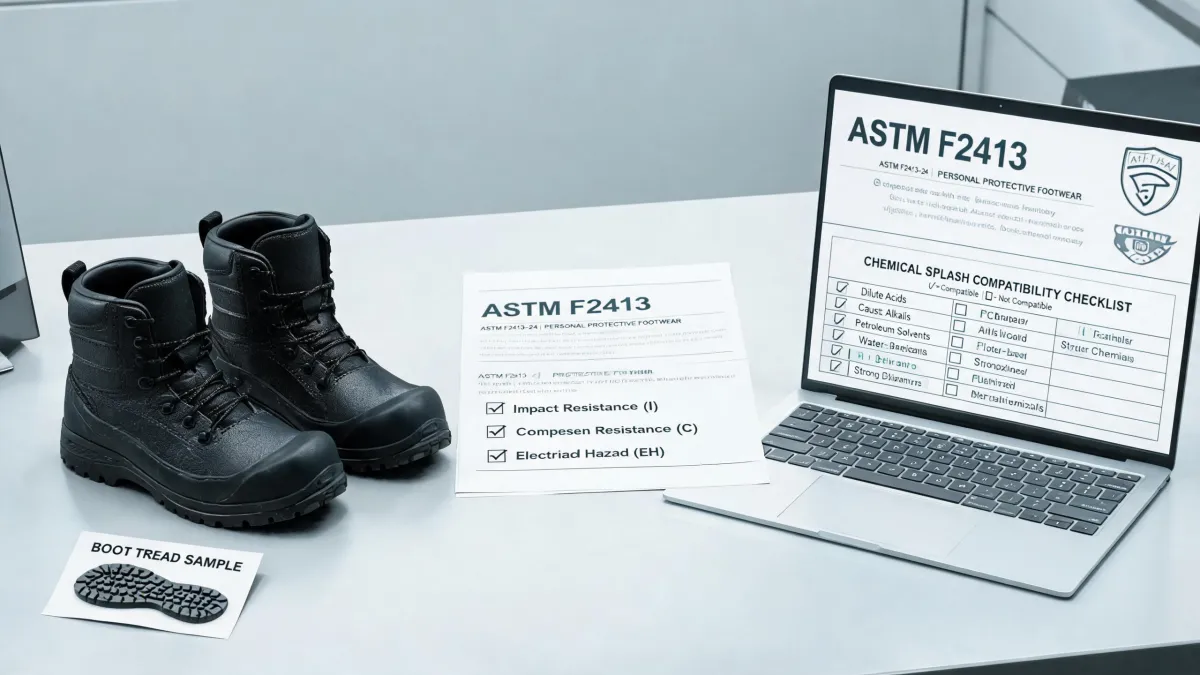
A vendor can say waterproof all day. What I mean is: can they show me the test? For foot protection, I look for a clear ASTM F2413 marking. For earplugs, I check the NRR and the instructions for proper fit. Hidden costs add up fast (sizing returns, downtime, compliance paperwork). I would rather have a supplier who can answer those questions than one who just promises to ship fast.
What I ask suppliers now
- What safety standard does this meet, and can you show me the certificate?
- How did you test the waterproofing?
- If I order 40 pairs with mixed sizes, what happens when five do not fit?
- What is the real lead time, not the usual lead time?
The Price of Certainty
This brings me to a procurement rule I do not see written down often: in an emergency, the cost of uncertainty is higher than the cost of speed. If a crew needs boots tomorrow because today's pair failed, I will pay the rush charge. The $60 expedite fee is nothing compared to a shutdown or a safety violation.
In March 2024, we paid about $400 extra to get a hazmat boot order delivered in three days instead of ten. The project involved a chemical cleanup with a strict deadline. That $400 was the cheapest part of the whole project. The alternative was missing a $15,000 contractual window and paying penalties that would make the rush fee look like pocket change.
I also think about shipping the same way I think about postage. According to USPS (usps.com/stamps), a First-Class Mail letter costs $0.73 as of January 2025. That is a published rate. You do not negotiate it. With safety gear, you are not buying a stamp; you are buying a delivery date. If a supplier cannot commit to that date without an upgrade, I pay for the upgrade.
I get the counterargument: not everyone can budget for that, and plenty of jobs do not need an emergency. True. I have been in shops where a $400 rush fee would have required a manager's sign-off and a prayer. That is why the fix is not always to pay more in the moment. It is to plan for the moments where paying more is the only reasonable choice.
This is where I will add my usual caveat: our situation is a mid-size company with predictable order cycles. If you are a solo contractor or a company with seasonal demand spikes, your calculation might be different. You might choose a lighter pair of Reebok work boots for indoor jobs and only invest in Dunlop insulated rubber boots for winter months. That is not wrong. The wrong move is pretending every product with a safety toe is the same just because it looks the same in a catalog photo.
Bottom Line
So here is my position: the more dangerous the job, the more you should pay for certainty, not just features. That does not mean buying the most expensive option. It means buying the one with evidence, a clear rating, and a vendor who will stand behind it.
If you are comparing Dunlop boots with another brand, do not start with the price per pair. Start with the environment, the safety requirement, and the number of days you expect them to hold up. Then add the cost of being wrong. If you are searching earplugs near me at 7am because someone forgot theirs, do not overthink the $8 stop at a hardware store. That is not waste. That is risk management. And if you have been wondering how does Loop earplugs work, they work by reducing noise, just like every other properly rated earplug, and the NRR matters more than the style.
I do not have a perfect record. I have made bad calls, bought budget options that failed, and paid rush fees I could have avoided. But I stopped lying to myself about what those calls actually cost. The cheap boot was not cheap. The shortcut was not faster. The only real bargain in safety gear is the one that works for the entire time you need it.
Prices and standards as of March 2025. Verify current rates and requirements before ordering.