I've spent the last five years reviewing safety footwear before it goes out to our crews. Not the most glamorous job, but it's an honest one. Roughly 200 pairs a year cross my loading dock—steel toes, rubber boots, electrical hazard rated models, metatarsal guards. And I've come to a conclusion that might sound like I've drunk the brand Kool-Aid:
The most expensive safety boot is the one that fails when someone actually needs it.
That's not a slogan. It's a line-item, worked-out truth from incidents I've lived through. I've seen a $65 pair of boots cost a company $18,000 and change—and I've seen the reverse: paying more upfront for the right boot saved us way more than the price difference in the long run.
So when people ask why Dunlop boots keep showing up on my specification sheets, the answer isn't "they're the best." It's that they offer the one thing I need: certainty. And in safety footwear, certainty is worth paying a premium for.
Certification beats marketing. Every. Single. Time.
Here's something that might surprise you: the safety footwear market is full of claims. Actually, that won't surprise anyone who's spent more than ten minutes comparing "safety shoes." What surprised me is how thin the evidence is behind a lot of those claims. Per FTC guidelines (ftc.gov), advertising has to be truthful and substantiated. But "substantiated" sometimes means "the manufacturer ran one test on a good day and put the results in a brochure."
That's not good enough for me. I read the actual certification documents. I check the ASTM standards for impact and compression. I verify the electrical hazard ratings. I track batch numbers, because a certified model can still ship a bad batch—I've seen it happen.
The surprise wasn't that premium boots had certifications. The surprise was how many budget options didn't, even where the marketing said they did. I don't need to name names—I've rejected a lot of boxes, and a lot of those boxes came with fancy logos.
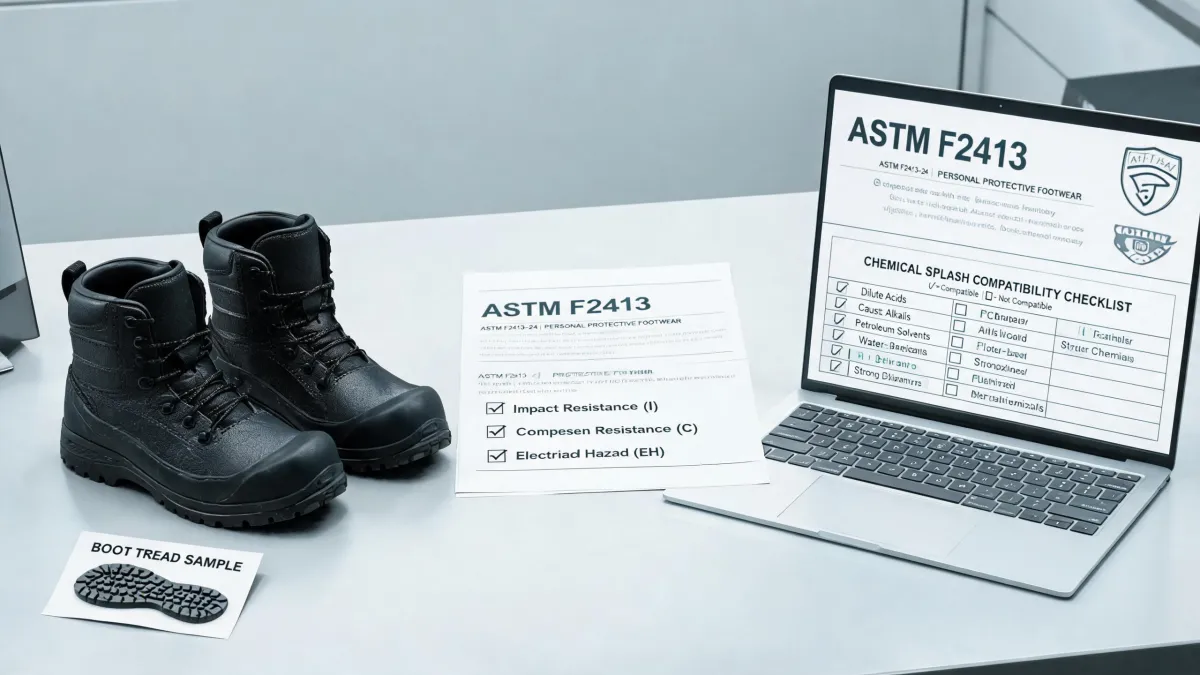
When I review Dunlop boots, the paperwork aligns. The steel toe models carry the ASTM F2413 ratings. The EH-rated ones actually meet electrical hazard standards. The rubber boots have the kind of vulcanized construction that doesn't just... quit after four months. I'm not saying that makes Dunlop "the best." I'm saying it makes them predictable. And predictable is the entire job requirement.
What boot failure actually costs
Let me walk you through a scenario from Q4 2024, because the "budget boot" argument falls apart when you land in the numbers.
We had a worker in a wet processing area wearing a pair of inexpensive rubber boots from a brand I won't mention in print. Four months in, the sole started separating from the upper. He didn't notice—he was carrying a load. Then he slipped on a damp floor and twisted his knee.
The boots were $58.
The injury report, the two weeks off, the temporary replacement on the line, the ergonomic assessment, the safety meeting, the supervisor's time with paperwork—that added up to way more than the $58 we "saved." Then we had to replace every pair from that batch, because we couldn't trust the rest.
If I remember correctly, the total landed north of $18,000. I say "north of" because I genuinely don't want to remember the exact figure.
The fix would have been simple. A pair of Dunlop Chesapeake rubber boots would have held up—they're built for wet environments, with rubber compounding and seam construction made for conditions like ours. That's why the Chesapeake keeps showing up in Dunlop chesapeake rubber boots reviews year after year.
Here's the part that still bugs me: the budget boots looked "good enough" at a glance. The specs were vague, the warranty was thin, and the price tag made them look like a reasonable gamble. It was a gamble—and we lost. That's the nature of uncertainty. You only discover how expensive it was after the incident.
The hazmat factor and the time dimension
I've also spent a lot of time reading Dunlop hazmat boots reviews before putting them through our own testing. My honest take: don't trust the reviews alone. Trust the manufacturer's track record, and use the reviews to dig up the lab data cited underneath.
Hazmat environments are the clearest case of the certainty premium. If a boot might resist chemical splashes—emphasis on might—that's not a risk I'm allowed to take. The cost of being wrong isn't a twisted knee. It's chemical burns, contaminated work sites, an OSHA investigation, possibly a lawsuit. I'll choose the certified, proven, purpose-built pair every time.
There's also a timing dimension. When a client calls on a Tuesday and needs a crew fully geared up by Friday, I need to know that the boots I spec are available—not "probably available" or "estimated ship date pending." I've paid rush charges before. And you know what? Totally worth it. The certainty of delivery on a deadline is cheaper than the alternative: explaining to a client why their project didn't start because the boots were stuck in a warehouse somewhere.
Dunlop's hazmat and chemical-resistant lines aren't a side project. Rubber protective gear is the company's entire history—about a century of it. There's a difference between a factory that decided to add boots to the catalog and a rubber company whose whole identity is protective gear. That difference shows up in the field.
The Wolverine question
Let me address something I'm asked a lot: are Wolverine work boots good?
To be fair—yes, they are. I've seen plenty of Wolverines in our facility over the years. They make solid leather work boots. Comfortable footbeds, decent durability for dry indoor work, reasonable choice for general construction. If you're on a dry site and don't need chemical or electrical protection, Wolverine is a legitimate option. I have nothing bad to say about them.
But "good" isn't the same as "right for the environment." Wolverine boots are leather, built for abrasion and general work. They're not designed for eight hours of standing water, chemical splash, or high-risk electrical environments. When I look at a spec sheet, I don't ask "is this a good boot?" I ask "is this the right boot for the conditions my crew will face?"
That's why my approved list includes several manufacturers. But for wet, hazardous, or electrically risky environments, I reach for the Dunlop rubber boots. Not because of brand loyalty—because the specifications match the environment.
About "lightweight work boots"
I also keep hearing about lightweight work boots. Everyone wants a lighter boot. I get it—nobody wants to feel like they're lifting their feet through wet concrete at the end of a ten-hour day.
But here's the lesson I've learned the hard way: lightweight is a nice-to-have. Protection is a must-have. Some of the lightest boots on the market achieve their weight by having less boot—less material between the foot and the hazard. I'm not willing to make that trade in an industrial setting.
Dunlop isn't the lightest option out there. I won't pretend their steel-toe rubber boots feel like running shoes. But the day a worker thanks me for a boot that's four ounces lighter while it's also keeping their foot dry and intact—that's a day I'll happily wait for.
What I've come to believe
I almost didn't write this. A lot of my job is procedural: check the label, verify the standard, sign the form. But after about a thousand pairs and way too many incident reports, I've arrived at a perspective the spec sheets don't capture:
Certainty is the only feature that actually matters.
Not style. Not brand image. Not the three ounces you save on paper. Certainty.
If you're buying safety shoes for a crew, do the math on what a single failure costs. If you're buying for yourself, ask what your ankles are worth. Cheap boots aren't cheap—they're just expensive in a way you can't see until the bill shows up.
I'll keep spec'ing Dunlop's Chesapeake rubber boots for wet sites, the hazmat line for chemical environments, and the steel-toe line for construction. Not because Dunlop is perfect—I don't trust "perfect" as a specification. Because they're proven. And in safety, proven beats perfect.
Even after I approved the switch company-wide, I kept second-guessing. What if we had a bad batch? The two weeks between order and delivery were stressful—honestly, they were. Then the delivery confirmation email hit my inbox at 4:47 PM on a Friday. Still one of my favorite work moments.
It took me five years and way too many near-misses to understand that certainty is worth paying for. But now that I have, I don't hesitate when the purchase order crosses my desk. The premium is the best money I've ever spent.