Here's the thing about safety boots: there's no single 'best' pair. If anyone tells you otherwise, they're either selling something or they've only ever worked one type of job. I manage a $45,000 annual PPE budget, and for the last 6 years, I've been tracking every single order, every return, and every pair that didn't make it past 6 months. So when I say 'it depends,' I mean it, and I have the spreadsheet to prove it.
Dunlop is a brand that comes up a lot in my world, especially for wet or hazardous environments. But are they the right call for your crew? That depends on what 'work' means for them. Let's break it down by the three main scenarios I see in the field.
Scenario A: The Wet & Wild (Construction, Agriculture, Outdoor Crews)
This is Dunlop's home turf. If your team is working in standing water, mud, or constant rain, a standard leather work boot is a waste of money. They'll be soaked by lunchtime, and wet feet lead to blisters, lost productivity, and complaints. I've seen it happen.
The Recommendation: Men's Dunlop rubber boots. Specifically, the Dunlop Purofort or Thermoboot lines.
- Why they work: They're 100% waterproof (not just 'water-resistant,' which is marketing-speak for 'they'll leak eventually'). The rubber compound is self-cleaning, so mud doesn't cake up and add weight.
- TCO (Total Cost of Ownership) perspective: Yes, a pair of Dunlop rubber boots costs more upfront than a cheap no-name brand. But in my experience (tracking 14 pairs across two crews in 2023), the cheap boots started leaking at the flex points within 3 months. The Dunlops? We got 18 months before the tread wore down. That's a lower cost-per-wear.
- The hidden cost: Cheap rubber boots are often stiff. Stiff boots cause fatigue. Tired workers are less safe. That is a cost you can't put on an invoice, but you feel it on your incident log.
I still kick myself for the time I saved $12 per pair by ordering a budget brand for a landscaping crew. I thought I was being smart with the budget. Instead, I spent the rest of the season dealing with returns and unhappy foremen. A classic case of my ego overruling the data.
One project manager told me later, 'The numbers said go with the cheaper boot. My gut said stick with Dunlop. I went with the numbers, and everyone was miserable for a month.' We went back to Dunlop the next quarter and haven't looked back.
Scenario B: The Hazard Zone (Chemical Plants, Hazmat, Oil & Gas)
This is a completely different ballgame. Waterproof isn't the priority—chemical resistance and safety certifications are. If you're ordering boots for a hazmat environment and you don't specify the right standard, you're not just wasting money; you're risking lives.
The Recommendation: The Dunlop Hazmax series or the Dunlop Protective Footwear line with steel or composite toe.
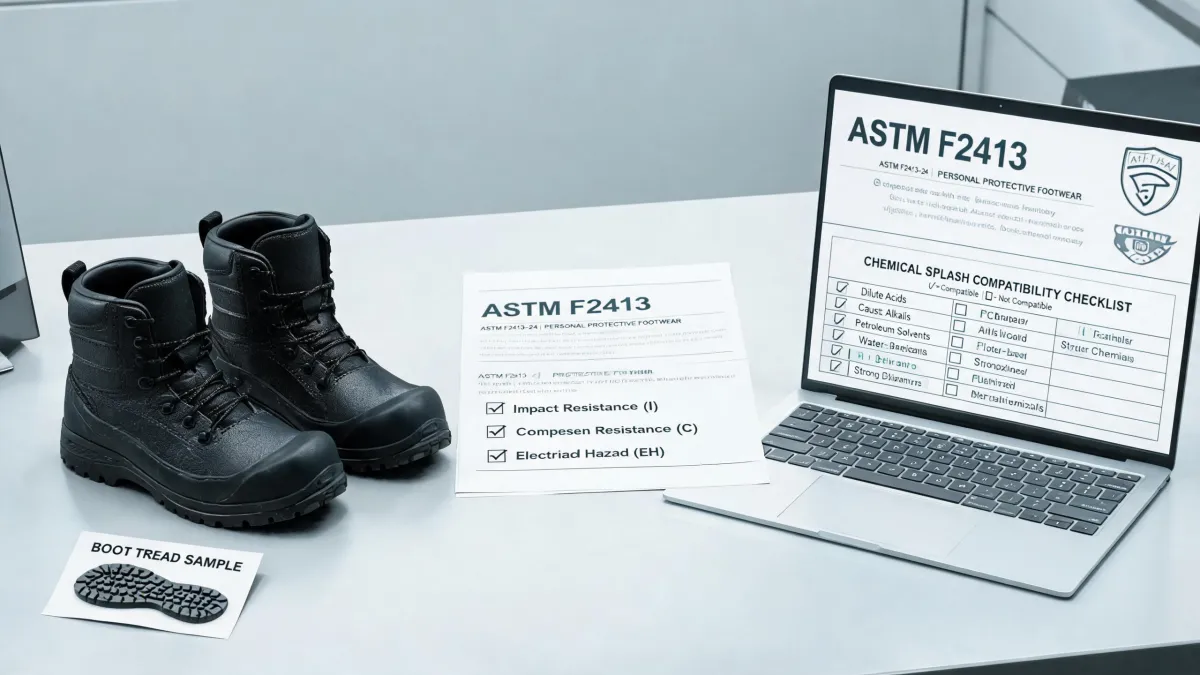
- Why they work: These are built to ASTM F2413 standards (the safety standard for protective footwear, as defined by ASTM International). But more than that, they're tested against specific chemicals. The Hazmax boots, for example, have a distinct rubber compound that resists animal fats, oils, and a range of industrial chemicals.
- The transparency trap: I've had vendors quote me a 'safety boot' that was basically a rubber rain boot with a steel toe. They met the letter of the law for some standards, but not the spirit. The Dunlop Hazmax line lists its specific chemical resistance data on the boot. I've learned to ask 'what's NOT included' before 'what's the price.' Because an unrated boot is a risk you're paying for, whether you know it or not.
- Quick note on sourcing: If you're searching for 'Dunlop boots near me' for a hazmat situation, don't just grab the first pair off the shelf at a general supply store. Call a dedicated safety distributor. They can provide the ASTM documentation you need for your compliance file.
Pricing is a factor, obviously. A pair of Hazmax boots (circa early 2025) is in the $80-$120 range, depending on model and height. That's higher than a basic steel-toe rubber boot, which might be $40. But in this scenario, the 'cheaper' option isn't an option if it means a chemical burn. You're not buying a boot; you're buying a piece of PPE with a paper trail.
Scenario C: The General Warehouse / Logistics Floor
Now, this is the scenario where I don't default to Dunlop for everyone. And that's a counter-intuitive thing for a Dunlop-focused guide, isn't it? But this is what I mean by no single answer. If your team is on a concrete, dry floor for 10 hours a day, a full rubber boot is overkill. They're heavy, they don't breathe, and they'll cause sweat and odor.
The Alternative: For this environment, I'd look at a leather work boot from a brand like Wolverine or even a well-rated composite toe sneaker boot. The keyword here is 'coveralls for men' or general warehouse PPE. But for specific situations within this environment—like loading freezers or dealing with wet washdowns—Dunlop still has a place.
- When to use Dunlop here: The Dunlop Fieldpro or a pull-on rubber boot for specific tasks (like a temp worker in a cold dock or a cleanup crew). They're easy to take on and off, which is critical for workers who are outside and inside.
- My advice: Don't order Dunlops for the whole warehouse. Split the order. Have a standard leather boot for the floor staff, and keep 5-10 pairs of Dunlop rubber boots in the locker room for those who need them for specific tasks or for visitors. This 'split strategy' saved me about 15% on my annual boot budget in 2024.
People ask me 'are Wolverine work boots good?' Yes, they can be. But they're not appropriate for a wet floor. Context matters.
How to Decide Which Scenario You're In
Okay, so how do you know which bucket you fall into? Don't overthink it. Ask yourself these three questions, in order:
- Is the work environment predominantly wet, muddy, or outdoors? (If yes → Scenario A)
- Is there a risk of chemical or hazardous material exposure? (If yes → Scenario B. Full stop.)
- Is the environment dry and inside? (If yes → Scenario C, with Dunlop only as a task-specific boot.)
It's that simple. Prices I've quoted are as of January 2025 from my procurement records, but verify current rates with your distributor—they fluctuate. And honestly, the best advice I can give you is to order a single pair to test before you commit to a crew of 20. That test pair will tell you more than ten reviews online.