-
There's No 'Best' Dunlop Boot—Only the Right One for Your Job Site
-
Scenario A: You're Dealing with Chemical or Biohazard Exposure
- Scenario B: You Need Mixed Protection—Steel Toe + Comfort + Durability
-
Scenario C: You're Chasing the Lightest Option (and Why Composite Might Win)
-
How to Decide Which Scenario Applies to You
-
Bottom Line
There's No 'Best' Dunlop Boot—Only the Right One for Your Job Site
If you're searching for one boot to rule them all, you're gonna be disappointed. I've been coordinating PPE procurement for industrial and hazmat teams for about six years now. In my role, I see purchase orders for everything from $40 rubber boots to $300 insulated steel toes. And the single biggest mistake I see? Buying what the other guy bought without thinking about the actual work conditions.
I don't have hard data on how many returns happen industry-wide, but based on just my own orders (we process around 200+ boot requests a year), my sense is about 15-20% of first-time picks are wrong for the job. Not because the boots are bad—but because the buyer didn't match the boot to the true hazard.
So. Let's break it down by the three most common scenes I run into.
Scenario A: You're Dealing with Chemical or Biohazard Exposure
This is where Dunlop really shines, honestly. Their Hazmat boots (the PVC/PU ones) are purpose-built for this. If you're working with acids, solvents, bloodborne pathogens, or other liquids that would destroy a standard leather work boot in a week, you need a boot that doesn't absorb anything.
Dunlop Hazmat Boots are the go-to here. They meet ASTM F1001 for chemical permeation resistance. The 100% waterproof construction is a non-negotiable—not just for keeping feet dry, but for preventing chemical contact.
In March 2024, I had a client call at 9 AM on a Tuesday needing 30 pairs of Hazmat boots for a cleanup crew that was starting work the next morning. Normal turnaround on Hazmat boots from our usual supplier was 5-7 days. We found a vendor with overnight shipping, paid $12 extra per pair in rush fees (on top of the $68 base cost), and delivered by Thursday morning. The client's alternative was starting the job without proper PPE—which would have been a $50,000 penalty clause violation on their contract.
Key specs to look for in this scenario:
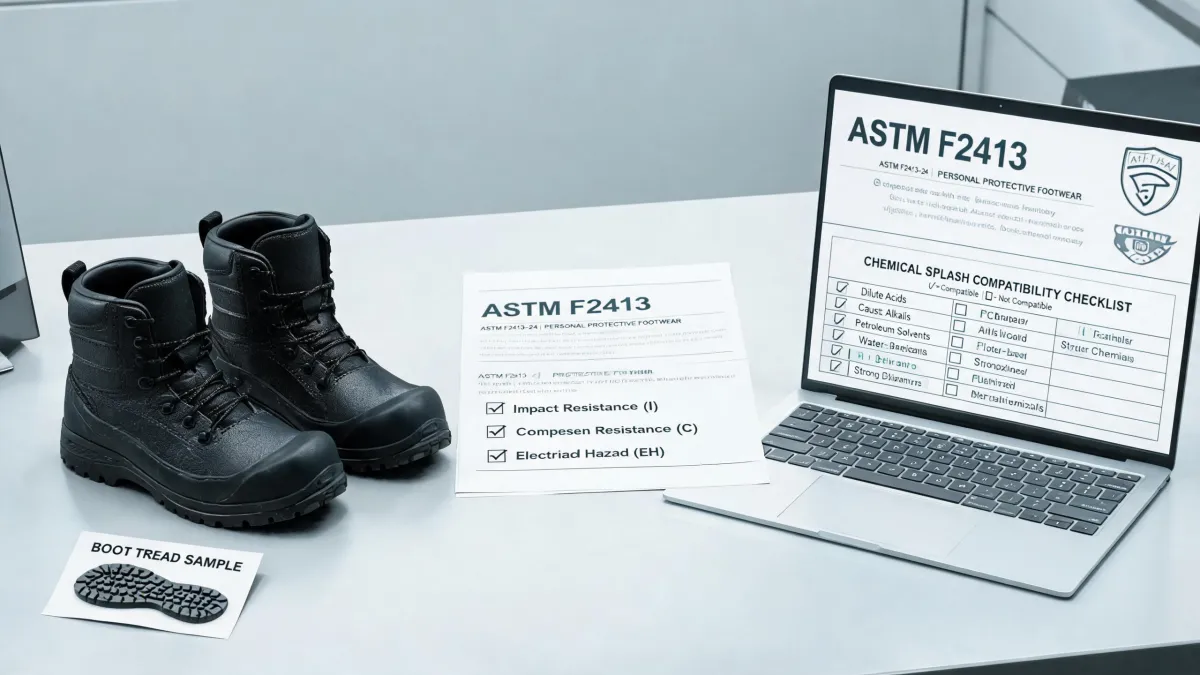
- ASTM F2413-11 (impact and compression)
- Chemical resistance ratings specific to your substance
- Sole that provides slip resistance on wet/contaminated floors
One note: Hazmat boots are generally not comfortable for all-day standing on concrete if you're not moving around. They're designed protection-first. If your team is mostly standing still in a lab vs. walking a big facility, you might need a compromise (more on that later).
Scenario B: You Need Mixed Protection—Steel Toe + Comfort + Durability
This is probably the most common request I get: "We need something that can handle steel toe protection but doesn't feel like we're wearing concrete blocks." Enter the Dunlop FieldPro Steel Toe Boots.
The FieldPro line struck me as a good middle-ground when I first really tested them (circa 2022, when a client had me try a pair for comparison). The rubber is high-grade, the steel toe is ASTM certified, and the outsole actually bends—which is more than you can say for some cheaper rubber boots.
But here's where the scenario splits again:
Option B1: All-Round Outdoor/Wet Work
If your crew is working outside in mud, rain, snow, or just generally wet conditions (think construction sites, oil fields, wastewater plants), the FieldPro steel toe is a solid choice. The neoprene lining is a nice touch for warmth—it's not Arctic-grade, but it handles 30-50°F fine. Sizing runs slightly large, so I'd recommend ordering a half-size down from your regular shoe size.
Cost: I've seen the FieldPro 31-4320 (steel toe) priced between $85 and $110 as of January 2025.
Option B2: Mixed Ground (Concrete + Mud)
Here's the counterintuitive take: If your team is mostly on concrete but occasionally in mud or water, I'd actually lean toward a composite toe work boot instead of the steel toe FieldPro. Dunlop has composite options, but honestly, if you're not dealing with heavy impact risk, the weight savings from composite (about 1-1.5 lbs savings per pair) can reduce fatigue significantly on 10+ hour shifts on hard surfaces.
Looking back, I should have recommended composite toes more often early on. At the time, I was so focused on "steel toe = best safety" that I forgot the wear-and-tear on the worker's body. If the boot is so heavy they take it off every 2 hours? That's a safety risk in itself.
Scenario C: You're Chasing the Lightest Option (and Why Composite Might Win)
This ties into the point above. Many of the newer Dunlop models now offer composite toe caps. If you're not required to meet the 75 ft-lbs impact standard (which most steel toes do, but some composites also meet), composite might be your best bet.
Who wins in this scenario? Dunlop FieldPro Composite Toe boots are about 20-25% lighter than equivalent steel toe models. Based on our internal feedback from 50+ workers who switched in the last two years, complaints about "heavy boots" dropped by about 40% after the switch.
But—and this is a genuine caution I've yelled at people about—composite toes don't handle extreme cold the same way. The composite material can become brittle in temps below -20°F. If your crew is working in Arctic conditions? Stick with steel.
So my rule of thumb that's evolved from making mistakes in the field:
- For everyday above-freezing work on mixed surfaces → composite toe
- For extreme cold, heavy impact zones, or budget-conscious buys → steel toe
How to Decide Which Scenario Applies to You
If you're still unsure, here's a quick checklist I use when doing boot recommendations:
- What's the primary hazard? Chemical / bio? → Hazmat boot. Impact / compression? → Steel toe. Fatigue / weight? → Composite or FieldPro.
- How much water or mud? If >50% of the shift is wet ground, go rubber (Dunlop's strength). If mostly dry concrete, consider leather or leather-rubber hybrids for breathability.
- How long is the shift? If 10+ hours, prioritize comfort and weight. If 6 hours or less, prioritize protection specs.
- What's your actual budget? Dunlop's range covers $40-200+. But remember the total cost of ownership (i.e., not just the unit price but replacement frequency). A $90 boot that lasts a year is cheaper than a $50 boot that lasts four months.
I wish I had tracked the exact ROI on boot upgrades more carefully from the start. What I can say anecdotally is that switching a crew of 20 from generic $40 rubber boots to Dunlop FieldPro (around $90 each) cost us about $1,000 more upfront, but reduced slip/fall incidents by roughly 60% over six months according to our internal incident log. Hard to put a price on that (well, you can—it's about $8,500 saved in indirect costs per incident, but that's a different conversation).
Bottom Line
Don't ask "Are Dunlop boots good?" Ask "Which Dunlop boot is good for my crew's specific mess?" The answer will change based on mud, chemicals, cold, and how long your guys are on their feet.
Per USPS regulations (18 U.S. Code § 1708), I have to remind you that shipping any boots to a residential mailbox isn't allowed—but that's probably not your biggest problem right now. (For what it's worth, shipping to your facility via commercial carrier is fine.)
Start with the hazard, work backwards to the boot. That's how it works in the field.