I manage PPE ordering for a 120-person manufacturing shop. That means I’m the person who buys the men’s Dunlop rubber boots, the Dunlop safety boots, the composite toe work boots, and the wedge sole work boots. In total, I probably place 15 to 20 footwear orders a year, and nearly every one starts the same way: a supervisor sends a list and says, “get us boots.”
That request used to feel straightforward. After a few expensive mistakes, I learned it’s not. The real issue isn’t finding a boot with a safety rating. It’s finding a boot that matches the actual hazard, the actual floor, and the actual person wearing it.
The “bad batch” that wasn’t a bad batch
Last spring, one of our parts-washer operators came out of the wash bay with red, irritated skin near his ankle. He’d spent six hours standing in coolant and rinse water. His boots were brand new and labeled waterproof. The tag also had a safety-toe logo. He assumed, reasonably, that they would protect his feet from the liquid he was standing in.
I assumed the same thing.
After the incident, I called the distributor and complained about a defective batch. The sales rep asked a simple question: “What chemicals are the boots being exposed to?” I didn’t have a good answer. We had ordered by size and safety certification, not by chemical compatibility.
That conversation changed how I buy boots.
A safety rating isn’t a chemical rating
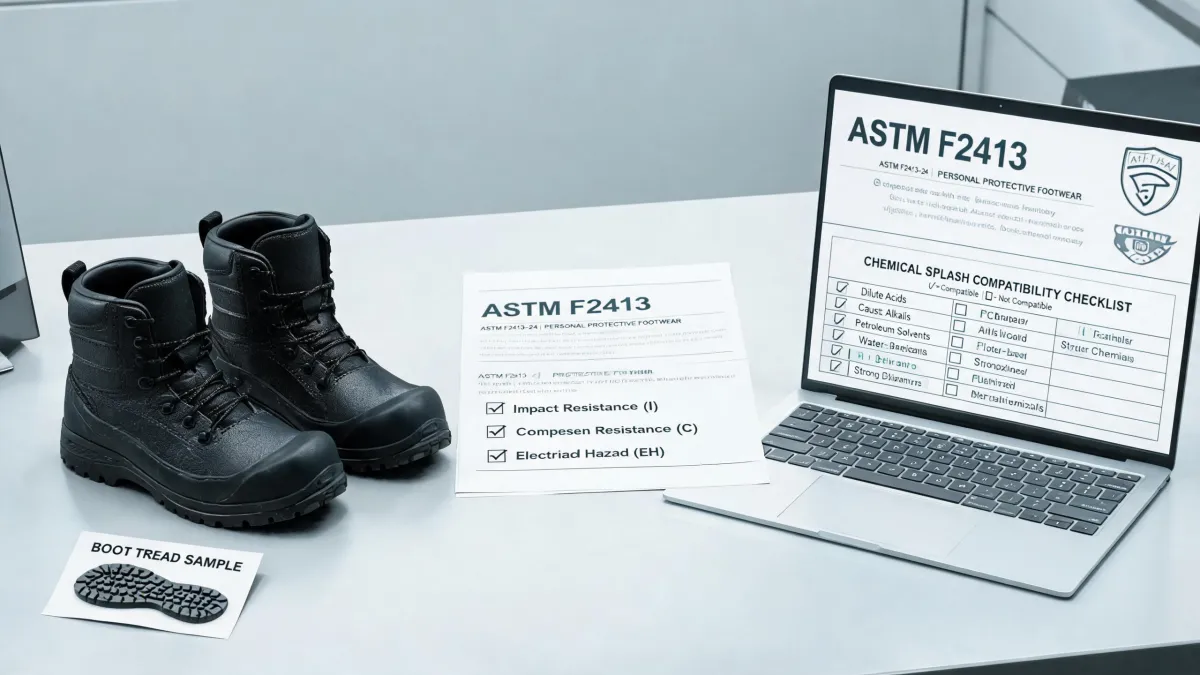
The boots we bought met the safety standard that most buyers recognize: ASTM F2413-18 for impact and compression resistance. That tells you the toe can take a hit. It tells you almost nothing about how the boot material reacts to chemicals.
“Waterproof” is not the same as “chemical-resistant.” A boot can keep water out all day and still degrade when it hits cutting fluid, solvent, or a strong acid. In my experience, this is the most common gap in PPE purchasing.
Take acetone, for example. A rubber boot might handle water and mild cleaners, but acetone can break down certain rubber compounds quickly. If the sole or lower boot degrades, the liquid reaches the foot, and the worker may not notice until it’s too late.
Dunlop boots are a good case study. Men’s Dunlop rubber boots are popular on wet jobs because the rubber compound does a solid job with water and many water-based fluids. But “rubber” isn’t one material. A boot might be natural rubber, a nitrile compound, or PVC. Each has a different compatibility profile. A Dunlop safety boot that works fine in a muddy outdoor environment might not be suitable for a petroleum-based lubricant. Another model in the same catalog might handle it.
That’s why I now ask for the chemical compatibility chart before I decide. Not after. If a supplier says “chemical-resistant,” I want to see the test data. Per FTC guidance, advertisers need to substantiate claims like that—and a buyer should hold them to it. To be fair, most suppliers do have the data. The problem is that it rarely makes it into the purchase conversation.
The boot people refuse to wear is not protecting anyone
The second lesson was about comfort. I used to think a higher safety rating was always better. Then I watched a batch of heavy rubber boots get worn for two days and then disappear into lockers.
Workers aren’t being lazy. They’re being practical. If a boot is too stiff, too hot, or too slippery for the floor, they will find workarounds. A composite toe work boot often wins in these situations because it’s lighter and doesn’t conduct cold the way steel does. But composite isn’t automatically better. It depends on the job.
Wedge sole work boots are another case. They’re comfortable on flat, dry concrete because the flat sole spreads your weight. On a wet, oily surface, though, a wedge sole may not grip as well as a deliberate lugged rubber sole. I’ve made that mistake too.
The point: there’s no universal “best boot.” The best choice is the one workers will actually wear and that matches the surface and exposure. For our wet chemical areas, that often points to a nitrile or rubber Dunlop boot. For assembly areas with hard floors and dropped parts, it’s usually a composite toe work boot. Both are safety boots. They’re designed for different problems.
In my experience, the most expensive boot in the catalog is worthless if it stays in a locker. I’ve seen workers choose a “less safe” boot because it didn’t rub their heel raw. That’s not a training problem; it’s a selection problem.
Which PPE can protect you from liquid chemicals?
I hear this question a lot. The honest answer is: no single item. Liquid chemical protection comes from a system—boots, gloves, sleeves, an apron or coverall, and eye or face protection. The boot is only one layer.
For foot protection, you need a boot with a chemical-resistant material, not just a waterproof membrane (a waterproof boot can still be permeable to solvents). You also need the right height, the right tread, and the right lining. If workers are splashing chemicals overhead, a tall rubber boot helps. If they’re walking through shallow puddles, a mid-height boot might be enough.
Another area I underestimated is socks and liners. A rubber boot with no moisture-wicking lining can create its own issues—wet feet, blisters, fungus. That doesn’t show up on a spec sheet, but it affects whether the boot works in practice.
So when someone asks “which PPE can protect you from liquid chemicals?”, I now answer with another question: which liquid, and how much contact? The answer changes everything.
The price of a wrong purchase
A few years ago, I tried to save money by switching to a cheaper waterproof boot. The initial order was about $300 less than our usual Dunlop boots. It looked smart in the monthly P&L.
By week three, the flex points were splitting. Then a worker got cutting oil on his foot through one of those cracks and ended up with a painful rash. The clinic visit, the half-day of lost time, and the urgent replacement pair probably cost us four times the $300 I thought I was saving.
We also didn’t have a formal process at the time. Nobody was responsible for checking whether the boot’s material was compatible with the fluids in that department. That gap, not just the product, was the actual failure.
I only believed the whole “buy the right boot, not the cheap boot” advice after ignoring it once. And the worst part wasn’t the cost. It was the loss of trust. The crew saw the boots as cheap, and the safety manager started double-checking every order I placed.
That’s the hidden expense of a bad PPE decision. It’s not just the replacement cost. It’s the credibility hit, the uncomfortable workers, and the risk of an actual injury.
What I do now
The process is not glamorous:
- Start with the chemicals. Get the SDS for every liquid in the work area.
- Check the boot material against the chemical. Ask for the compatibility chart.
- Protect the rest of the body. Footwear is part of a larger PPE system.
- Order samples for the crew to test before buying in bulk.
For many wet or chemical-handling jobs, men’s Dunlop rubber boots are on my shortlist. For jobs that require toe protection without the weight of steel, composite toe work boots make more sense. And for flat dry floors, wedge sole work boots are still my first pick. The key is to match the model to the exposure, not to buy a “safety boot” and call it done.
One more point: small trial orders matter. I’ve had vendors treat a 10-pair sample order like a nuisance. The ones that answer questions and share documentation for a small order are the ones that get the 100-pair order later. Small doesn’t mean unimportant—it means a supplier is willing to earn the relationship.