The email landed at 7:41 AM on a Thursday. Subject line: "RE: Boots—quick question." The body was one sentence, asking whether our "chemical-resistant" rubber boots were supposed to start cracking at the toe crease after eight weeks.
I knew before I opened the photo attachment that the answer was no.
That email started a chain of events that ended with us re-supplying 228 pairs of boots at our own expense, rewriting our entire footwear spec process, and learning more about rubber compounding than I ever expected to need. This is that story. If you're responsible for buying or specifying safety footwear, I want you to learn it cheaper than we did.
How the Order Started
I'm a quality compliance manager for an industrial supply distributor. I review every piece of PPE that goes through our warehouse—roughly 200+ unique items annually—before it reaches customers. Steel toe boots, insulated coveralls, safety glasses, welding gear, chemical-resistant gloves. If it has a North American safety standard attached to it, it crosses my desk at some point.
About 14 months before that email, a regional chemical processing plant—I'll call them Meridian—came to us with a straightforward request. Their maintenance and process floor crews needed new rubber boots for a wet processing area. They sent over their hazard assessment: standing water, periodic chemical splash from dilute acid baths, wet concrete floors, and the occasional dropped hand tool. Standard stuff for that industry, nothing that seemed out of the ordinary.
Their safety manager also mentioned that most of the crew already wore Carhartt coveralls insulated in winter, and the boots needed to work with that layering without being too bulky around the calf. Noted.
The spec was clear enough: rubber boots, waterproof, steel toe protection, slip-resistant sole. I wrote it up and started the vendor evaluation.
The Choice: Spreadsheet vs. Gut
Three options made it to the comparison list.
First was a Dunlop rubber boots steel toe model—a classic work boot with a reinforced toe cap and a reputation for holding up in wet environments. Dunlop has been making rubber footwear for over a century, and their industrial line has a strong presence in the North American market. Price came in at $67 per pair.
Second was an import brand that I won't name, at $42 per pair—roughly 35% cheaper. Their spec sheet claimed ASTM F2413-18 impact and compression protection, chemical-resistant rubber, and a slip-resistant outsole. On paper, it hit every line we'd put in the request for quote.
Third was an Ariat composite toe boot—lighter, leather-and-composite construction, positioned for dry warehouse environments. It was actually being evaluated for a separate client, but I kept it in the comparison because our safety managers ask about composite options.
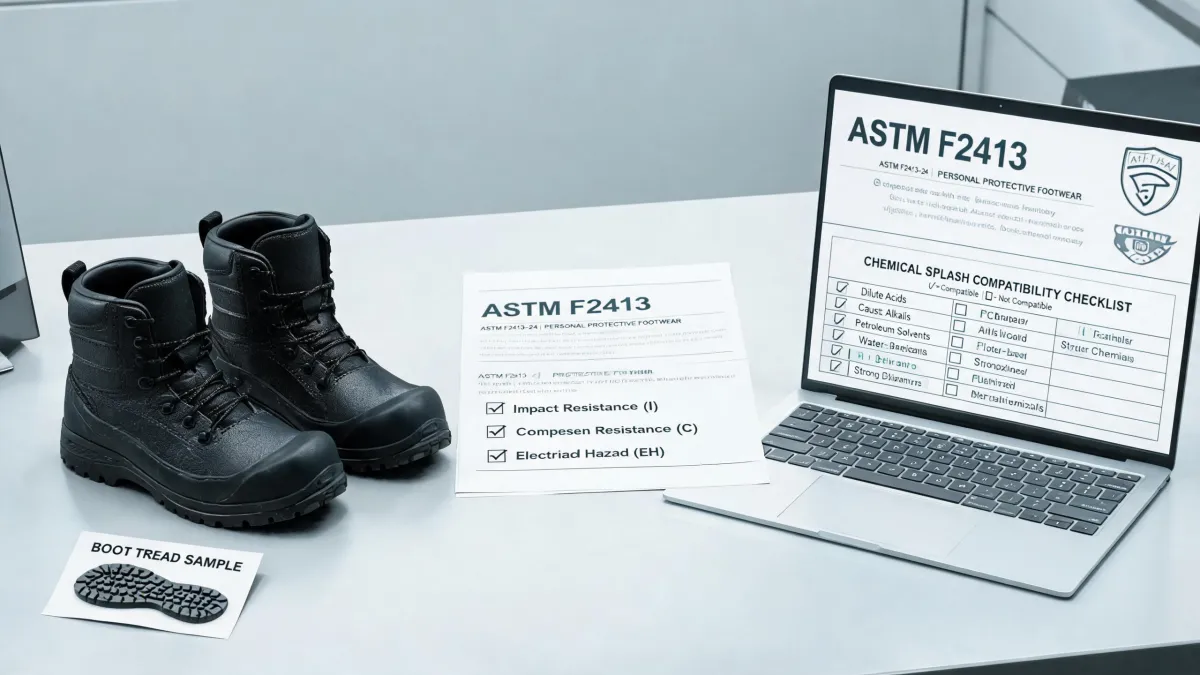
At this point, I should clarify something about how safety certification works. ASTM F2413-18 is the standard that governs impact and compression protection for protective footwear—well, it also covers puncture resistance, but the impact and compression ratings are the ones that matter for this story. When a boot passes that standard, it gets rated for impact (I) and compression (C). That's what a "steel toe" designation refers to: the toe cap's ability to withstand a 75-pound impact and 2,500-pound compression without failing.
OSHA 29 CFR 1910.136 is the regulation behind all of this. It requires employers to make sure workers wear protective footwear when there's a risk of injury from falling objects, chemical splashes, electrical hazards, or sharp objects. But the regulation points to the standards—it doesn't tell you which boot to pick. And here's the part I underestimated at the time: ASTM F2413-18 says nothing about chemical resistance. Not a word. It's a physical protection standard.
The chemical-resistance claim on that import spec sheet was based on the manufacturer's own testing—and I didn't dig into the test parameters nearly carefully enough. The spreadsheet favored the import brand. The savings on a 228-pair order came to about $5,700. My gut had a nagging feeling about their chemical resistance data (it was right, in hindsight). It was a single acid concentration, tested at room temperature, with no exposure time documented. I raised the concern in our review meeting.
We shipped the import boots anyway. Not because anyone was cutting corners intentionally. We shipped them because the timeline was tight, because the price looked good to the client, and because I didn't push hard enough on a data sheet I didn't fully trust. I told myself we were being efficient. What we were actually being was impatient.
Eight Weeks Later
The photo attachment showed the problem clearly. The toe crease of the boot had developed a deep crack where the rubber flexes during walking. The material around it had turned soft and almost spongy. That's what chemical degradation looks like. The acid vapors in the process area had partially dissolved the polymer structure of the boot.
I visited the plant the next week. In the process area, I counted boots that were already delaminating at the seams. The maintenance director didn't yell. He just showed me the extent of the damage and asked a fair question:
"How do we get boots that actually work in this environment?"
That question hit differently. My job is supposed to prevent exactly this. I wrote the spec. I approved the product. I was responsible for choosing chemical resistance claims over chemical resistance evidence.
A lot of numbers got thrown around in the weeks that followed. The invoice total: $24,000 for replacement boots plus expedited shipping to get them on-site before the plant's next maintenance cycle. That's the number I remember—or rather, the one I can't forget. Every time I think about the $5,700 we initially "saved," I have to multiply it by four.
Actually Doing the Homework
For the replacement order, we went back to the Dunlop boots with the steel toe spec. But this time, I didn't stop at the product page. I requested the full technical documentation from the manufacturer and read all of it.
Here's what I learned. Rubber boots are not one product. The polymer compound, the number of layers, the seam construction, and the liner type all affect how the boot behaves in chemical environments. A compound that handles one acid fine might soften in the presence of a different chemical. Heat and concentration change everything. Real chemical resistance data has to include the specific chemical, concentration, exposure time, and temperature. All four variables. Not just "tested against acid."
We also looked at the full Dunlop industrial lineup rather than just the steel toe model. For Meridian's low-impact areas—no dropped-tool hazard, but still wet floors and chemical splash—we specified the Dunlop Chesapeake men's rubber boots plain toe version. Why pay for a steel toe cap where you don't need one? The plain toe is lighter, flexes more naturally through the metatarsal, and costs less. Those workers needed chemical protection and waterproofing, and the Chesapeake covered both.
For the dry warehouse crews at Meridian, we went with the Ariat composite toe boots we'd been evaluating. Composite toe protection meets the same ASTM F2413-18 impact standards, and the lighter weight suits workers who spend shifts walking on concrete. The leather construction handled the dry environment better than full rubber.
The lesson I keep coming back to: a "safety boot" is not one thing. It's a set of properties—impact protection, chemical compatibility, slip resistance, electrical hazard rating, thermal insulation—that have to be matched against the actual hazards of the workplace. It's tempting to think that if you check the steel toe box, you're done. But the steel toe is just one layer of the protection story. At Meridian, it wasn't even the most important one.
From the outside, the import boots and the Dunlop boots looked nearly identical—black rubber, a toe cap, similar tread pattern. The reality was in the compounding data we hadn't read. That's the part you can't see in a product photo.
The Same Lesson, in Another Category
A few months later, the same principle showed up with eye protection. We were kitting out a construction client's maintenance crew, and the buyer had swapped the spec from safety goggles to safety glasses to lower the per-unit cost. When I caught it, the buyer asked what the difference was—they both carried Z87.1 markings on the lens.
The difference is the protection profile. Safety glasses vs safety goggles: they're not interchangeable. Safety glasses protect against impacts and flying debris, but they don't seal around the eyes. Safety goggles form a sealed barrier, which protects against liquid splashes and fine particles that can get around the edges of glasses. ANSI/ISEA Z87.1 covers both categories, but it doesn't tell you when to use which. The hazard assessment does. That client was spraying concrete sealers and working with solvents—splash territory. Glasses would not have cut it. We caught that one before it shipped (thankfully).
What Changed Afterward
Meridian got their Dunlop boots. The crews reported back a few weeks later that the difference was noticeable—no more stiff toe creases, no swampy feet at the end of a shift, and the boots were holding up against the chemical exposure. The maintenance director sent a one-line follow-up: "These are better. Thanks." No exclamation point. Honestly, I was just relieved.
Since then, we've restructured how we spec PPE across the board. Every new footwear SKU has to pass a three-stage approval process before it goes into our catalog:
- First, we read the actual test reports, not the summary sheets.
- Second, we map the product's protection profile against at least three known client hazard assessments. If it doesn't clearly match at least one, it doesn't qualify.
- Third, we run a 30-day wear test with at least ten workers, then review comfort, durability, and any visible degradation.
The process takes more time upfront. But it cut our footwear return rate from about 8% to under 1.5%, which saves us more in re-supply costs and client trust than it costs in coordination. That was the counterintuitive part of the whole experience. I used to think efficiency meant moving fast. Now I know it means asking the right questions before moving at all. Standardized verification turned out to be the most efficient thing we've adopted in years—it just didn't look that way at first.
If You're Buying Safety Boots
Here's the honest version of what I'd tell anyone specifying footwear for an industrial team:
- Ask what exactly the certification covers. A steel toe boot meeting ASTM F2413-18 tells you about impact and compression. It tells you nothing about chemicals, heat, or slip resistance. Ask what else the boot was tested against, and request the actual lab report.
- Write down the actual hazards at your site—the specific ones, not the generic list. Then match each hazard to a boot property. If you can't match a hazard to a property, you're guessing. And your crew deserves better than a guess.
- Look for vendors that make verification easy. We've standardized on Dunlop for wet and chemical environments because their industrial line documents protection data across models—from the steel toe rubber boot for impact areas to the Chesapeake plain toe for lighter duty. The Ariat composite line covers our dry-environment clients. The brands that make it easy to verify specs end up on our approved list.
And if you hear the words "chemical-resistant" without a chemical list, a concentration, a temperature, and a test method attached, ask for the evidence before you buy.
That email—the "quick question" about cracking boots—was a turning point for me. The 228 pairs we replaced cost us money and credibility with a client we cared about. Credibility is a lot harder to re-order than boots. Keep your process tight, ask the uncomfortable questions, and don't let a spreadsheet savings override what your gut is telling you.