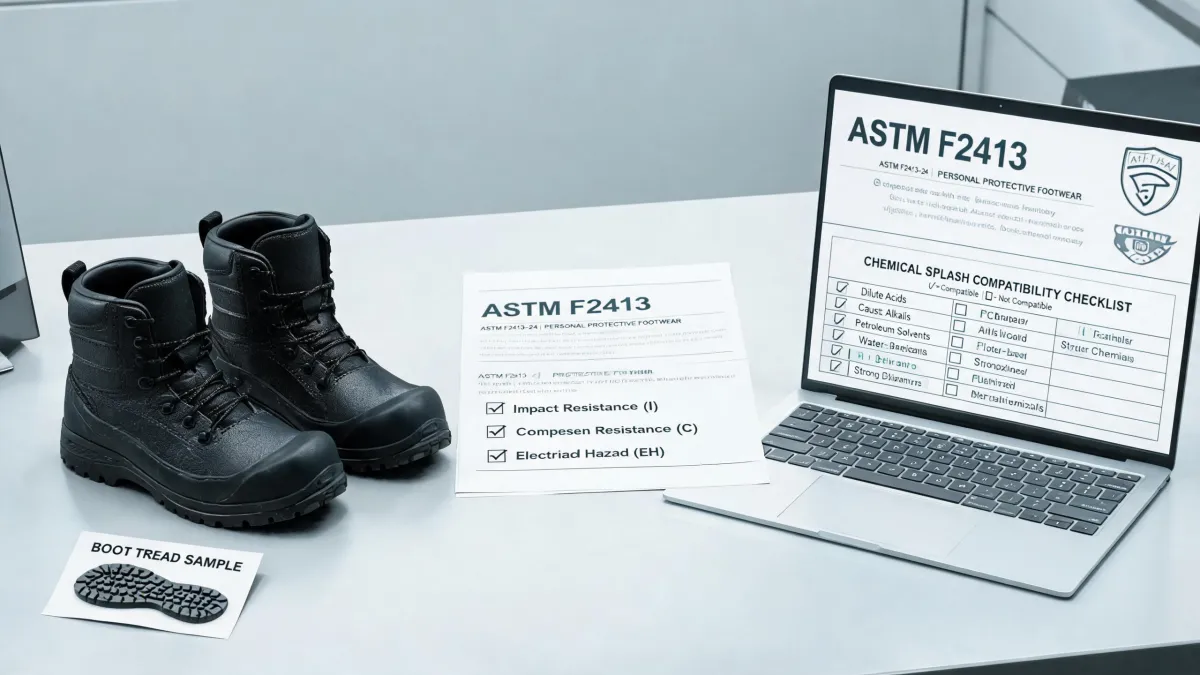
Here's the thing about safety boots that most articles won't tell you: there's no single 'best' option. What works for a warehouse worker could be dangerous on a hazmat site. And what a construction foreman swears by might fail completely in a chemical plant.
I learned this the hard way. In my role coordinating PPE for a mid-sized industrial contractor, I've seen what happens when teams buy boots based on price alone—or worse, based on what's trending on social media.
So let's break this down by actual job scenarios. Because your feet deserve better than a one-size-fits-all recommendation.
Scenario 1: The Chemical Exposure Risk
If you're working around solvents, acids, or hazardous materials (the kind you'd find in a hazmat suit scenario), your boot choice isn't just about comfort—it's about survival.
The common mistake: People think 'waterproof' equals 'chemical resistant.' It doesn't. Standard waterproof boots (like many Dunlop rubber boots) protect against water, but they can degrade when exposed to certain chemicals.
What actually works: Dunlop chemical resistant boots are specifically designed for this. They use a different rubber compound that resists degradation from oils, acids, and solvents. Is this overkill for a construction site? Absolutely. Is it essential for a hazmat environment? Non-negotiable.
(Note to self: verify the specific chemical resistance chart before recommending to a client. That matters more than brand name.)
When you're standing in a puddle of unknown liquid, you don't want to wonder if your boots can handle it. You want to know.
Scenario 2: The Heavy Impact Zone
Warehouses, construction sites, manufacturing floors—these are places where falling objects are a real risk. This is where steel toe boots (or composite toe) come into play.
Popular options that might not fit: Dr. Martens steel toe boots have a loyal following. They look good, they feel solid. But here's the issue I've seen: their toe box design doesn't fit everyone. If you have wide feet (and many tradespeople do), the fit can be problematic after 8 hours.
Alternative to consider: Carhartt steel toe boots often offer a roomier fit, especially in the 'work' line vs their 'lifestyle' line. But—and this is important—Carhartt boots tend to run heavy. If you're on your feet all day, that extra weight compounds.
My experience: Everything I'd read about safety boot comfort said to prioritize cushioning. In practice, for our crew, what mattered more was arch support and ankle stability. A boot that fits correctly with good arch support outperforms the thickest insole every time.
Scenario 3: The All-Day Walking / Standing
Distribution centers, retail stockrooms, those 'walk 15 miles a day' jobs. Your priority isn't impact protection (though steel toe is often required)—it's fatigue reduction.
What I'd recommend: Look for safety boots Dunlop or similar brands that combine steel toe protection with lighter materials. The newer composite toe options are worth the extra cost if your workplace allows them (they're not always accepted on heavy construction sites).
The mistake I made: We didn't have a formal boot evaluation process. Cost us when we ordered 50 pairs of a mid-range boot that looked good on paper but caused blisters by day 2. The crew hated them. That's when I created a 2-week trial program.
Oh, and one more thing: how to lace work boots matters more than you think. Proper lacing can prevent heel slip, reduce pressure points, and keep your foot from sliding forward (which crushes your toes against the steel cap). If you've never learned proper lacing techniques, look it up. It's a game-changer for long shifts.
How to Judge Which Scenario You're In
Here's a quick decision framework based on what I've learned from handling (I want to say hundreds of boot orders, but don't quote me on the exact number):
- Ask what's on the floor. Are you walking on concrete, gravel, or chemicals? That determines sole material and chemical resistance needs.
- Check the weight limit. OSHA or your site safety officer will have minimum requirements for impact and compression. Steel toe is not optional where falling loads are present.
- Consider your foot shape. If you've ever had blisters from any shoe, you need to try on multiple brands. Don't order blind.
- Don't trust a single review. The guy who loves his Dr. Martens steel toe boots might have a completely different foot shape and job than you.
The fundamentals of foot protection haven't changed: keep your feet safe from impact, punctures, and chemicals. But the execution has transformed. Materials are lighter, designs are more ergonomic, and there are options for almost every niche. What was best practice in 2020 (heavy leather boots that take months to break in) may not apply in 2025.
Your move: figure out your primary risk, match it to the right boot category, and then try at least two options before buying. Your feet will thank you.