When I took over purchasing in 2020, one of the first things I learned is that nothing—nothing—causes more arguing than safety boots.
I'm an office administrator for a mid-size company, about 400 employees across three locations. I manage 60-80 orders a year, covering everything from printer toner to PPE. Roughly $80,000 a year flows through my desk, and I report to both operations and finance. So I see both sides of every boot purchase: the crew wants comfort, finance wants savings.
At least once a month, someone requests "steel toe shoes" and links to something that looks like a gym shoe with a reinforced toe. The Nike steel toe shoes come up a lot. They look sharp. They seem comfortable. And honestly? For some jobs, they're completely fine. For others, they're the wrong tool.
I'm not here to knock Nike—that's not the point. The point is bigger: we treat "steel toe" like a single product category. It's not. And that mistake has cost us time, money, and a few close calls.
Steel toe is a rating, not a product
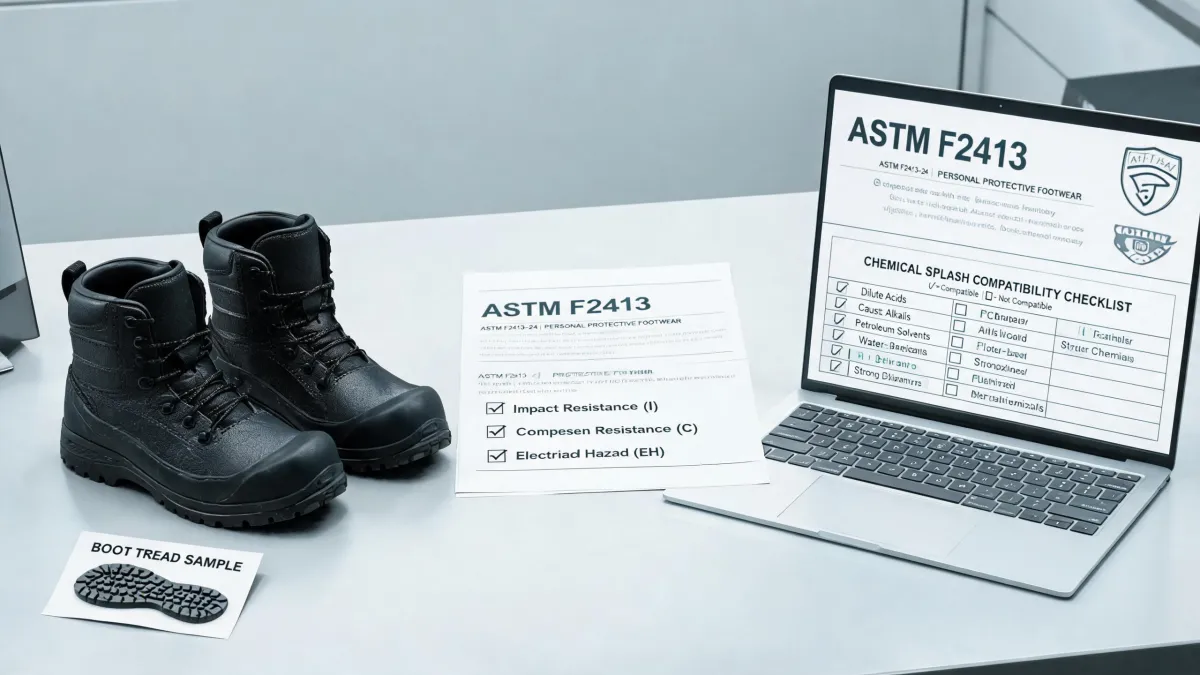
The safety footwear standard most US employers rely on is ASTM F2413-18. It covers several distinct types of protection:
- Impact resistance (I)
- Compression resistance (C)
- Metatarsal protection (Mt)
- Electrical hazard protection (EH)
- Puncture resistance (PR)
- Static dissipative (SD)
These are separate ratings. A boot can pass impact and compression and still be useless against chemicals, punctures, or electrical current. When I started, I didn't get this. I'd buy whatever the crew requested as long as the box said "safety toe."
Then two things happened. A worker slipped on a wet ramp with a smooth-soled steel toe shoe and sprained his ankle. And another guy's "all-purpose" boots started breaking down after two months of contact with diluted chemicals in a washdown area. No one had checked whether the boots were actually rated for the environment.
That was my wake-up call.
The real problem isn't steel toe—it's hazard mismatch
Here's the pattern I kept seeing: people request what they want—comfort, style, brand—but what they need is something that matches the conditions of their specific job. Those two things are often not the same.
In our operation, we have two main work environments:
Indoor mechanical work. Dry floors, heavy parts, people on their feet 10 hours a day. Here, a breathable leather work boot with a steel or composite toe is the right call. Comfort matters, and a sneaker-style steel toe shoe can actually work for some roles.
Outdoor maintenance. Wet ground, oil film on concrete, occasional chemical contact. This is where a leather boot is the wrong tool. Leather soaks up moisture, breaks down fast, and turns into an odor factory. You need a waterproof boot with the right outsole and, if there's chemical exposure, the right material. This is where the Dunlop Safety on Site steel toe cap safety boots came in for us. They're not fashion statements, but the rubber holds up in wet conditions, and the sole grip is solid on slick surfaces. For the washdown areas, we switched to Dunlop chemical resistant boots, which handle diluted cleaning agents without breaking down.
Here's what took me too long to accept: there is no "best boot." There's only the right boot for the right hazard. A brand that tries to do everything usually does something mediocre.
The stink problem is a buying problem
I noticed a lot of searches for "how to make work boots not stink" when I was researching this topic. I've been there. Those searches led me to the same internet listicle you've seen: baking soda, vinegar spray, freezer bags. I tried several of those tricks before I realized something.
Boots stink because of trapped moisture. That's not a foot problem. That's a boot problem—and a buying problem.
Two things cause it:
- Wrong material for the environment. Leather absorbs sweat and rainwater. If it doesn't dry overnight, bacteria multiply. In wet work environments, a "breathable" boot isn't breathable—it's a sponge.
- No rotation. Wearing the same pair every single day means they never fully dry. Even the best boot needs 24 hours to air out.
The fix isn't a cleaning routine. It's buying the right boot in the first place, and having two pairs in rotation so they can dry. Budgeting for boot rotation is annoying to explain to finance, but it's cheaper than replacing boots twice a year because the old ones are unsalvageable and stinking up the locker room.
I don't have hard data on this, but after we switched to material-appropriate boots and added a second pair per person, the odor complaints in our company dropped dramatically. Five years of anecdotal evidence is worth mentioning.
What a wrong boot costs
Let's talk money, because that's what actually gets management's attention.
OSHA's foot protection standard (29 CFR 1910.136) requires us to provide protective footwear when there's a risk of foot injury from falling objects, punctures, or electrical hazards. But note: it says the footwear must be appropriate for the working conditions. It's not "give them a steel toe and call it a day."
The slip I mentioned earlier cost us about $3,200 in workers' comp and overtime coverage. The boot that would have prevented it cost $20 more per pair. That's a $3,200 lesson.
Now multiply that out. Industry sources consistently put the cost of a serious foot injury—a fracture, a puncture wound—well into five figures once medical bills, lost time, and replacement training are factored in. I'm not going to quote a specific number I'm not 100% sure about, but the magnitude is what matters: a fleet of wrong boots is nowhere near as expensive as one right-sized injury.
There's also an invisible cost: compliance. If boots are uncomfortable, stink, or fall apart early, the crew stops wearing them. That's a safety violation waiting to happen, but more importantly, it's a person standing in a hazardous area with inadequate protection.
How I buy boots now
My process today looks nothing like it did in 2020.
- Walk the floor first. I talk to crew leads and observe the actual conditions—wet floors, sharp edges, live wiring, whatever is there. I write it down.
- Match the hazard to the rating. Each environment gets its own boot spec. Wet/chemical? Waterproof rubber or PVC, possibly with a steel toe. Dry/heavy assembly? Leather or synthetic, breathable steel toe. Electrical risk? EH-rated. Puncture risk? PR-rated.
- Buy by zone, not by person. We keep a small matrix of approved boots instead of a single universal SKU. Early on, I tried to make it a one-SKU world. I went back and forth on that decision for weeks. Simpler for me, cheaper per pair. It was a disaster. The warehouse crew found the rubber boots too hot; the maintenance crew found the leather boots too wet. One boot can't do two completely different jobs.
- Then negotiate price. Price only matters once the spec is right. Buying a cheaper boot that doesn't match the hazard isn't savings—it's deferred cost.
One caveat: this works for us because we're a mid-size operation with predictable zones. If you're running a much larger facility with diverse hazards, your matrix will need more granularity. The thought process is the same, but your spreadsheets will be scarier.
On the brand question: I'm not loyal for the sake of loyalty. Dunlop has earned the wet-work and chemical-resistant parts of our program because their rubber boots have been consistently reliable for years, and their Safety on Site line covers the steel toe cap requirements we need. But if another manufacturer can match the spec and quality, I'll switch without hesitation. The hazard isn't brand-specific.
Bottom line
Steel toe is the starting line, not the finish line.
If you're buying men's work boots for a crew—or for yourself—stop asking "does it have a steel toe?" and start asking:
- What am I walking on and in?
- What's overhead that could fall?
- What could splash, soak, or pierce?
- Does the boot have the specific rating for that risk?
- Do I have a second pair so these can dry out?
Do that, and you'll spend less money on replacements, fewer hours dealing with complaints, and you'll never have to Google "how to make work boots not stink" again.