After six years and about $180,000 in tracked safety purchases, I can tell you where the waste is hiding. It isn't in the gear that costs more. It's in the gear that fails too soon. A pair of Dunlop steel toe boots at $65 that lasts 18 months costs about $0.12 per workday. A $40 boot that breaks down in 6 months costs $0.22 per workday. The cheapest safety gear is almost never the most cost-effective choice. Here's what I've learned from buying boots, glasses, and harnesses for a living.
Trust me on this one: I do not write about equipment I haven't tracked on a spreadsheet. I manage procurement for a 140-person manufacturing company. Our safety budget runs about $60,000 a year, and I've documented every order, return, and failure in our cost tracking system. This is the short version of a six-year audit.
Why Dunlop boots keep ending up on our purchase orders
Dunlop boots aren't flashy. They don't try to be fashion boots. They do rubber and basic hazard protection well. That matters more than you'd think.
From the outside, all rubber boots look like rubber boots. The reality is that the rubber compound matters. Cheap rubber cracks in cold weather, gets eaten by oils, or goes stiff after a few months. Dunlop rubber boots have held up on our plant floor in conditions that killed other pairs in weeks.
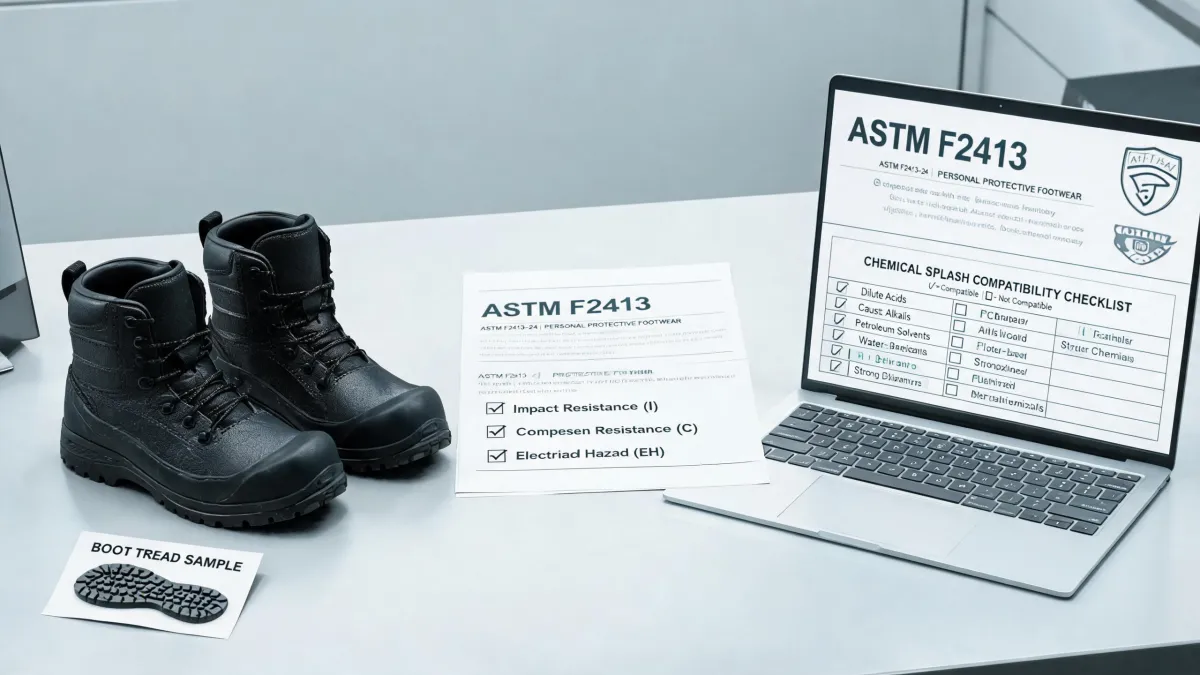
If you need steel toe protection, look for the ASTM F2413-18 mark on the boot. Most Dunlop steel toe models carry it, but check the actual stamp. If you deal with chemicals, the Dunlop Hazmat line is the one I spec. If you need extra top-of-foot protection, look at the metatarsal styles. Don't guess.
One practical note: Dunlop boots run snug. I order a half size up for employees who wear thick work socks. A boot that pinches is a boot that ends up in a locker. And employees who are not wearing their boots are not protected. That's a cost problem, not a comfort problem.
The hidden costs I track before buying any safety shoe
A few years ago, I compared two safety shoe vendors. Vendor A quoted a lower price per boot. Vendor B quoted about 8 percent more but included free shipping and free return labels. I almost went with Vendor A because the unit price looked better on the initial quote. That 'cheaper' option would have cost us more once I added shipping, return handling, and the time spent on two wrong-size exchanges.
Since then, I've learned to ask a simple question before asking the price: 'What's NOT included?' A vendor who lists all fees upfront, even when the total looks higher, usually ends up costing less. The sticker price is not the total cost. The total cost includes shipping, returns, downtime, employee discomfort, and early failure.
The same logic applies to where you buy. Zappos and Amazon safety shoe listings can work well, but only when I know the exact model and size. If you already know a specific Dunlop boot style fits, these channels are convenient. If you're trying a new model, buy one pair first. Have the employee wear it for a couple of shifts. Then order the rest. That two-week test has saved me from a lot of bad bulk orders.
Early on, I ignored my gut and bought a cheaper brand because the numbers looked good. My gut said the construction was weak. The first six-week failure proved it. In hindsight, I should have followed the rule I use now: test before you trust.
My four-step check before a bulk order
I use the same checklist before any large PPE order:
- Match the hazard first. For boots, that means checking the ASTM rating. For lab safety glasses, that means ANSI Z87.1. For a no-pull harness, that means checking the front clip and the intended use.
- Test on one person. I never order 20 pairs of an untested model. One trial pair for three days on the actual floor tells me more than any spec sheet.
- Calculate real cost per day. Add shipping, returns, and an honest guess at lifespan. Compare that to the cheapest option, not the sticker price.
- Check the return policy. If the vendor charges for return labels, I account for that. The lower price might be a trap.
The most expensive gear is rarely the most expensive line item on a purchase order. It's the item that didn't get worn because it fit badly, failed early, or was bought without checking the standard.
Lab safety glasses: stop overcomplicating it
For lab safety glasses, the most expensive pair is not the safest pair. The first thing to check is the ANSI Z87.1 mark. A $6 pair that meets the standard and stays on the face is more protective than a $30 pair that slips every time you look down.
In our lab, we switched to lighter frames with an anti-fog coating. Compliance went up because people didn't feel like they were wearing cheap goggles. If your employees take their glasses off, they aren't protected. That's a behavioral cost you cannot solve by spending more on branding. Anti-fog is worth the small upcharge if people move between warm and cold areas. It stops the cycle of taking glasses off to wipe them, which is exactly when lab accidents happen.
How does a no pull harness work?
This one confuses a lot of buyers, including me the first time I ordered one for our site K9 team. So let's answer it clearly. A no pull harness works by changing the leverage point. It attaches the leash at the chest, not the back. When the dog pulls forward, the tension rotates the dog's front quarters to the side. Pulling becomes physically awkward, so the dog learns to walk loosely.
The mechanism is clever because it doesn't rely on pain or intimidation. It just breaks the opposition reflex. When you buy one, check the front clip. That part takes the most force, so it should be metal or high-strength plastic. Extra padding is nice for long shifts, but it's not what makes the harness work. The front clip is the feature that matters.
The boundary cases where I still pay more
There are cases where buying online doesn't make sense. If you need same-day boots because an employee's pair failed right before a shift, no online order will help. That's when you call a local safety supply house. It'll cost more per pair, but the total cost is lower because someone is wearing a certified boot today instead of a sneaker.
Had 3 days to replace a batch of wet-floor boots before a safety audit. Normally I'd run a two-week trial, but there was no time. I used the exact model we had already tested through our usual supplier. It was more expensive than an online order, but it was the right call.
Don't buy a boot style solely for the brand name either. Dunlop makes good boots, but not every Dunlop model fits every job. Check the safety markings, test the fit, and calculate the cost per day. No safety product is a guarantee. The right equipment still has to be worn, maintained, and replaced when it's damaged.
If your people won't wear the gear, all the spec sheets in the world won't help. Buy with them, not for them. That's the final line in my cost tracking system.