If you've landed here searching for "dunlop boots," you're probably not wondering whether they're good. The question I get—from coworkers and other buyers—is always the same: which Dunlop boot should I get? The honest answer is that it depends on what your crew actually steps in, kicks, and walks through on a given day. There's no single universal model.
A bit of context: I'm the office administrator for a 150-person industrial services company. I manage all PPE and safety supply ordering—roughly $120,000 a year split across six vendors. I report to both operations and finance, so I feel the pressure from both sides: stay compliant, stay on budget, and keep the crews from complaining.
When I took over purchasing in 2022, everything I'd read about industrial buying said to standardize. One boot model, one helmet model, one supplier. Simpler inventory, better volume pricing, fewer decisions. In practice, standardization backfired for my team. I bought boots that didn't match the hazards on the ground, and the mismatches cost us more in the long run—in reordering, in workers swapping boots, and in a couple of uncomfortable conversations with safety. That's when I started treating boot selection like a decision tree instead of a one-size-fits-all answer.
First, ask: what's the primary hazard?
Dunlop makes a broad range of work boots—rubber wellingtons, steel toe models, hazmat-rated options, insulated versions. But they all exist to solve one of three threat categories:
- Water, mud, or slick surfaces? You need a rubber boot with a proper slip-resistant outsole.
- Chemical or hazardous material exposure? You need a chemical-rated boot, not just any waterproof boot.
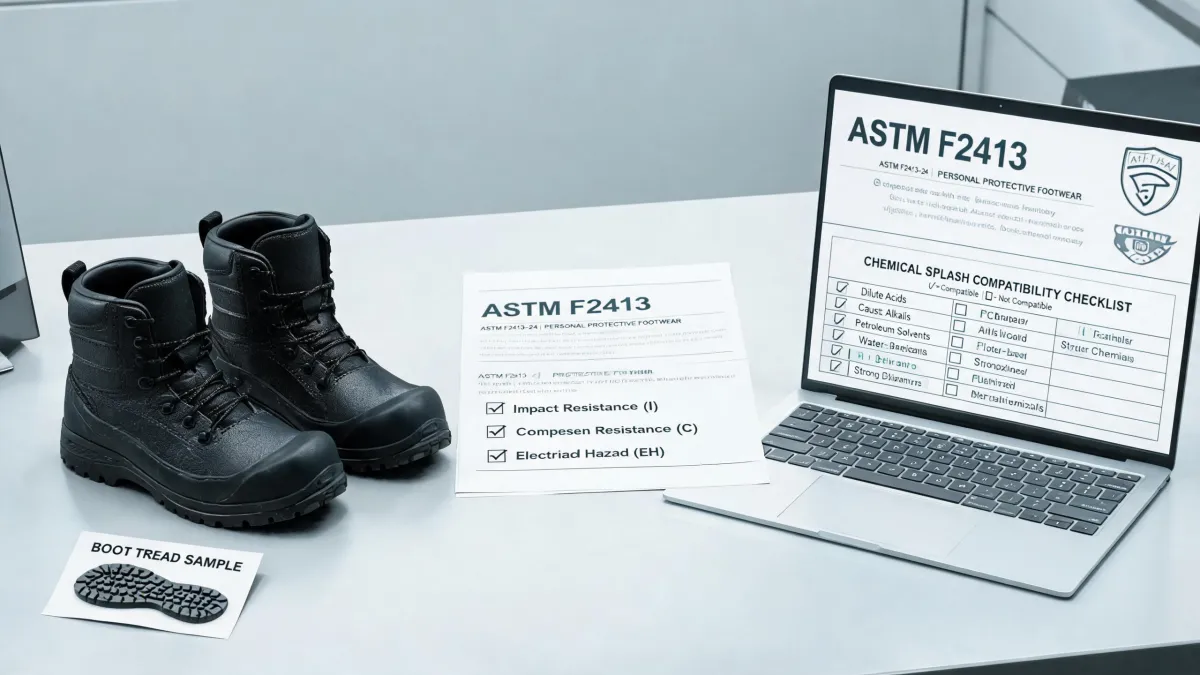
- Impact or compression hazards? You need a certified steel toe boot that meets ASTM F2413.
These aren't mutually exclusive. In my experience, around half the orders I place are mixed—some crew members need steel toe, some need hazmat, some just need solid waterproof boots. Matching the boot to the task is the whole game.
Scenario A: Wet, muddy, or slick environments
If your crew works outdoors in wet weather, in wash-down areas, around mud, or on floors that turn dangerous when wet, your priority is a genuine rubber boot with serious tread. This is Dunlop's strongest territory. The rubber compound and outsole design on their work boots have outperformed the alternatives we tried, especially on slick concrete and wet grass.
When people search for "non slip work boots," this is really what they mean. Here's what I've learned:
- Tread depth beats tread pattern. Shallow "fashion" treads clog up in mud and lose grip fast. Deep, self-cleaning lugs shed mud as you walk and hold up much better.
- Slip resistance can be tested—there's a standard, ASTM F2913, that measures whole-shoe slip performance. But lab results don't always match your actual floor conditions. Buy a sample pair and test them on site before committing to a bulk order.
- Watch the "waterproof" wording. A rubber boot is waterproof by construction. A "waterproof leather" boot is a different product with different limits. For genuinely wet work, go rubber.
Dunlop's Purofort line and Premium wellingtons are the models I've ordered most for this scenario. The Purofort noticeably lighter, which makes a big difference on a 10-hour shift.
Scenario B: Chemical or hazmat exposure
If you're searching "dunlop hazmat boots for sale," you probably already know what you're dealing with—spill response, chemical plant work, solvent exposure, cleanup duties. This is the scenario where I made my most expensive mistake.
I knew I should have revisited the hazard assessment when a work process changed. But I thought, "I've been ordering the same boot for two years, what are the odds?" The odds caught up with me. A worker in a processing area stepped into a puddle of dilute acid while wearing boots that weren't rated for chemical exposure. The boots held up that day, luckily. The safety manager was less forgiving, and she was right to be.
What I took away from that incident:
- There's no single "chemical resistant" rating that covers everything. Boot materials handle different chemical families differently. You have to check the specific chemicals on your site against the manufacturer's compatibility data.
- Ask the distributor for permeation test results. Real chemical-rated boots come with documented testing (methods like ASTM F739). If a vendor can't produce test data, don't trust the label.
- Steel toe is not chemical protection. Some steel toe boots have seams and overlays that trap contaminants and make decontamination harder. Hazmat situations call for a boot built as a barrier, with sealed construction and easy decontamination—not just a metal toe cap.
Dunlop's hazmat line is built for exactly this. They're not flashy, but they work. I keep them in stock for spill response teams and anyone whose task list includes chemical exposure.
Scenario C: Impact and compression hazards
"Dunlop rubber steel toe boots" is a search phrase I've typed out myself, and it's one of the most common ways people find this topic. Construction, warehouses, equipment yards—anywhere something heavy can drop or roll—that's where you need a certified toe cap.
The relevant US standard is ASTM F2413, which replaced the older F2412/F2413 system. It covers impact resistance (I/75 means the toe cap survived a 75 lb impact) and compression resistance (C/75 for compression loads), plus optional extras like metatarsal protection (MT), electrical hazard resistance (EH), and static dissipation (SD).
One simple rule: if the boot doesn't have the rating printed on the tongue or inside the shaft, it's not certified. I got burned by a distributor once who described a boot as "steel toe style." That word "style" was doing a lot of work. Since then, I check markings on every batch.
Now here's the contrarian piece: steel toe isn't always the right answer.
- Workers on ladders or around live equipment need the EH rating. Not every steel toe boot has it. Always confirm the complete rating instead of assuming.
- Steel conducts cold. For cold-weather work, an insulated boot or composite toe may serve crews better—Dunlop has both options.
- If rolling objects are the main risk, a plain steel toe boot misses the real threat. You may need metatarsal protection or a boot with lateral support. Check the hazard assessment rather than defaulting to the most protective-looking toe cap.
For yard and field crews with mixed risks, I usually order steel toe work boots from Dunlop's work line. The combination of rubber waterproofing and certified toe protection covers the widest range of hazards, which is what most of our crews need.
Bonus decision: safety helmet vs hard hat
If this is your first year buying PPE, you'll eventually face this question, so here's the breakdown. People use "hard hat" and "safety helmet" interchangeably, but they're different products with different test requirements.
Under ANSI/ISEA Z89.1-2019:
- Type I hard hats are tested for impact and penetration from above—things falling straight down onto the top of the head.
- Type II safety helmets are tested for lateral impact too. Side blows, like hitting your head on a beam or equipment edge, are a major factor in serious head injuries.
Type I is fine for typical construction and facility work. Type II is the safer call for work at height, boom lifts, confined spaces, and anywhere lateral impact is a real risk. There's also electrical class to consider: Class E (up to 20,000 volts), Class G (up to 2,200 volts), and Class C (no electrical protection).
The reason I know this? A consultant warned me to verify ANSI types before ordering. I nodded, then bought Type I hard hats for a crew doing elevated work that needed Type II. The ops manager caught it before anyone wore them out, but I ate the return shipping and the embarrassment. These lessons hurt less when they're someone else's.
How to figure out your scenario
If you're not sure which scenario applies, here's how I'd approach it:
- Read the hazard assessment. OSHA requires one for PPE selection. If you don't have it, that's the first problem. If you do, recheck whether anything has changed since it was written—new chemicals, new equipment, new tasks. That's the exact step I skipped.
- Walk the floor and talk to the crew. Spec sheets don't tell you the floor is always wet by mid-afternoon or the acid pump drips on the night shift. Workers know. Ask.
- Buy for the highest-hazard task within each role. If a worker has mixed duties, the higher-risk task drives the boot choice.
- Test one pair before ordering 50. Sizing runs differently between boot models—one of our technicians wears a 10 in one Dunlop model and an 11 in another. I don't fully understand why; best guess is differences in the last shape. But a sample pair tells you more than any spec sheet.
While we're on compliance—and because this topic lives on the same desk—check your fire extinguisher inspection tags while you're at it. NFPA 10 requires a monthly visual check and an annual maintenance by a certified technician. A lot of facility managers assume the landlord handles it; many leases don't. If your tags are expired, search for "fire extinguisher service near me" rather than guessing at local companies, and verify their license before booking them.
One more vendor tip: make sure your distributor can produce itemized, compliant invoicing. I once ordered hazmat boots from a reseller with great pricing and lousy paperwork. Finance rejected the invoice because it wasn't itemized, and I spent a week chasing documentation. The "cheaper" option ended up costing more in processing time than it saved.
Bottom line
Getting the right boot the first time isn't just a compliance box to check—it's the most efficient way to buy. When I stopped forcing a single standard and started matching boots to hazards, our reorder costs went down and worker complaints dropped. Efficiency in purchasing isn't about shrinking your inventory to one option. It's about not buying the same thing twice.
A quick cost note, since someone always asks: as of Q4 2024, I was seeing Dunlop rubber boots range from about $120 to $200 per pair depending on the line and configuration, and hazmat models run higher. Supply chain costs have been shifting, so get current quotes before you build a budget around those numbers.
If you're new to buying PPE, start small. Order samples, talk to your crew, and confirm what the hazards actually require before you place a big order. And if you're still unsure which Dunlop boot to choose, go back to the hazard assessment. The answer is in the hazards, not in a product review.