I'll say it straight: buying the most certified, most expensive safety boots on the market is not the same as buying the right ones. I learned that the hard way after a purchase order for 47 pairs of steel toe boots got rejected at the site gate — not because the boots were bad, but because they met the wrong standard.
That mistake cost us $4,200 in returns, a week of downtime, and a very awkward call with our client's safety officer. Since then, I've built a pre-purchase checklist that's caught 23 potential spec mismatches in the past two years. I'm sharing it because I know I'm not the only one who's been burned by assuming "safety boot" means the same thing everywhere.
What I Got Wrong About Safety Footwear
When I first started handling PPE procurement for industrial sites back in 2018, I assumed the certification logo meant universal compliance. If it said "steel toe" and had a CE mark, it was good to go. Right?
Wrong. That's not how it works at all.
What I didn't understand was that safety boots get certified for specific hazards. A boot that passes impact resistance testing might completely fail on electrical insulation requirements. A waterproof rubber boot designed for chemical splash protection might have zero puncture resistance. They're different tools for different jobs — and a single site can require multiple boot types depending on the work area.
Check #1: Match the Certification to the Actual Hazard
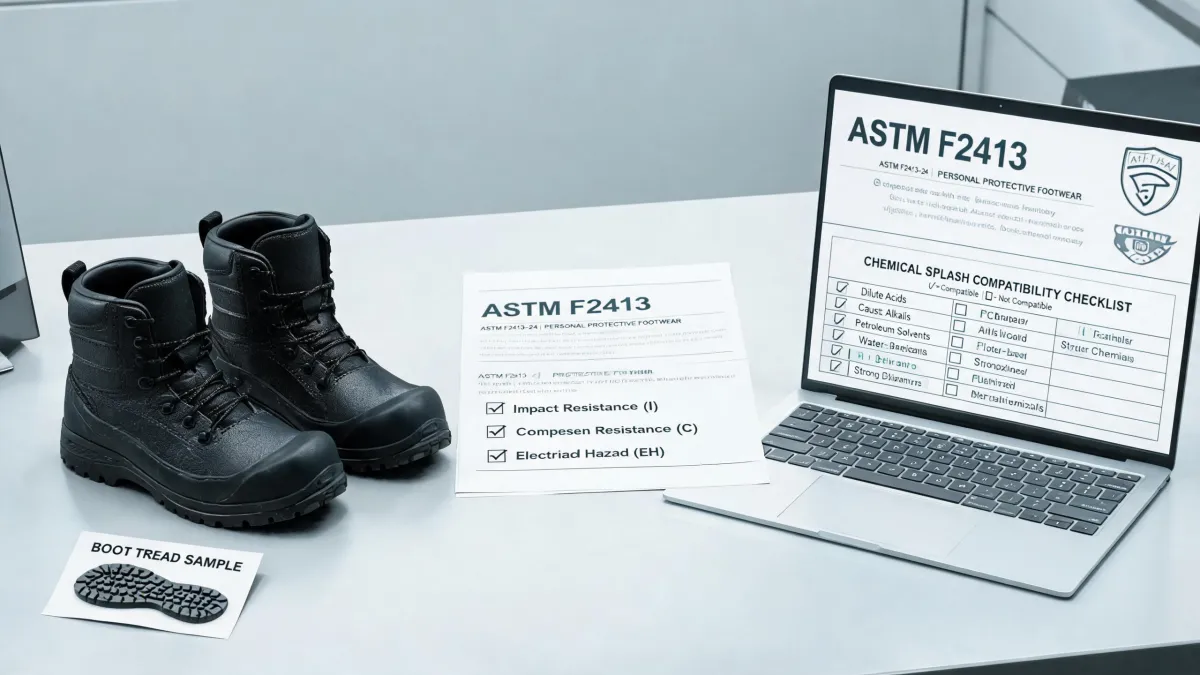
ASTM F2413 is the standard most US industrial sites reference for protective footwear. It covers impact resistance (I), compression resistance (C), metatarsal protection (Mt), electrical hazard (EH), puncture resistance (PR), and static dissipative (SD) properties. But here's the thing — a boot doesn't automatically have all of them just because it says ASTM F2413.
Each boot is certified for specific combinations. I've seen steel toe boots that were rated for impact and compression but had no electrical hazard rating at all. On a site where electricians were working, those would have been a hard fail.
So now I ask a simple question before ordering: what's the actual hazard in the area where these boots will be worn? If it's a rubber boot for chemical handling, I'm looking for chemical resistance ratings and slip resistance. If it's for electrical work, I need to see the EH rating explicitly listed. If it's general construction, impact and puncture resistance are usually the priorities.
The Dunlop range, for example, includes models specifically designed for different hazard profiles — their Hazmat boots are built for chemical exposure, while their steel toe lines focus on impact and compression. Same brand, very different applications. I've stopped assuming one model covers all needs.
Check #2: Don't Ignore Fit and Fatigue
This one took me longer to appreciate. I used to think boots were boots — as long as they passed certification, comfort was a secondary concern. Then we had a crew working 12-hour shifts in rubber boots that were technically compliant but brutally uncomfortable. Two guys developed foot issues within a month. One actually went home early on a critical pour day because he couldn't stand in them anymore.
That's when I realized: compliance doesn't matter if the boots don't get worn.
Now I look at a few practical things before recommending any model:
- Weight per boot — heavier boots (like some metatarsal guards) protect better but cause faster fatigue. For long shifts, that trade-off matters.
- Break-in period — rubber boots typically need less break-in than leather, but the wrong size creates hot spots that never go away.
- Sole tread pattern — deep lugs for mud and uneven terrain, flatter soles for concrete. I've seen slip-and-fall incidents that were directly tied to the wrong tread for the surface.
I even started ordering one test pair before placing a full order. Sounds like overkill until you've had to return 22 pairs because everyone's size was off by a half-size from what the spec sheet suggested.
Check #3: Factor in the Full Replacement Cycle
Here's a number that surprised me: cheap boots can cost more than expensive ones over a project timeline. Not because of quality — because of replacement frequency.
We ran a small comparison on a six-month project. The "budget" rubber boots at $45 a pair needed replacing every 8-10 weeks under heavy use. The better-constructed Dunlop rubber boots at roughly $110 a pair lasted the full six months with minimal wear. That's $270 in replacements versus $110 for one purchase. Same certification, different longevity.
And that's before you factor in the time cost — someone has to process the replacement order, the worker has to break in new boots again, and during the gap between failure and replacement someone might be wearing non-compliant footwear. I've seen that happen. It's not worth it.
"Bottom line: the cheapest compliant boot is rarely the lowest total cost. I now calculate cost-per-month-of-wear before making any recommendation."
Even for rubber boots used in wet environments — where you'd think durability is straightforward — the difference between a $50 pair and a $120 pair often comes down to whether the sole separates from the upper after 200 hours or 800 hours. That's not a brand thing. It's a construction thing. Look for reinforced heel and toe junctions if you're buying for heavy use.
What About Those "What If" Worries?
I still second-guess myself sometimes. There are moments when I wonder if I'm overthinking the certification side and underthinking the human side. What if a worker simply won't wear the $180 hazmat boot because it feels clunky, and the $80 rubber boot that's "good enough" for 90% of tasks is actually the better choice for that person?
That's a real tension. My approach now is to involve the crew in the selection when possible. I'll narrow it down to two or three compliant options, then let the people who'll actually wear them try them on. The boot that gets worn consistently — even if it's the cheaper one — beats the perfect spec sheet every time.
But here's where I hold the line: if the hazard requires a specific protection (like electrical insulation or chemical resistance), that's non-negotiable. Comfort matters up to the point where it compromises safety. After that, it doesn't matter how comfortable the boot is — if it doesn't meet the requirement, it's not coming on site.
The Checklist That Actually Works
After all the mistakes — the rejected order, the complaint about metatarsal boots being too heavy, the rubber boots that split at the seam after three months — I've boiled it down to four questions before any safety boot order goes out:
- What specific hazards are we protecting against? (Get this in writing from the site safety plan.)
- Does this exact boot model carry the certification for those hazards? (Check the spec sheet, not the marketing page.)
- Will people actually wear this for the full shift? (Order a test pair if you're unsure.)
- What's the cost per month of expected wear? (Not just the sticker price.)
It's not a perfect system. I still get surprised sometimes — like the time a "waterproof" boot wasn't waterproof enough for a flooded trench situation. But using this checklist, I've cut our spec-mismatch errors from about one in five orders to almost zero. That's worth the extra 15 minutes per purchase.
And honestly? I'd rather spend 15 minutes checking certifications than another week explaining to a client why their crew was turned away at the gate.