March 2023: The Order That Looked Fine
In March 2023, I submitted a $4,800 PPE order for our chemical processing team. 37 pairs of steel-toe boots. 120 pairs of safety glasses. A few cases of gloves. I hit submit on a Friday afternoon and went home feeling efficient.
I've been handling PPE orders for a mid-size chemical processor for six years. I've personally made (and documented) 11 significant mistakes, totaling roughly $18,400 in wasted budget. Now I maintain our team's checklist to prevent others from repeating my errors.
We run a mid-size plant. Corrosive acids, caustics, occasional solvents. Not a refinery. Not a lab. In between. Our safety manager had been asking for a standardized PPE kit for months. I volunteered. How hard could it be?
The Sourcing Spree
I started where most buyers start: Zappos, Amazon, and a few safety supply sites. I compared dunlop work boots, under armour tactical boots, and generic steel-toe shoes. The Dunlop rubber boots looked practical. The Under Armour tactical boots looked tough. I ordered a mix.
I bought safety glasses. I thought safety glasses vs safety goggles was a marketing distinction. It is not. Safety glasses protect against impact. Goggles seal against splashes. Our team handles acids. We needed goggles. ANSI/ISEA Z87.1-2020 draws a clear line between spectacles and goggles. I ignored it.
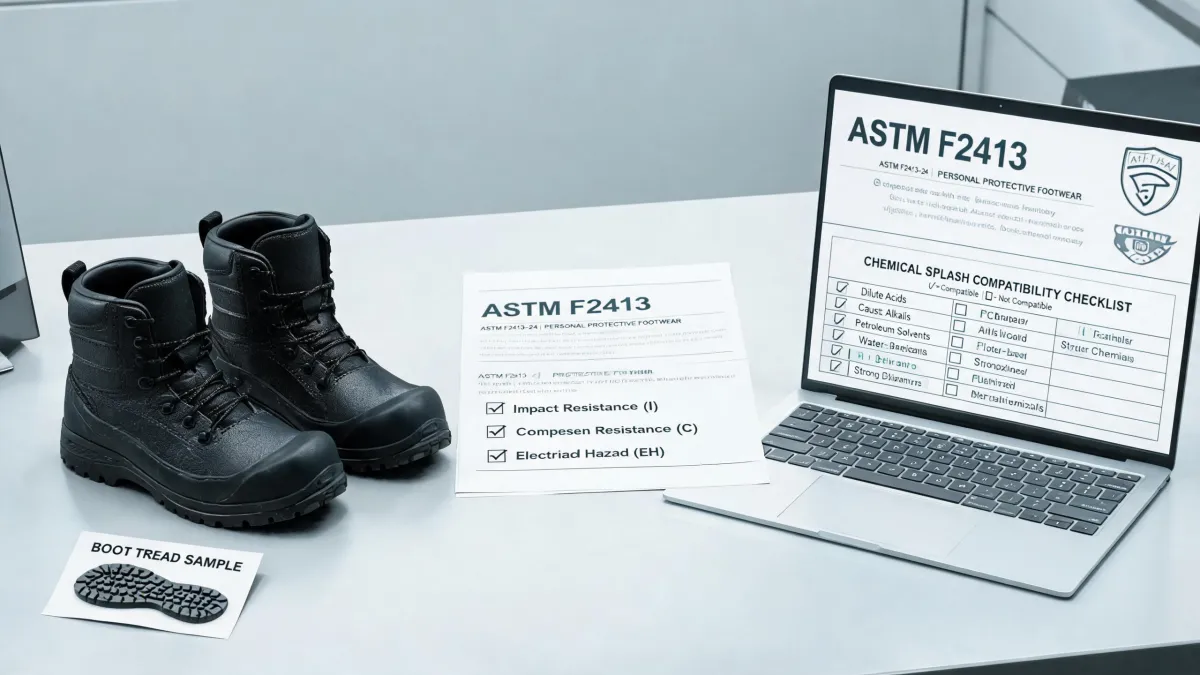
I ordered steel-toe boots that met ASTM F2413-18 for impact and compression. Good. But our hazmat team needed chemical resistance. ASTM F2413 does not cover chemical permeation. EN 13832 does. I did not check. The boots were fine for construction. Wrong for acid splash.
I also missed the electrical hazard rating on two models. We have a maintenance crew that works near energized equipment. OSHA 29 CFR 1910.136 requires protective footwear where there is a danger of foot injuries. It points to ASTM F2413 or equivalent. I had the standard. I did not read the ratings.
September 2023: The Audit
The audit happened in September 2023. The safety manager walked the floor with a clipboard. She stopped at the hazmat storage area. Looked at the boots. Looked at the glasses. Then she looked at me. 'These are not splash-rated.'
The $4,800 order was dead. We had a two-week delay and a rush reorder.
That error cost $4,800 in unusable stock plus a 2-week delay. The rush reorder added $1,100 in expedited shipping. Credibility damaged. Lesson learned.
People think expensive boots are safer. Actually, certified boots can charge more because they have paid for testing. The causation runs the other way. Certification does not guarantee quality, but lack of certification is a red flag.
What I Did Next
I called a Dunlop distributor. Not because I am loyal to a logo. Because they had the certifications on the spec sheet. We ordered dunlop rubber boots for the hazmat team: steel toe, chemical-resistant, sealed. We ordered insulated dunlop work boots for the winter maintenance crew. For the splash zones, we switched from safety glasses to sealed goggles. For impact-only areas, safety glasses stayed.
Why did this happen? Because I treated PPE like office supplies. Convenience beat verification. To be fair, the Amazon listing was convenient. But convenience is not compliance.
Switching to a pre-check list cut our PPE turnaround from 5 days to 2 days. The automated process eliminated the data entry errors we used to have. Efficiency is competitiveness. But efficiency without verification is just speed in the wrong direction.
This worked for us, but our situation was a mid-size chemical processor with routine corrosive exposures. Your mileage may vary if you are in construction with impact risks instead of splash risks. I can only speak to domestic operations. If you are dealing with international logistics, there are probably factors I am not aware of.
The Checklist I Use Now
Three things: toe protection, chemical resistance, electrical hazard rating. In that order.
- Check the standard, not the brand. ASTM F2413-18 for toe impact and compression. EN ISO 20345:2022 for safety footwear. EN 13832 for chemical protection. NFPA 1991 for vapor-protective ensembles, when applicable.
- Match the eye protection to the hazard. Safety glasses vs safety goggles is not a style choice. It is a splash-versus-impact decision. ANSI/ISEA Z87.1-2020 is the reference.
- Verify the channel. Zappos and Amazon safety shoes can work, but verify the seller and the certification paperwork. A listing photo is not a spec sheet.
- Do not buy tactical boots for chemical work just because they look tough. Under Armour tactical boots have their place. That place is not an acid splash zone.
- Build a one-page pre-check. It is not glamorous. It is cheaper than another $4,800 mistake.
Now I keep that checklist taped to my monitor. Toe protection. Chemical resistance. Electrical hazard. Splash versus impact. Certification numbers. Simple. Done.