-
What does Portwest actually do as a company?
-
Are their safety helmets worth standardizing on across a site?
-
Which Portwest safety shoes should our people be wearing?
-
Leather gloves for men—what's the real difference versus synthetic?
-
Are bifocal safety glasses a gimmick or a legitimate need?
-
How should our company-issued work boots actually be washed?
-
Why does the cheapest compliant PPE sometimes cost us more over a year?
I'm the office administrator for a 400-person company—facilities plus field crews, spread across three sites. I manage roughly $420,000 a year in ordering across eight vendors, and I report to both operations and finance. So when I say "we're looking at a few Portwest items" or "we need to standardize how our crews wash their boots," that's coming from someone who deals with quotes, invoices, and employee complaints all day, not someone reading from a catalog.
Here are the questions I actually ask before placing a bulk order. No fluff, no hard sell. Should take you about 12 minutes.
- What does Portwest actually do as a company?
- Are their safety helmets worth standardizing on across a site?
- Which Portwest safety shoes should our people be wearing?
- Leather gloves for men—what's the real difference versus synthetic?
- Are bifocal safety glasses a gimmick or a legitimate need?
- How should our company-issued work boots actually be washed?
- Why does the cheapest compliant PPE sometimes cost us more over a year?
What does Portwest actually do as a company?
They're an Irish-founded, UK-headquartered PPE manufacturer with global distribution—public product catalogs list coverage of 130+ countries as of January 2025. Translation for a buyer: they're not a specialty manufacturer, they're a one-stop shop. Helmets, safety glasses, gloves, hi-vis, coveralls, boots, rainwear, welding gear, FR garments. That breadth is the whole point.
We buy from a regional distributor that also carries two competing brands, so we have a fair comparison at the same counter. Portwest's pricing sits in the middle—not the cheapest, not the premium tier. What's made them our primary is the invoice and compliance documentation. Every product line ships with the relevant ANSI or EN documentation without us having to chase it down. Finance flags anything without a current spec sheet, so that matters here.
To be fair, they're not going to win on niche items. For a specific high-heat welding PPE or a custom-molded boot, we still look elsewhere. But for the 80% of routine gear, they cover it.
Are their safety helmets worth standardizing on across a site?
Depends on which helmet. For general industrial work, the ANSI Z89.1 Type I, Class E (electrical, up to 20kV) is the standard our insurance carrier asks us to verify. Portwest's standard hard hat line meets that. Full-brim for outdoor sun, cap-style for indoor work. Adjustable suspension and a four-point chin strap are non-negotiable for us—I've watched enough crews lose helmets to a wind gust to know that.
One thing I didn't fully appreciate until 2024: replacement cycles. Manufacturer guidance is typically 2-3 years in normal service, or immediately after any significant impact. We ran a site audit in March 2024 and found helmets in use that were stamped from 2019. Employees had been wearing them since they were issued and never said anything about a dropped helmet. The number on the shell told the story.
Now our buying policy includes a mandatory replacement schedule. Helmets are ordered on a three-year rolling cycle regardless of visible damage. Bulk pricing runs roughly $18-35 per unit depending on style (January 2025 quotes from our regional distributor; verify current pricing).
Which Portwest safety shoes should our people be wearing?
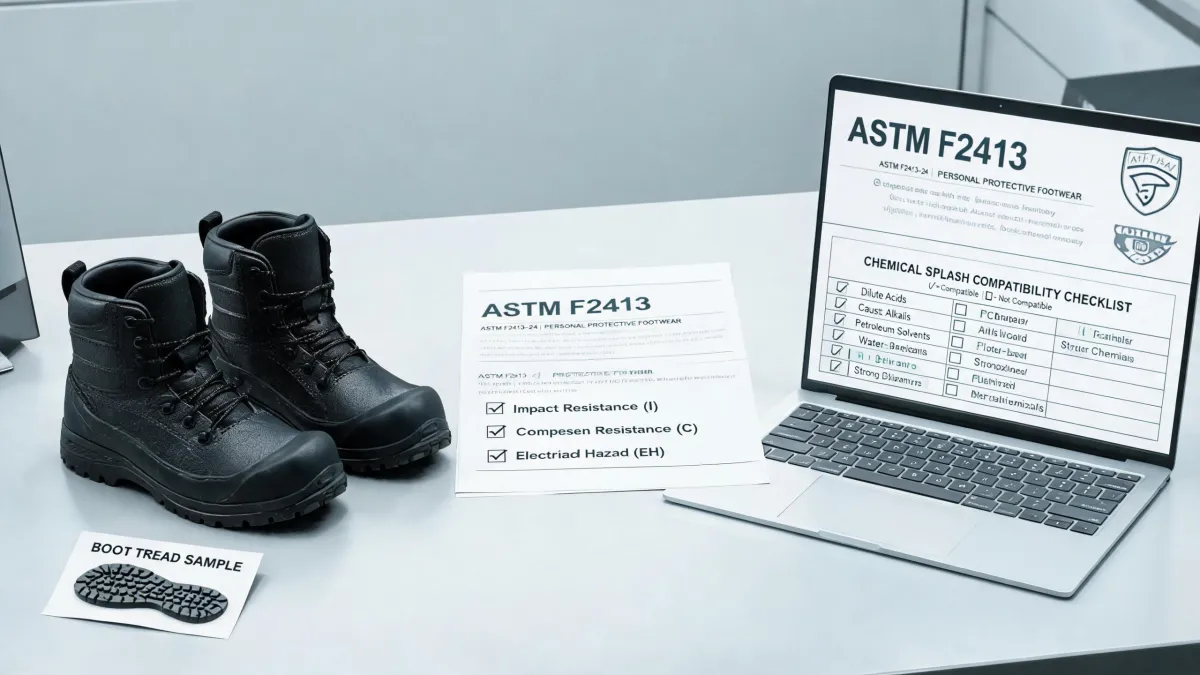
Match the certification to the hazard, not to what looks good on a spec sheet. Our site crews need EN ISO 20345 S3 (penetration resistance, anti-static, energy absorption, water resistance) or ASTM F2413 I/75 C/75. Portwest's SR and S3 lines cover that. Indoor warehouse teams can use lower-tier SB-class only if there's no penetration risk—and most warehouses do have it when pallets are involved.
The bigger issue is fit. When I consolidated our shoe program in 2023, I made the classic specification error: I assumed one shoe model would fit everyone the same. It doesn't. Different foot shapes blow out different zones of the boot in different ways. Our return rate on the first bulk order was 11%.
What worked: switching to a fit-first model where employees try on in person at a local distributor before we place the volume order. Return rate dropped to under 3%. The lesson is basic and it cost me a few months—if the crew won't wear it, the compliance paperwork means nothing.
Bulk pricing runs $75-140 per pair depending on tier (January 2025 quotes; verify current).
Leather gloves for men—what's the real difference versus synthetic?
Leather gloves for men are usually referring to full-grain or split-grain cowhide, pigskin, or goat leather work gloves. Pigskin is generally more breathable and supple; cowhide is more durable for abrasion. Leather handles general material handling, has good grip when dry, and softens with use. It also stiffens when soaked and doesn't hold up to oil or chemical exposure.
Synthetic—nitrile-coated, PU-coated, cut-resistant—is cheaper per pair, washable, and better for chemical or food contact. For cut resistance specifically, leather alone is inadequate.
Here's the rookie mistake I made: I ordered a unified glove program, all leather, for warehouse plus packaging. Within six weeks, the packaging line was asking for something washable. Leather was fine for moving pallets and shipping. It wasn't fine for anything with sanitation requirements. If I'd asked two crews what their hands actually touch in a day, I'd have avoided the whole issue and a $600 reorder.
Our current split: leather for material handling and yard work, nitrile for packaging and food-adjacent, cut-resistant for any blade handling. Pricing for men's leather work gloves runs roughly $3-12 per pair depending on grain and reinforcements (January 2025 quotes; verify).
Are bifocal safety glasses a gimmick or a legitimate need?
Legitimate need—if you're buying for anyone over 45 who reads close-up at work. The ANSI/ISEA Z87.1-2020 standard governs the frame and lens impact resistance. Bifocal safety glasses put a magnification segment at the lower part of the lens, typically +1.5 to +3.0 diopters, so the wearer can inspect parts or read gauges without swapping to reading glasses. Not a gimmick. It's reading glasses that meet impact standards.
Where we got burned: our first supplier only stocked +1.5 and +2.0. Four of our shop-floor employees needed +2.5 and +3.0. We had a six-week fulfillment gap while the distributor sourced the higher powers, and two shop employees walked around without proper eye protection for most of that period. I still kick myself for not confirming power range coverage before we signed.
Progressive lenses are a different conversation—more expensive, longer fitting time, and most industrial buyers I know don't go there.
Pricing runs $8-25 per pair depending on prescription range and frame style (January 2025 quotes; verify). If you're sourcing for a mixed-age workforce, spec the full +1.5 to +3.0 range from the start.
How should our company-issued work boots actually be washed?
Not in a washing machine. Ever. You'll break down the waterproof membrane on any decent leather work boot and void the warranty within one cycle.
Our company-issued Portwest boots now ship with a one-page care sheet based on the manufacturer's own instructions, which I copied verbatim onto the distribution paperwork. The process we tell employees:
- Brush off dry dirt with a stiff brush before anything gets wet.
- Wipe down with a damp cloth for stubborn spots—no soap on full-grain leather, mild soap on synthetics.
- Stuff with newspaper and air-dry at room temperature, away from heat. Overnight is usually enough.
- For leather, re-condition with a light leather conditioner after every wash.
- For waterproof or synthetic, follow the specific product instructions—some need a re-proofing spray after cleaning.
I printed and handed out the care sheet in Q2 2022 because we were replacing boots every 9-10 months in high-wear positions. After the care sheet went out, that cycle stretched to 14-15 months on average. Not the only factor—we also switched to a better boot tier—but a meaningful chunk of the improvement. Extended life matters more than most buyers realize; a $95 boot lasting 50% longer is a $95 boot that buys you a second pair in savings.
Why does the cheapest compliant PPE sometimes cost us more over a year?
It took me roughly six years and around 3,000 purchase orders to understand that the sticker price on a compliant item is not the cost. The cost is: unit price + freight + how much time your team spends processing the invoice + what happens when it's wrong.
Concrete example. In 2023, we were buying Portwest helmets from one vendor, gloves from a second, safety glasses from a third, boots from a fourth. Each vendor sent a separate invoice on a different schedule, with different freight terms. Our accounting team tracked four sets of compliance documentation and reconciled four purchase orders per replenishment cycle. When our helmet vendor and glasses vendor both shipped in the same week during the supply chain disruption that spring, we double-ordered roughly $5,400 worth of product because neither team could see the other's open orders. Finance flagged it two weeks later.
Consolidating to one primary supplier (Portwest via our regional distributor) plus one backup for niche items cut our invoice volume by roughly 40% and eliminated the double-ordering completely. The unit price on our Portwest items was about 4% higher than the cheapest of the four vendors—but the total spend was lower once invoicing time and corrections were counted.
I'm not saying always consolidate. When I first considered it, part of me worried about putting all our eggs in one basket. Another part had lived through that $5,400 mistake and was done. I went with primary-plus-backup and it's held up across two more supply chain disruptions since.
If you're evaluating a PPE supplier, ask three questions: can they invoice properly, can they document every item to the standard you cite, and can they tell you what they don't carry? The vendor who can answer all three is worth a small price premium. The one who can't is going to cost you elsewhere.