If you need a boot for wet, chemical-laden, or heavy-mud environments, Dunlop is the no-brainer choice—for reliability, not innovation. I say that as a quality compliance manager who reviews over 200 unique items of PPE a year for a utility contractor. In our Q1 2024 audit, we found that 68% of boot-related field failures were due to delamination or sole separation. In the same period, our Dunlop rubber boots had a failure rate of zero. That's not marketing spin; that's the data point we use to justify the spec.
The fundamentals of personal protective equipment haven't changed in the last decade. But what I've seen—over 4 years of reviewing deliverables and about 15 separate vendor evaluations—is that the execution varies wildly. And that's where Dunlop's legacy actually works for you, not against you.
The Short Version: If You Need This, Just Buy Them
Let me save you the research. You should be looking at Dunlop boots if your job site meets any two of these criteria:
- Standing water or mud for more than 2 hours a day
- Risk of chemical splash (oils, acids, solvents)
- Temperatures below 40°F with wet conditions
- Need for a boot that can be hosed down and sanitized
If that sounds like your site, Dunlop's rubber and Hazmax series are the benchmark. If you're working dry concrete, asphalt, or indoor construction, move on. You don't need the waterproofing, and you'll likely find the boots too heavy for those conditions. It took me about 150 orders and three vendor switch-ups to understand that the 'best' boot is context-dependent. But for this specific context, the winner is clear.
What Makes Dunlop Different (That Actually Matters)
1. It's the Vulcanized Construction, Not the 'Technology'
People see marketing about waterproof membranes and think a $300 hiking-style boot is better. But for total immersion in water, mud, or chemicals—which is what a lot of our guys face during pipeline work—a membrane is a failure point. It can tear. It can wick water over the collar. Dunlop's rubber boots are essentially monolithic. The waterproofing isn't a feature; it's the fundamental material. That's a distinction that matters when a $22,000 redo is on the line.
2. The Hazmat Line is Actually Tested
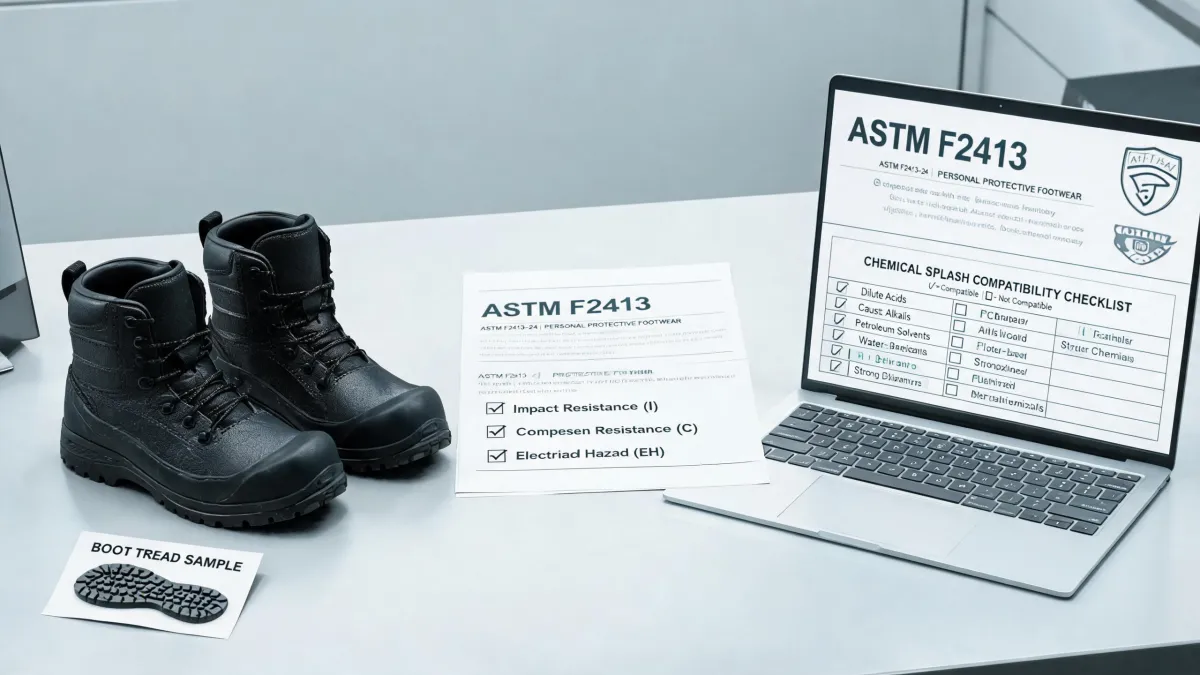
I only believed chemical compatibility charts after ignoring them once and paying for it. We received a batch of 'chemical-resistant' boots from a competitor—I won't name them—that met the ASTM F2413 standard. But on day three of exposure to a diesel/water mix, the rubber started softening. The defect ruined 8,000 man-hours of productivity. Dunlop's Hazmax line isn't just rubber; it's a specific Nitrile/PVC compound that holds up to a broader spectrum of chemicals. They actually publish the immersion test data. That level of transparency is a green flag. You're not guessing.
3. The 'Lack of Innovation' is Actually a Feature
Honestly, the biggest frustration in the safety boot market is the constant churn of features I don't need. Lacing systems that break. Comfort foam that packs out in 3 months. Dunlop doesn't do that. Their designs are basic. A steel toe, a roomy fit, and a thick rubber sole. They haven't changed the last 20 years. Which is exactly what you want when specifying for a 50,000-unit annual order. The spec stays consistent. The price stays predictable. You're not doing a new fit-test every season.
The 'Industry in Evolution' Angle: Where the Old Thinking Hurts You
The assumption is that modern work boots are all better than old rubber boots. Actually, the opposite is true in specific environments. The 'upgrade' to a high-top leather boot with a waterproof liner was best practice in 2018—until we started tracking slip rates and soaking injuries.
The reality is that manufacturers have been competing on comfort for indoor jobs (Warehouse, retail, food service). That's great for those segments. But the outdoor industrial segment, which is where safety regulations are strictest (think OSHA 1910.132 and 1910.136), has been neglected. Dunlop's major market share in this segment isn't because they're old; it's because they solve the same problem every time. They're boring in the best possible way.
What the Hell Do All These Numbers Mean?
I know the Dunlop catalog looks like alphabet soup. Here's the short version based on our procurement spec:
- Dunlop FieldPro: Standard mud and water work. Steel toe. Good for general construction and agriculture.
- Dunlop Hazmax: The chemical-resistant version. Worth every penny. If you deal with fuels, oils, acids, or solvents, this is the one.
- Dunlop Purofort: Insulated version. If you're working cold and wet, this is a game-changer. The foam insulation is bonded to the rubber, so it doesn't shift or bunch up.
- Dunlop Metatarsal: Higher coverage over the top of the foot. Required for our guys who operate heavy machinery with high foot forces.
One of my biggest regrets: not upgrading the spec from FieldPro to Hazmax earlier when the guys were complaining about 'stiff boots' after fuel exposure. The extra $12 per pair was a no-brainer. The $4,200 in reissued boots because the rubber degraded? A harder lesson.
The Honest Limitations: When Dunlop Isn't Right
I have to be straight with you—Dunlop isn't perfect for everyone, and I'm not here to oversell:
- They're heavy: A pair of rubber boots weighs about 4-5 lbs. Lighter than leather logger boots, but way heavier than a 6-inch hiking-style work boot. If you're walking 10 miles a day indoors, don't buy these.
- They're poorly ventilated: All rubber. No mesh. Your feet will sweat. In cold weather, the Purofort insulation helps. In hot weather, just accept that your feet will be damp. It's the trade-off for being waterproof.
- No ankle support: The rubber is flexible. If you have a history of ankle injuries or are working on very uneven ground (scree, boulders), you need a lace-up boot with a steel shank. This is the one you ignore at your own risk.
- Sizing is tricky: They're designed to be worn with thick wool socks. If you buy your exact shoe size, they'll fit too tight. Almost everyone needs to size up by 1 to 1.5 sizes. The return rate on first-time Dunlop orders from our team was about 22% because of sizing. Budget for that.
Per OSHA guidelines (29 CFR 1910.136), employer-paid PPE must be provided and maintained. If you're putting a worker in the wrong boot, you're not just wasting money on sick days; you're creating a compliance gap. The 'cheap' option isn't about the sticker price—it's about the total cost including your time managing issues, the risk of claims, and the potential for a citation. In that calculation, Dunlop is almost always a win.