I think most people buy Dunlop safety boots wrong.
I was one of them. For my first two years managing PPE procurement at a mid-sized chemical processing plant, I treated safety footwear like a commodity. You put out a spec—steel toe, waterproof, chemical resistant—and you bought the pair with the lowest unit price. It took a pretty expensive mistake, and about 180 orders over four years, to understand I had the whole thing backwards.
Let me be clear with my central argument: The single best value in a Dunlop boot isn't found on a spec sheet or a price tag. It’s found in the specific, measurable cost of reducing an injury risk over a defined period. This sounds like corporate jargon, but the financial reality is brutal.
The False Economy of "Cheapest."
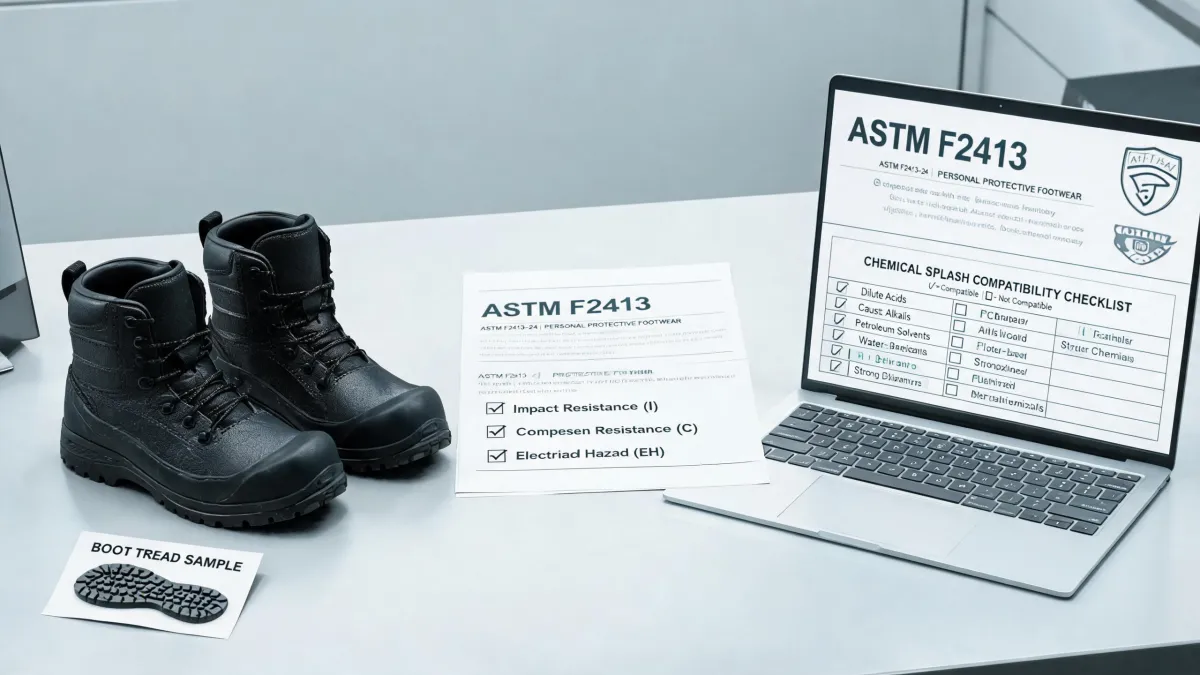
In Q3 of 2023, our safety manager flagged a recurring issue. Our crew rotating through the hazmat zone was suffering from foot fatigue and two minor incidents where compromised boot material led to contact dermatitis. Our cheap supplier (not Dunlop) had delivered a boot that technically met the ASTM F2413 standard, but its chemical resistance was borderline. It wasn't a catastrophic failure, just a slow, expensive erosion of safety and productivity.
The Real TCO Math
When I went back to audit our 2023 spending, I built the TCO (Total Cost of Ownership) spreadsheet. Here’s the kicker (pun intended) that changed my mind:
- The "Cheap" Boot: $45 per pair. Initial cost for 50 workers: $2,250. But we had to replace them every 4 months due to degradation. Annual replacement cost: $6,750 (including re-ordering labor). Lost productivity from fit issues and complaints: roughly $1,200.
- The Dunlop Hazmax (e.g., the 6800 Series): $95 per pair. Initial cost for 50 workers: $4,750. These lasted 14 months on average. Annual replacement cost: ~$4,080.
That's a $3,870 annual difference in favor of the more expensive boot. (I’m not 100% on the Hazmax exact model number, but it was the high-wall, dual-density, safety-toe version). This isn't about unit price. It’s about price-per-wear and price-per-risk-mitigated.
"What was best practice in 2020—buying the cheapest compliant boot—is now a liability in 2025."
— My own procurement log, after the '23 audit.
The Misunderstanding of "Hazmat."
From the outside, a hazmat boot looks like a heavy rubber boot. The reality is that the critical technology isn't in the rubber itself, but in the bonding and layering. A standard rubber boot might have a 2mm wall. A proper Dunlop Hazmax boot uses a multi-layer construction with specific chemical-resistant compounds for the midsole and outsole. People assume "hazmat" means it's just a thick, heavy boot. What they don't see is the engineering to prevent a solvent from wicking up the fabric lining and causing a chemical burn on the instep (a truly nasty injury we almost had).
I'd argue that for 90% of industrial environments (chemical, oil & gas, wastewater), the best Dunlop hazmat boot is the one you don't think about. It's the one that doesn't fail. That's where the ROI is. A $1,500 workers' comp claim for dermatitis absolutely crushes any savings from buying a cheap boot.
The Evolution of the "Work Boot."
The industry has evolved. The idea that a safety boot is either a heavy-duty rubber boot (Dunlop) or a leather lace-up (Twisted X, Red Wing) is outdated. The best choices now sit in the middle.
Twisted X steel toe boots (e.g., their WDW005 work boot) are phenomenal for comfort and dry environments. But I've seen them melt on a chemical spill. Conversely, a standard Dunlop steel toe is a fortress against liquids but lacks arch support for 12-hour shifts.
A Personal Recommendation (with a caveat)
If I had to pick a single best option for a general industrial environment today, it's the Dunlop Purofort + series (like the 6930). It's the sweet spot: it's got the full waterproof rubber shell, better insulation for winter (so you don't need a separate insulated boot), and an ergonomic insole that actually works. It's not cheap ($120-140), but it eliminates the argument for buying a separate winter boot.
What About Metatarsal Guards?
You mentioned metatarsal boots. This is a sub-argument. The term "metatarsal boots" refers to boots with an internal guard protecting the metatarsal bones. Dunlop makes some models with them. Here's the thing everyone gets wrong: They think it's just about the static guard. It's actually about how the guard interfaces with the steel toe. A poorly designed met guard creates a pressure point. A good one (like in the Dunlop FieldPro) distributes the force. It's not a commodity feature; it's a piece of safety engineering. If you have heavy falling object risks (steel plants, foundries), it's non-negotiable. You shouldn't even look at a boot without it. For a warehouse or construction site, it's overkill (unfortunately). The fundamentals of a good safety boot haven't changed—protect the foot, keep it dry, keep it comfortable—but the execution has transformed completely.
I used to think the goal was to find the cheapest option that met the standard. I now know the goal is to find the option that costs the least when you factor in the full cost of failure over the boot's life.
"Don't hold me to this exact comparison without running your own numbers, but my experience over 6 years of procurement says this: The Dunlop is rarely the cheapest. It is almost always the most cost-effective."
— Personal note in my 2024 procurement plan.
To answer the question "what are the best Dunlop boots?"—the best ones are the ones that fit your specific risk profile. For most, that's the Hazmax or a Purofort + series. To answer the question "what are metatarsal boots?"—they are a critical safety upgrade for specific risks. Don't buy them unless you need them. And please, stop looking at the price tag before looking at the TCO.