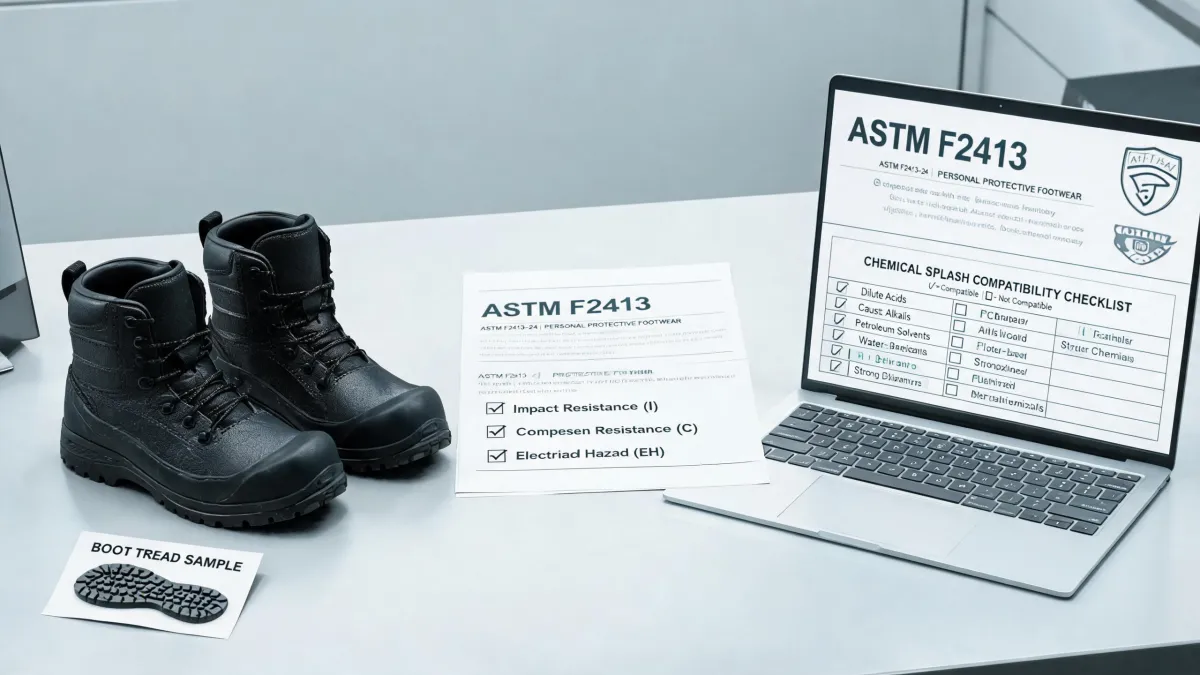
I'll be blunt. If you're choosing between a $80 pair of Dunlop steel toe boots and a $55 pair of Skechers work boots for your crew, and you've got a project deadline breathing down your neck—spend the extra $25. Every time.
I know that sounds like a sales pitch. But honestly, after six years of managing procurement for a mid-sized industrial cleaning company—analyzing over $180,000 in PPE spending—I've learned that the 'cheaper' option often carries a hidden cost. And that hidden cost is rarely about the boot itself. It's about uncertainty.
When you need a pair of Dunlop Dakota safety boots delivered to a site by Friday, you're not just buying rubber and steel. You're buying a promise. A promise that your crew will have the right gear, that they'll be compliant, and that you won't have to explain a delay to your client.
The Hidden Cost of 'Cheap Enough'
In Q2 2024, I was sourcing a special order of Dunlop Hazmax boots for a chemical plant job. The preferred vendor had them for $89/unit. A secondary vendor—let's call them Vendor X—had an alternative brand for $62/unit. Same ANSI Z41 rating, same cut-resistant midsole, similar outsole. On paper? Nearly identical.
The buyer on that project almost went with Vendor X. Saved $27 a boot across 30 pairs—that's $810. Then I ran the numbers on what I call the 'true procurement spreadsheet'.
- Delivery: Vendor X quoted standard 7-day shipping. Our deadline was in 8 days. Any hiccup and we'd be scrambling.
- Returns: Vendor X had a 15% restocking fee. The preferred vendor had a 30-day, no-questions-asked policy for sizing issues.
- Consistency: The preferred vendor had a 98% on-time delivery rate over the last 12 months based on our system. Vendor X? I didn't have hard data, but based on two prior orders that were each two days late, my sense was riskier.
That 'save $810' turned into a potential liability. What happens if those boots show up on Day 9 instead of Day 7? We'd have to delay the crew. That delay would cost us roughly $2,000 a day in idle labor and missed production. Add in the $1,200 rush shipping we'd have to pay to get the correct boots overnight, and suddenly the 'savings' disappear.
The 'Deadline Insurance' Factor
This isn't just about budgeting for costs. It's about budgeting for consequences. I've seen this play out repeatedly. We once needed a specific replacement for a Dunlop steel toe boot—the FieldPro model—for a site manager who wore them down in four months. We ordered from the cheaper supplier (a different brand, Ariat work boots, actually). They were $10 cheaper. But they arrived a day late, the manager couldn't work on the floor that day, and we lost $450 in billable hours. The $10 'savings' cost us $440.
It's tempting to think you can just compare unit prices. But the assumption is that 'fast enough' is 'good enough.' The reality is, when you're tight on a deadline, certainty becomes the most expensive line item on your budget. Or rather, uncertainty becomes the most expensive hidden cost.
The Real Value of Dunlop's Reputation
People think expensive vendors deliver better quality. Actually, vendors who deliver quality can charge more. The causation runs the other way. Dunlop has been making these boots for decades. They've standardized their manufacturing. Their supply chain is mature. That means when they say 'delivery on Friday,' they have the data and processes to back it up. You're not just paying for a boot. You're paying for their track record.
I'm not a logistics expert, so I can't speak to carrier optimization. What I can tell you from a procurement perspective is this: the cost of a 'maybe' from a vendor is way higher than the premium for 'guaranteed.'
When the 'Cheap' Option Actually Works
Look, I'm not saying you should never buy Skechers work boots or Ariel work boots. For non-critical roles where a boot can be swapped out in a day, the budget option might be perfectly fine. But for a crew that needs to be on site Monday morning? For a job where a missing boot means a $15,000 manufacturing delay?
Pay the premium. Buy the certainty.
I have mixed feelings about this, honestly. On one hand, it feels wasteful to spend more upfront. On the other, I've seen the operational chaos that a one-day delay causes. I reconcile it by building a 'risk contingency' into every procurement order over $5,000. That contingency often justifies paying a little more for reliability.
What This Means for Your Next Order
If you're shopping for Dunlop boots online, or comparing them to Ariat work boots or Skechers work boots, here's my advice: look at the delivery guarantee, not just the price tag.
Price data for standard turnaround Dunlop Dakota safety boots (size 10, 2025): ~$85-95 online. For comparable Ariat work boots, ~$65-75. That $20-30 difference is your insurance policy against a missed deadline. Based on publicly listed prices, March 2025.
Also, consider this: where are you buying them? A specialized safety store with a warehouse might have your size in stock. A general online retailer might not. Don't just search 'work boots near me' and hope for the best. Call your distributor, ask them specifically: 'Can you guarantee delivery by Thursday?' If they can, and it costs $20 more, pay it.
It's basically a trade-off between speed and cost. But speed, in this context, isn't about getting the boot faster. It's about getting the result faster—getting your crew productive on day one. That's what you're really paying for.
And seriously—if you're ever shopping for a fire extinguisher for your facility? Same principle. Don't just check where to buy a fire extinguisher near me. Check if they can deliver before your safety inspection. A $50 extinguisher that arrives a day late is worthless if you fail the audit.