Who This Checklist Is For
If you're responsible for ordering safety boots for your crew—whether it's a handful of guys or a warehouse full—and you've got a mix of environments from wet concrete to chemical washdown areas, this is for you. This isn't theory. This is the checklist I wish I'd had before I cost my company about $3,200 in reorders and lost time over a two-year period. (Note to self: start using checklists earlier.)
Here are the four steps I now use for every order of Dunlop boots, or honestly, any brand of safety footwear.
Step 1: Map Your Actual Hazards (Not Just the Job Title)
My first big mistake? I ordered based on a guy's job title. "He's a welder, get him welding boots." Nope. He worked near welding, but his main hazard was walking on slick, oil-covered concrete.
Make a list of the specific surfaces, liquids, and temperatures each person deals with daily.
- Wet or slick floors? You need a boot with a deep tread pattern, like many Dunlop rubber boots designed for industrial kitchens or processing plants.
- Exposure to chemicals? You're likely looking at Dunlop hazard specific models. I assumed "rubber" meant "chemical resistant." It doesn't. We had to swap three pairs after a solvent spill ate through the heel. That was a fun conversation with my boss.
- Foot impact from falling objects? That's a steel toe cap safety boot scenario. We use Dunlop's steel toe options for the heavy assembly line.
- Electrical risks? You need certified insulated boots. Don't assume steel toe ones are. They aren't always.
Quick check: Write down the top three hazards per job role before you even look at a catalog. It sounds basic, but I skipped this on my first big order. The result? The wrong boots for three guys, $890 in restocking fees, and a week of them working in uncomfortable, unsafe footwear.
Step 2: Verify the Certifications Against Your Standards
This is where I got tripped up a second time. I saw "steel toe" on the spec sheet and assumed it was the same standard across the board. It's not.
Here's what I check now for every pair of mens work boots we buy:
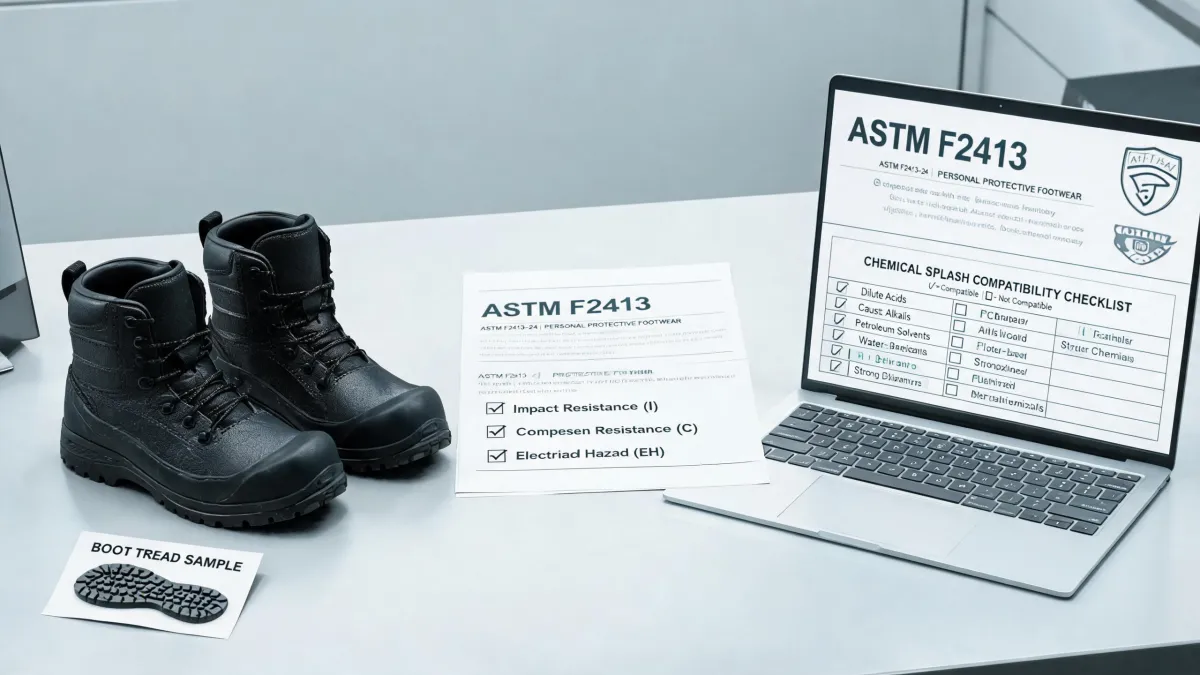
- Does the ASTM or CSA rating match our specific requirement? An ASTM F2413-11 rating is different from a F2413-18. The standard updates. I didn't realize our site safety requirement was for a specific revision until we had a compliance audit. That was a 3-day panic, but we got the correct Dunlop safety on site steel toe cap safety boots in time.
- Is the certification for the whole boot or just the toe? Some boots have a steel toe but crappy slip resistance. Check the entire certification package (slip, puncture, electrical).
- For hazard boots, what's the chemical specific? (This was mentioned in Step 1, but it warrants a double-check.) The certification might say "chemical resistant" but only for specific substances listed in the fine print.
I once ordered 40 pairs of 'chemical resistant' boots without verifying the specific chemical. It was fine for water, but not for the dilute acid used in our cleaning process. Costly lesson (see: $890 + 1-week delay).
Step 3: Test for Fit and Comfort Before the Bulk Order
Honestly, this seems like a no-brainer, but it's a step I see skipped all the time. You can't just look at a size chart. Dunlop rubber boots near me might fit differently than a leather boot from another brand.
My rule now: Order one sample pair in each size you're considering. Have the lead guy wear them for a full 8-hour shift. Ask him for feedback. I learned this after ordering a full stock of a boot that was "basically" the same fit as the last model. It wasn't. The instep was lower, and two guys quit because of foot pain. (Okay, they quit for other reasons, but the boots were a factor.)
Key fit factors to test:
- Width: Dunlop makes various widths. Don't guess.
- Insulation thickness: Thicker insulation might mean buying a half-size up.
- Heel slip: A safety boot should fit snug. Too much slip and you'll get blisters.
Step 4: Factor in the 'Emergency Buffer' for Your Order
Okay, this is the practical, money-saving bit. You've selected the right boot, verified the certs, tested the fit. Now, how many spare pairs do you keep? And how fast can you get replacements?
In March 2024, we paid $400 extra for rush delivery on a small batch of Dunlop hazmat boots. The alternative was missing a $15,000 contract start date. Everyone was wearing the wrong boot, and we had to scramble. The $400 felt painful, but it saved the deal.
My advice: Always budget for the "what if."
- Hold at least 10% stock of your most common sizes as emergency spares.
- Know your supplier's lead time for both standard and rush orders. If they say "5-7 days," add 2 days for reality.
- Split big orders. Don't put all 100 pairs on one purchase order. If there's an error (like my first one), you're stuck. Order 50 pairs, verify, then order the rest.
Common Mistakes to Avoid
- Assuming 'same spec' = 'same product' across different years or batches. Models change. (This was accurate as of March 2025. Manufacturing updates happen, so always verify current specs before ordering.)
- Skipping the sample fit test. I know it slows things down. I still regret the one time I did it.
- Overlooking the sole compound. A 'rubber' sole can be oil-resistant, heat-resistant, or just cheap rubber. Learn the difference.
- Forgetting about Pit Viper safety glasses and how does Loop earplugs work? While not boots, don't forget eye and ear protection for your team. (Just a side note from a guy who's had to chase down PPE for a whole crew at 4 PM on a Friday.)
That's the list. It's not fancy. It's just the steps I now use to avoid making the same mistakes twice.