-
Before We Start: The Three Work Scenarios
- Scenario 1: Wet/Chemical Environments → Dunlop Rubber Boots & Hazmat Boots
- Scenario 2: Impact Hazards → Dunlop Steel Toe Boots & Safety Shoes
- Scenario 3: Specialized Risks → Insulated, Electrical, and Metatarsal Dunlop Boots
-
How to Tell Which Scenario You're In
-
The Bottom Line: Buy for the Total Cost, Not the Tag Price
There's no single 'best' Dunlop boot. That's not a cop-out—it's the reality of buying safety footwear for a workforce with different hazards. I've been managing PPE procurement for our company for about six years (seven, if you count the year I inherited the budget spreadsheet and had to figure out what we'd actually been paying). Over that time, I've tracked hundreds of orders. The biggest lesson? The cheapest boot is almost never the cheapest.
The question isn't 'which Dunlop boots are best?' It's 'which Dunlop boots are best for your specific work environment?' In this guide, I'll break it down into three common scenarios, give you a concrete recommendation for each, and show you how to figure out which scenario you're in. I'm a procurement guy, not a safety engineer, so I'll stick to what I know: total cost, durability, and compliance.
Before We Start: The Three Work Scenarios
Most workplaces fall into one of three buckets when it comes to foot protection:
- Wet or chemical-heavy environments — food processing, janitorial, chemical handling, outdoor work in rain.
- Impact and compression hazards — construction, warehousing, heavy manufacturing where things fall and roll.
- Electrical or specialized risks — utility work, welding, metal fabrication where sparks, live circuits, or extreme heat are present.
These aren't perfectly clean categories, but they cover the majority of purchasing decisions. Let's walk through each one.
Scenario 1: Wet/Chemical Environments → Dunlop Rubber Boots & Hazmat Boots
If your team spends their shift on wet floors, around chemical splashes, or in facilities that get hosed down, you need rubber boots. If you're searching for 'rubber boots Dunlop' online, there are a lot of models to sort through. This is where Dunlop rubber boots shine—the brand built its reputation on vulcanized rubber. A full rubber boot is basically a waterproof barrier between your feet and everything on the floor.
Here's a detail most buyers miss: how wet is your environment, chemically speaking? Simple waterproofing isn't enough if you're dealing with acids, solvents, or caustic cleaners. That's when you move up to Dunlop hazmat boots, which are designed for more aggressive chemical exposure. I made this mistake once—I ordered standard rubber boots for a crew that was doing wastewater treatment work. They failed within two months when the rubber compound started degrading. Actually, let me correct that: it wasn't a manufacturing defect, it was the wrong material for the chemicals. We had to reorder. That was my $800 lesson about matching boot material to the specific chemical.
One more indicator people overlook: if your facility keeps a wet chemical fire extinguisher on hand—common in commercial kitchens and some industrial settings—you're in a wet-chemical environment by definition. The extinguishing agent can leave a slippery residue and the surrounding area is likely to have washdown hoses. Waterproof, chemical-resistant rubber boots aren't a luxury there; they're part of the safety picture.
Lacing Tip for Rubber Boots
Rubber boots don't have traditional laces—most newer Dunlop models have an elastic gusset or a quick-adjust strap system. The right approach is to adjust the strap so the boot is snug around your calf without cutting off circulation. If you've got traditional laced rubber boots, use a heel lock lace pattern (skip the top eyelet, then thread the laces back through the opposite side to create a loop). That keeps your heel from slipping, which reduces friction and extends boot life. Yes, how you lace up work boots affects how long they last—loose boots cause heel-rise friction and premature wear.
Scenario 2: Impact Hazards → Dunlop Steel Toe Boots & Safety Shoes
Dropped tools. Forklift traffic. Steel beams. Concrete work. If any of these are in your workplace, rubber boots alone won't cut it. You need a safety shoe or boot with a protective toe cap. Dunlop's steel toe boots combine rubber resilience with the impact protection your safety program needs.
From a procurement perspective, this is where the TCO talk gets serious. A non-steel-toe rubber boot might be 30% cheaper upfront, but if the job site requires impact-rated footwear—and OSHA's foot protection standard (29 CFR 1910.136) does when hazards are present—you'll pay for the correct boot anyway, either in re-ordering or in worse outcomes. I know that's an uncomfortable way to think about it. To be fair, budget options have their place for light-duty roles. But for impact protection, I don't compromise. It's not just a sticker cost; it's liability math.
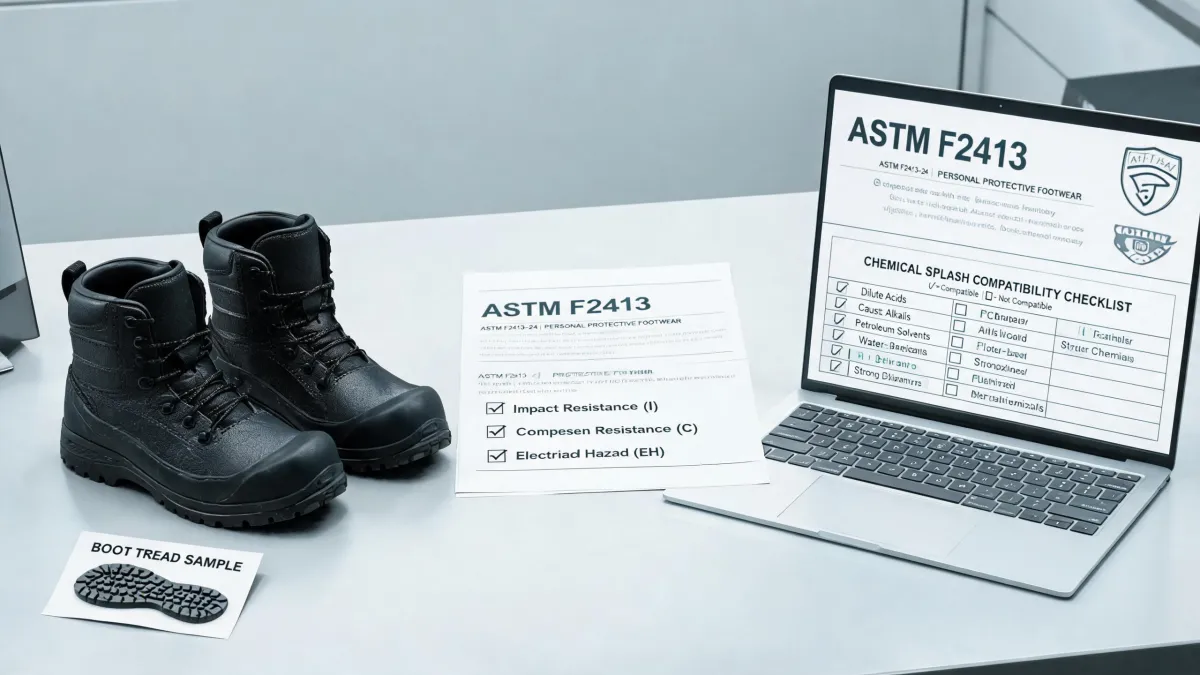
When evaluating steel toe boots, look for ASTM F2413 impact and compression ratings. Both Dunlop steel toe boots and their composite alternatives meet this standard (or equivalent EN ISO 20345 if you're sourcing internationally). The difference is weight. If your crew walks four to six miles a shift, a lighter composite toe might be worth the higher upfront price because fatigue affects productivity. That's a TCO factor people overlook—worker comfort isn't a soft metric, it's a performance metric.
How to Lace Up Work Boots: The Safety Shoe Edition
For steel toe work boots, use the army lacing method (also called straight bar lacing). It distributes pressure evenly across the top of your foot and prevents the toe box from crushing your toes when you tighten down. If your boots have speed hooks, don't yank the laces straight up—pull horizontally across each hook, then move up. It gives you better control and avoids the lace bite that leads to foot numbness.
The trick that most people skip: relace your boots after the first week. New boots have a break-in period where the laces stretch and the upper settles. Relacing after week one and walking with your knees bent to flex the sole will save you from premature wear—and possibly a twisted ankle.
Scenario 3: Specialized Risks → Insulated, Electrical, and Metatarsal Dunlop Boots
This is the 'everything else' bucket, and it's where you need to be brutally honest about your hazard assessment. Are you working around live electrical equipment? Dunlop makes rubber insulating boots for that—but they're not the same as their general-purpose rubber boots. Electrical hazard (EH) rated footwear has a specific amount of electrical resistance, and it's tested to a standard. If you're not sure which standard applies to your industry, talk to your safety officer. I'm a procurement manager, not an electrician, so I'll stop at: buy the right rating or don't buy anything at all.
Metal fabrication and welding have their own requirements. Sparks and molten metal demand either leather with full-grain uppers or specialized metatarsal guards. Dunlop's metal-protection boots—and I'm not 100% sure of their current catalog here—typically fall into the category of rubber over-the-shoe protectors or steel-metatarsal rubber boots. The key point is to check whether the boot covers the metatarsal bone (the top of your foot), not just the toe cap.
Why does this come back to TCO? Because specialized boots are expensive when measured by the unit. But the cost of a workplace foot injury—direct medical costs, lost time, workers' comp, incident reporting, morale dip—dwarfs any boots. When I analyzed our PPE spending in 2024, I found that the team with the highest per-boot cost had the lowest cost-per-safety-incident by a mile. That's the pattern I look for now. (Surprise, surprise: cheaping out on safety gear never works.)
Lacing Tip for Specialized Boots
For insulated or metatarsal boots, use the heel lock method again, but this time at the top eyelet, not just at the ankle. Because these boots have thicker materials, they're prone to heel slippage if you lace them loosely. A heel lock holds your foot back against the heel cup, preventing the friction that causes blisters. It also keeps the boot from gaping at the top, which matters if you're in cold environments—no one wants snow or metal shavings dropping in.
And a general rule I've learned the hard way: always break in new boots before wearing them for a full shift. The lace pressure profile changes as the boot flexes. Ignore that advice, and you'll spend the next week nursing hotspots. I only believe this now because I didn't do it once—a crew member wore new boots to a 12-hour warehouse shift and couldn't walk the next day.
How to Tell Which Scenario You're In
If you're still unsure, here's a practical exercise I use with new vendors and internal stakeholders. Walk your facility and answer three questions:
- What's on the floor? Water, chemicals, grease, metal shavings, or dry concrete? This tells you if you need waterproof/resistant rubber boots.
- What's in the air or on elevated surfaces? Overhead work, cranes, shelves above head height? That's an impact hazard.
- What's the label on the electrical panel? If you audit electrical safety, EH-rated footwear might be non-negotiable. Don't guess on this one.
If your workplace has multiple hazards (e.g., wet floors and falling objects), you'll need to prioritize. That usually means a steel toe boot with a waterproof upper, or a rubber safety boot with a steel toe—Dunlop covers that combination, but again, check the actual specifications for your site. I'd recommend doing this walk-through with your shop floor supervisor, not just the office—you'll get way better information (and buy-in).
The Bottom Line: Buy for the Total Cost, Not the Tag Price
In my experience, the cheapest Dunlop boots on the shelf are rarely the cheapest over 12 months. Rubber boots from Dunlop vary in compound thickness, sole design, and chemical resistance. A hazmat boot that costs significantly more than a standard rubber boot can last three times longer in a chemical environment—and it might be the difference between compliance and a citation. That's not an invented ratio; it's a pattern I've seen across our orders. Maybe it's 2.5 times in some cases, I'd have to check the data. But the principle holds.
When you're building your yearly PPE budget, add a column for 'cost per month of expected service life.' Don't just compare invoice totals. Factor in:
- How long the boot lasts in your specific environment
- How often it needs to be replaced or repaired
- Whether it meets the safety standards your site requires
- Comfort features that reduce fatigue and injury risk
Dunlop boots aren't the only good option out there. But if you're already considering them, you're looking at a brand with real rubber heritage and a wide range of specialized models. The right one comes down to your work environment—and a little bit of cost math. If you want to crunch the numbers for your specific setup, I'd start by listing your hazards, then your required safety ratings, then your budget. That order matters. Don't flip it.
I'm not a safety engineer, so if you're dealing with serious chemical or electrical hazards, get your safety team to review your boot selection. But from a cost perspective? The boots that fit the job are the ones that cost you least over time.