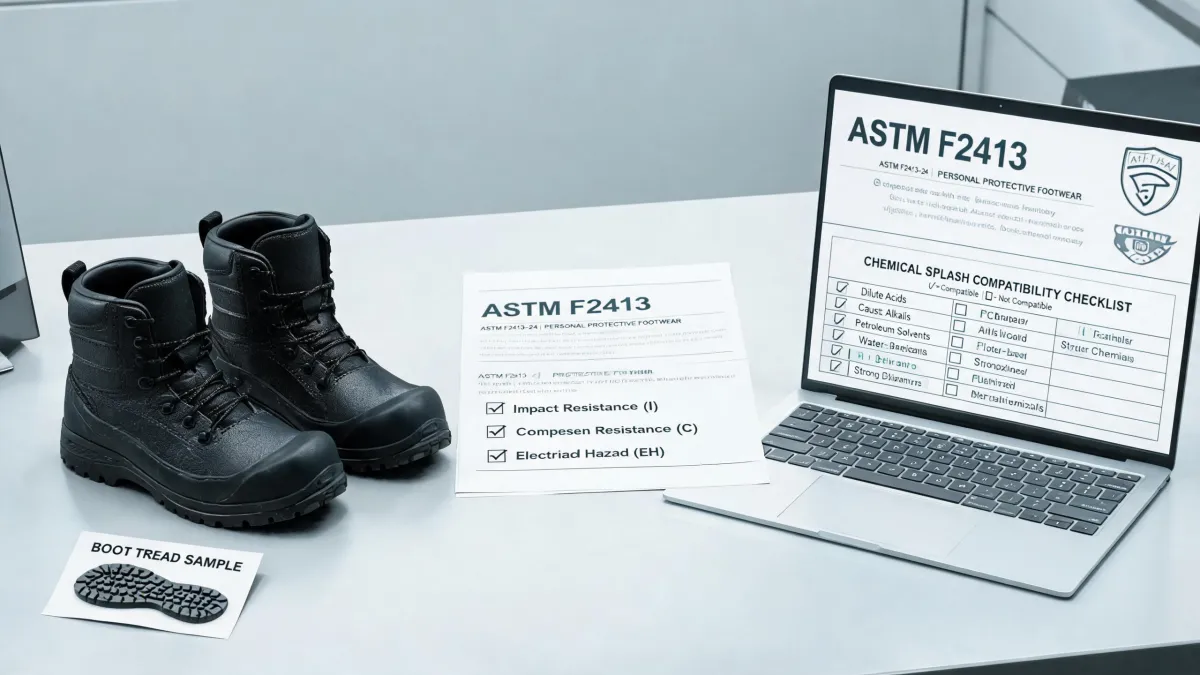
As a quality and compliance manager in the industrial safety business, I review boots before they get to the job site. Roughly 200 styles and samples a year, every year since 2021. In our Q1 2024 quality audit, I rejected 12.4% of first samples because the spec didn't match the sample. Not because the boots were dangerous—because the details were off. So here's my opinion, stated plainly: most boot failures are not a failure of safety technology. They are a failure of specification, fit, and process.
Searching for 'dunlop boots' or 'dunlop safety boots waterproof' is the right way to start. It shows you're looking for a specific model, not just a photo. But too many buying decisions stop at the search result. They see a color, a brand name, and a price. They don't check the toe cap rating, the sole compound, or the sizing. That's where my job comes in.
The First Spec I Check Is Not 'Waterproof'
Here's the thing: waterproofing is a property, not a promise. I've seen a 'waterproof' boot fail inspection because the seam tape was applied poorly. I've also seen a molded rubber boot pass the same inspection without a single drop of water entering, because there was no seam to fail.
That's the difference with Dunlop. Dunlop boots are known for molded rubber construction. The waterproofing isn't a spray-on coating—it's built into the outer shell. When I review a Dunlop safety boot, I check the toe cap position, the outsole adhesion, and the shaft height. If those are right, the waterproofing usually takes care of itself.
For the record: as of March 2025, the common North American safety footwear standard is ASTM F2413-18. Many global clients also reference EN ISO 20345:2022. They are not the same. Verify current requirements with your safety department or the official standard body before ordering.
Brown Work Boots and Rocky Work Boots: The Same Process Applies
I get a lot of questions that start with 'brown work boots should be...' or 'are Rocky work boots better than...' I can't tell you which brand is best, because 'best' depends on your site's actual hazards. What I can tell you is that the selection process is identical, whether you're evaluating brown work boots, Rocky work boots, or a molded Dunlop model.
- Identify the hazard: impact, puncture, slip, chemical, electrical.
- Check the rating that matches that hazard.
- Confirm the construction method—cemented, welted, or molded.
- Then look at comfort, color, and price.
Most of the time, the color 'brown' is a marketing preference, not a performance spec. Brown work boots are popular for a practical reason: they hide dirt and scuffs better than black. But if the outsole isn't rated for slip resistance, the color doesn't help you on wet concrete.
Rocky work boots have a strong reputation for comfort in certain ranges. That's fine. My point is that reputation is a starting point, not a substitute for a spec review. The same boot model can behave differently in a production run if the sole compound changes or the toe cap shifts.
Digital Efficiency Is a Safety Issue
I used to review boot samples with a paper cut sheet and my own memory. That worked for us until a 50,000-unit order showed up with a visibly different sole compound. We didn't have a formal 'sample versus production batch' verification process. That mistake cost us a $22,000 redo and delayed a client rollout.
The third time we ordered the wrong configuration, I created a digital sample verification checklist. It wasn't complicated. Every new sample gets a spec sheet, photos, a size run, and a test report, all in one shared file. Switching to that process cut our review turnaround from six weeks to two. It also eliminated the data-entry errors we used to get with handwritten notes.
Why does this matter for you? Because if your boot supplier doesn't have a digital link between the approved sample and the production batch, you're trusting memory. And memory is a terrible quality system.
How to Break in Leather Work Boots (Without Ruining Them)
Now, the search term I see the most: 'how to break in leather work boots.' Here's my honest take: if a leather boot requires weeks of pain, it's probably the wrong size or the wrong last. Break-in should be a short adjustment, not a punishment.
If you still need to break in leather work boots, do it slowly:
- Wear them around a clean, dry area for two to three hours at a time.
- Use thick wool or synthetic socks, not cotton.
- If a seam pinches, don't use heat. Heat can shrink or deform the leather.
- Condition the leather after the break-in period, not before. Oiling new leather too early can soften it too much.
What about Dunlop boots? Most Dunlop rubber and PVC models don't require leather break-in. The rubber shell flexes with body heat. But they still need a sizing check: your toes should not press against the front after a full day of standing. Even after choosing a molded rubber boot over a leather boot for a chemical plant, I kept second-guessing. What if the crew found them too stiff? The first two weeks of wear-test feedback were stressful.
Take this with a grain of salt—I'm not 100% sure every Dunlop model runs the same size, but most molded wellingtons have a little extra room to allow for heavy socks.
But Isn't This Overkill for a Pair of Boots?
I thought so too, early in my career. Then a batch of 'approved' boots arrived with a toe cap that shifted 3 mm to one side. Normal tolerance was 1.5 mm. The vendor claimed it was 'still within industry standard.' We rejected the batch, and they redid it at their cost. Now every contract includes a toe cap positioning requirement and a production-batch sample.
Since we implemented that protocol in 2022, first-sample rejections in our department have dropped from over 20% to single digits in two of the last three years. The goal isn't a perfect process—it's an efficient one. Efficiency in specification and verification saves money, avoids delays, and protects the people who wear the boots.
Bottom Line
So, my opinion remains the same. Whether you buy Dunlop boots, brown work boots from another label, or Rocky work boots, the process matters more than the brand. Start with the hazard. Check the toe cap and the sole rating. Understand how the waterproofing is constructed. Size the boot to the human foot, not to the photo. And if you're stuck in a painful leather break-in, step back and ask whether the fit is actually right.
Look, I'm not saying one brand is universally better. I'm saying that a boot that matches the hazard, the fit, and the production sample is worth more than any logo. That's the standard I review against, and it's the standard I'd want on my own feet.