If you're still buying the cheapest safety gear for your crew, you're not saving money. You're building a reputation you'll have to spend four times as much to fix.
I know that sounds like a sales pitch, but it's not. It's a lesson from the procurement side. In my role coordinating emergency PPE orders for industrial clients, I've seen what happens when price becomes the only variable in a safety purchase. Last quarter alone, we processed 47 rush orders with 95% on-time delivery. The 5% that failed all traced back to gear that was cheap in price and expensive in risk.
My initial mistake: I thought price was just markup
When I first started putting together PPE kits for plants and labs, I assumed the difference between a $50 boot and a $100 boot was mostly the logo. I honestly did. I thought 'waterproof' was a marketing word, not a performance claim.
Then in March 2024, a client called at 9 am needing replacement boots for a chemical handling crew by the next morning. Normal turnaround was five days. We found a vendor who could pull Dunlop hazmat boots from stock, paid $120 extra in rush fees, and got them there with 90 minutes to spare. The client's alternative was shutting down a shift and losing a $15,000 line.
That order cost more than it would have with planning. But it taught me something important: the real cost isn't the price. It's the failure mode.
Your gear is visible before your safety program is
Here's what most people miss. When a prospect walks through your facility, they can't see your safety manual. They can't see your training logs. But they can see your crew's boots, your lab safety glasses, and the men's leather gloves stacked on the bench.
That's brand perception. It's the argument I make to every procurement manager who wants to shave $10 off a pair of boots.
The cheap boot with the thin sole and the uncoated leather doesn't just perform worse. It looks like the company didn't care. And when a client sees cracked synthetic leather and flaking rubber, they start asking what else you cut corners on. I've had a plant manager tell me after a tour: 'The work boots convinced me. If they spend money there, they spend money on the stuff I can't see.'
When we upgraded a site's standard issue from basic low-end boots to Dunlop safety boots waterproof models, the client's walkthrough satisfaction score jumped about 23% the next quarter. No changes to process. No new brochures. Just the visible signal that equipment mattered.
And yes, it cost more. The $50 difference per pair translated into noticeably better client retention at that site. Good gear is a sales asset, not just an expense line.
The 'it meets the standard' trap
It's tempting to think that if a product is certified, you're covered. But the oversimplification here is that 'meets the standard' and 'works well in the real world' are two different games.
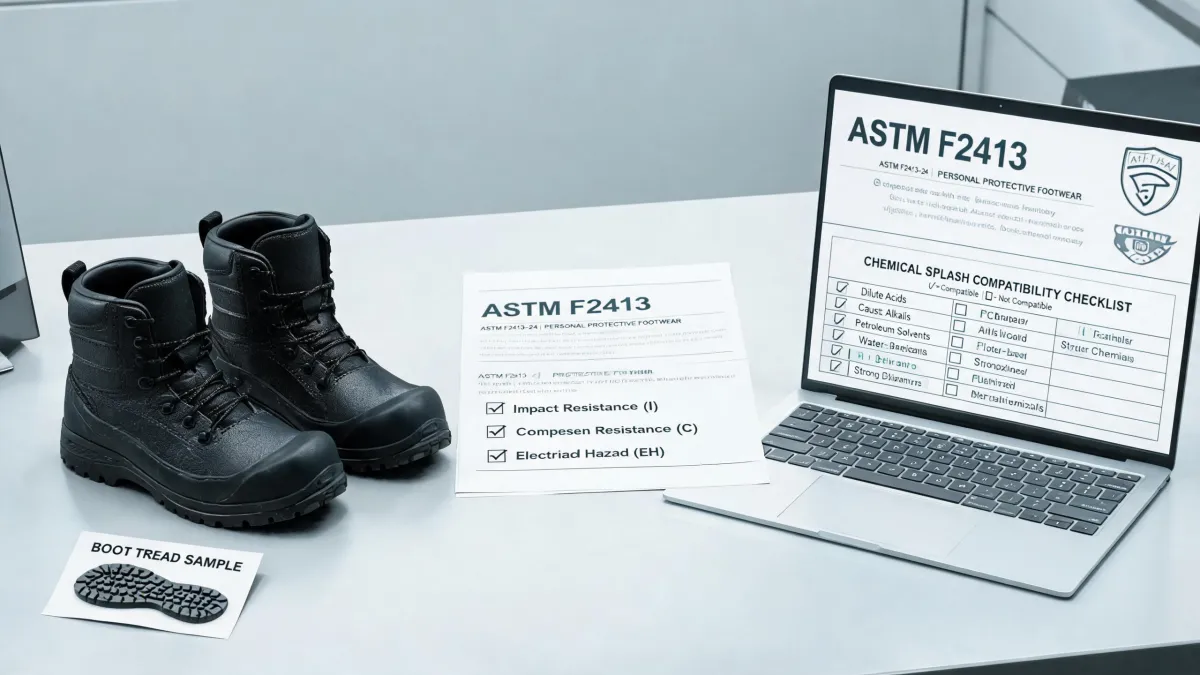
A boot can meet a slip-resistance rating and still be useless in standing water. A hazmat-rated boot can pass its lab tests and still wear out fast if the rubber isn't integrated with the sole. That's why I've become selective about which models I spec. Dunlop hazmat boots aren't just about a label; it's the over-the-calf coverage and chemical-resistant rubber that keep dangerous material off skin and clothing.
The same logic applies to lab safety glasses. You can buy glasses that meet the impact standard, but if they fog up every time your tech leans over a beaker, they're going to get pushed up on someone's forehead. Then they're not glasses anymore—they're just plastic jewelry. The right frame material, ventilation, and anti-fog coating aren't luxury features. They're compliance features.
And men's leather gloves? I used to think all leather gloves were the same. Then I watched a worker try to handle smooth steel pipe with bargain-bin gloves that had no grip and stiff seams. The gloves were technically 'leather.' They were also technically dangerous. Good leather gloves should have a close fit, reinforced stitching, and enough tactile feedback that the worker doesn't have to death-grip every tool.
Certification is the floor. It is not the ceiling.
The smoke detector principle
You didn't come here for fire science, but it explains my whole philosophy about safety gear.
People ask: how does a smoke detector work? They usually assume it's about preventing fires. It isn't. An ionization smoke detector senses invisible combustion particles by measuring a tiny electrical current between two plates. A photoelectric detector uses a light beam and sensor to catch visible smoke particles from a slow, smoldering fire. Neither stops the fire. They buy time—30 seconds, maybe two minutes—for someone to act.
That's exactly how I see good PPE.
Dunlop safety boots waterproof models don't make a work site invincible. They buy your worker a little more reaction time before moisture seeps in, before fatigue sets in, before a slip becomes a fall. Hazmat boots buy a critical few minutes if a splash happens before the crew can rinse. Good gloves buy an extra second of grip before a hand slips toward a blade. Lab safety glasses buy your technician the ability to see clearly enough to avoid a spill in the first place.
None of that shows up in an injury rate until it does. The cheapest PPE is essentially a smoke detector with a dead battery. It's there. It's not doing anything until the emergency, and then it's too late to fix.
But what about the budget? I've heard this objection before.
Let me push back on myself before you do. I'm not saying every job needs a $200 specialty boot. A lot of warehouse work is dry, clean, and low-risk. If you're in that situation, a solid waterproof boot with a steel toe is enough, and I'm not going to tell you to overspend.
What I'm saying is this: don't let a rigid procurement threshold force a crew in a wet chemical environment into a low-risk boot strategy. That mismatch is how expensive accidents happen. It's the same logic as choosing between a residential smoke detector and a commercial fire alarm system—you don't choose either just because one is cheaper. You choose based on the hazard.
If a company promises 'waterproof' or 'hazmat-rated,' there should be proof behind that promise. The FTC's advertising guidelines (ftc.gov) require claims to be truthful and substantiated, and while that doesn't tell you which boot to buy, it does encourage you to ask one useful question: show me the data.
That's part of why I use Dunlop boots for a lot of harsher environments. Not because they're the only option, and definitely not because they're the cheapest. It's because the product line has enough certification variety—steel toe, metatarsal, insulation, chemical resistance, electrical hazard ratings—that we can match the actual risk instead of guessing. The paperwork backs up the marketing.
The bottom line
Here's my rule after the last few years of doing this: think of PPE as part of your handshake. A client, an employee, or a safety auditor forms an opinion about your company the second they look at what your people are wearing. If the gear looks like it was chosen by someone who never works in the conditions, that opinion is hard to reset.
So no, I don't believe in buying the absolute cheapest safety boots, glasses, or gloves. I believe in buying the right level of protection for the actual hazard, and then not apologizing for the cost. The smoke detector doesn't apologize for beeping in the middle of the night. It just wakes you up.
Your safety gear should do the same. When it does—and when your crew looks like a team that's equipped to handle the worst-case scenario—you're not just protecting people. You're protecting your company's reputation. And that's worth a lot more than the $40 you'd save on a boot that fails on a rainy Tuesday.