-
Start With the Hazard, Not the Boot
-
Scenario A: Wet, Chemical, and Muddy Environments
-
Scenario B: Impact and Compression Risks
-
Scenario C: Long Hours on Hard Surfaces
-
How You Lace Your Boots Actually Matters
-
Don't Forget the Rest of the PPE Picture
-
On Price and Transparency
-
How to Decide Which Scenario You're In
When I first started reviewing PPE specifications for our company, I made the same mistake most people make: I assumed the most expensive boot in the catalog was automatically the right one. Four years and a lot of purchase orders later, I can tell you that's not how safety footwear works.
There's no single "best" Dunlop boot. There's only the best boot for your work environment — and figuring that out matters more than any brand preference. So let me walk you through how I break this down when our teams need new safety boots.
Start With the Hazard, Not the Boot
Before I look at any specific model, I ask one question: what are you actually stepping into every day? In my experience, the answer fits one of three scenarios:
- Scenario A — Liquids and chemicals: Water, mud, oils, solvents, acids. You need a waterproof or hazmat-rated rubber boot.
- Scenario B — Impact and compression hazards: Heavy objects, machinery, falling tools. You need a steel toe or metatarsal boot.
- Scenario C — Hard surfaces and long hours: Concrete floors or metal decking for full shifts. You need cushioning and support, even if that means looking beyond rubber boots.
Most workers overlap into two scenarios, but one usually dominates. That dominant hazard should dictate your primary boot.
Scenario A: Wet, Chemical, and Muddy Environments
If your work involves liquids, you want a rubber boot from Dunlop's waterproof line. This is where the brand has its deepest history — Dunlop was built on rubber technology, and it shows in how consistently the waterproofing holds up across production batches. I've cut open worn-out Dunlop rubber boots after years of service, and the membrane integrity is noticeably better than most generics. When people ask me about Dunlop safety boots, waterproof performance is always the first thing I confirm they're checking.
But here's a critical distinction: waterproof and hazmat-rated are not the same thing. A waterproof boot keeps rain and mud out. A hazmat boot is tested against specific chemical exposure and carries resistance ratings for substances like acids, solvents, and oils. If you're handling hazardous materials, don't settle for a general waterproof boot. You need to check the chemical resistance chart against the specific substances on your site — and verify that the model you're buying actually lists them.
When I review hazmat boot spec sheets, I look for three things:
- Specific chemical resistance data — not a vague "chemical resistant" claim on the marketing page.
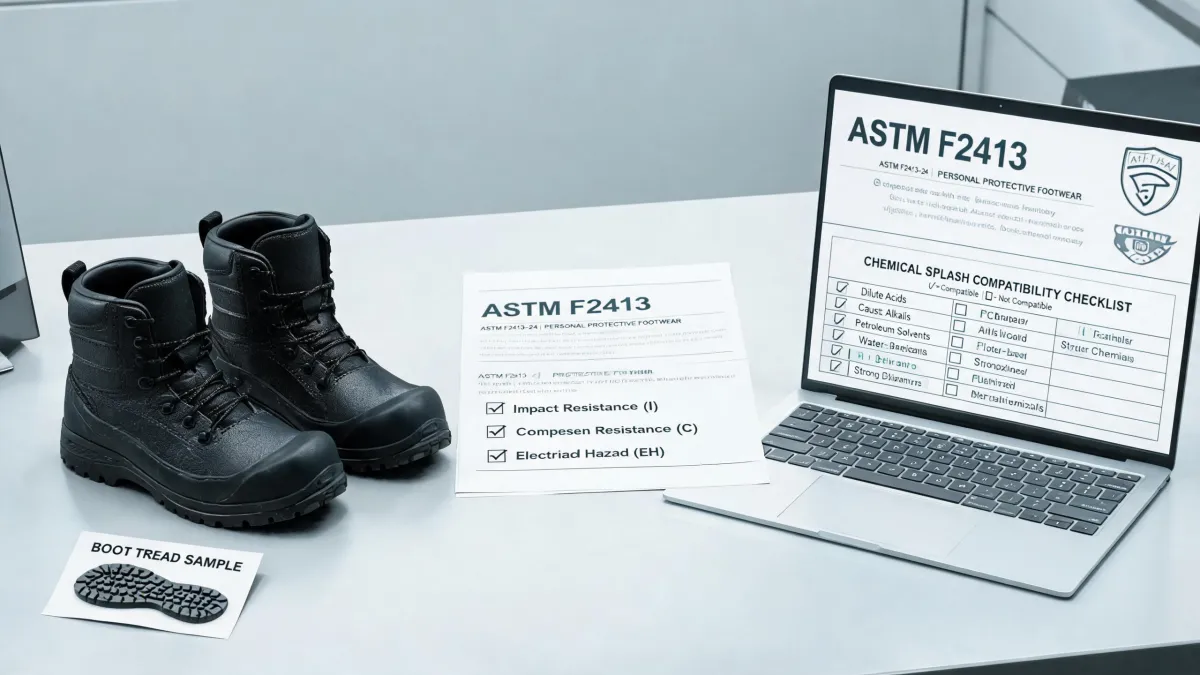
- ASTM F2413 rating — if the job also involves impact or compression hazards.
- Boot height — mid-calf for shallow water, knee-high for wading or splash-heavy environments.
Back in 2022, we received a batch of 300 hazmat boots where the neoprene thickness was visibly off — 35 mils against our 45 mil spec. Normal tolerance was ±5 mils. The vendor insisted it was "within industry standard." We rejected the entire batch, and they redid it at their cost. Since then, every contract we sign includes a thickness verification clause. When I look for Dunlop hazmat boots for sale, I don't just compare prices — I check the spec sheet, the certification number, and the production batch date. All of those matter for safety.
Scenario B: Impact and Compression Risks
For construction, manufacturing, and warehousing work, falling objects are the primary threat. That's where Dunlop steel toe boots come in.
Here's what I tell every new manager who asks about steel toe boots: the rating label matters more than the brand stamp. A boot can carry a recognizable name and still fail an impact test if the toe cap isn't anchored properly. ASTM F2413-18 is the standard for impact and compression resistance in North America, and I always verify that a model actually carries that certification before approving a bulk order. OSHA's PPE regulations (29 CFR 1910.136) also require employers to provide protective footwear when there's a risk of foot injury from rolling objects, punctures, or electrical hazards — so this is a compliance issue, not just a comfort preference.
One thing I learned the hard way: don't ignore the angle of the toe cap. A site supervisor warned me about a budget model we were pilot-testing in 2023. He said the toe cap sat too low — it wouldn't protect against a direct drop at a certain angle. I didn't listen. The spec sheet showed the boot passed impact testing, so I approved it for a small group.
Two weeks later, a worker in that pilot group dropped a steel bracket on his foot. The bracket caught the edge of the toe cap, not the center. He ended up with a broken toe and six weeks off work. The boot had technically passed its lab test. But the real-world angle made the difference. Now I always check the toe cap position physically before approving any new model — not just the certificate.
If your team handles heavy materials in tight spaces, consider metatarsal boots as well. The metatarsal guard protects the upper foot area that steel toe boots don't cover. Dunlop offers models with metatarsal guards, and for certain tasks — demolition, heavy fabrication — the extra coverage is worth the weight.
Scenario C: Long Hours on Hard Surfaces
This is where I'll say something that surprises people. If your crew spends 10-hour shifts on concrete floors — logistics, distribution, assembly — a heavy rubber boot might not be your best choice. Rubber is durable and waterproof, but it's heavy, and the sole doesn't absorb much shock.
People think expensive boots are more comfortable because they're expensive. Actually, comfortable boots can command higher prices because the demand exists — the comfort comes from the design, not the price tag. Midsole density, heel cup depth, and the last shape matter more than the logo.
In dry environments, I've seen more and more workers switching to comfort-focused footwear. Some of our warehouse staff swear by Hoka work boots. I tested a pair myself, and I have to admit — the midsole cushioning is genuinely different from any traditional work boot I've worn. You can feel the shock absorption the moment you step onto concrete. That said, Hoka work boots are not waterproof, and they don't offer hazmat or steel toe options in the same way. Different tool, different scenario.
If you're in a dry environment but prefer to stay with Dunlop, the FieldPro line is the strongest middle ground we've used. The air-cushioned sole makes a real difference on hard floors, and the boot holds up significantly better than comparable comfort-focused models we've tested.
How You Lace Your Boots Actually Matters
Here's a detail that half the workers I meet were never taught: the way you lace your boots changes how they fit and perform. Re-lacing a pair you already own can be more effective than buying a new pair.
- Heel lock (runner's loop): If your heel slips inside the boot, lace normally up to the top eyelet, create a loop with the lace, thread the opposite end through the loop, and pull tight. This locks your heel in place without overtightening the rest of the boot.
- Wide lacing: If your foot feels squeezed across the instep, skip the middle eyelets so the cross pattern spreads wider. This relieves pressure on the top of the foot while keeping the ankle secure.
- Firm toe, relaxed ankle: Lace the lower section snugly to keep your foot from sliding forward, then ease tension through the upper section. This prevents toe cramming on long shifts or downhill walks.
I've seen workers with chronic foot pain change their lacing pattern and feel the difference within a day. No new boots required. (I really should turn this into an official lacing guide for our safety onboarding — it's been on my to-do list for a while.)
Don't Forget the Rest of the PPE Picture
Your feet aren't the only part of you that needs protection. Prescription safety glasses are a piece that too many workers skip, often because they assume they have to choose between seeing clearly and being safe. That's a false choice.
Safety-rated prescription eyewear meets the same impact standards as regular safety glasses — ANSI Z87.1 in North America. They're available from most optical providers, and they're often covered by employers' PPE budgets if you ask. I've seen too many workers wearing scratched, non-rated glasses because they didn't realize prescription safety glasses existed. Your eyes are worth the five minutes it takes to ask HR about it.
On Price and Transparency
One more thing, especially for anyone buying boots in bulk.
I've learned to ask "what's NOT included" before I ask "what's the price." That single question has saved us more money than any discount negotiation ever did.
Say one vendor quotes $89 per pair, and another quotes $94. The second quote includes shipping, compliance paperwork, and a 30-day replacement warranty. The first adds all of that as extra line items at invoicing time. The "cheap" quote ends up costing more. I've watched this pattern repeat across multiple vendors over the years. But when I say "years," I do not mean a couple of isolated incidents — I mean consistently, in nearly every bulk purchase we've run.
"The vendor who lists all fees upfront—even if the total looks higher—usually costs less in the end."
That's not a warm, fuzzy sales philosophy. It's practical budgeting. Transparency on pricing and transparency on specs go hand in hand. If a vendor is upfront about what a boot can and cannot do, I trust their certification numbers. If they're vague, I move on.
How to Decide Which Scenario You're In
If you read all of this and still aren't sure which Dunlop boot fits your situation, go through this checklist:
- Walk through your actual workday. What is on the floor? What is above your head? What splashes, drips, or falls?
- Count your standing hours. Under four hours means a standard boot is fine. Over eight means comfort features move to the top of your priority list.
- Look at your current boots' wear pattern. That will tell you where your next pair needs more support or more protection.
- Check certifications before you check prices. A boot that isn't rated for your hazard is not a deal at any price.
The right Dunlop boot is the one that matches your actual conditions — not the one with the most impressive marketing or the highest price tag. Start with the hazard, verify the certification, pay attention to fit, and don't let a misleading base price dictate your decision. That approach has never let me down in four years of reviewing safety equipment.