-
Dunlop Boots FAQ: What This Guide Covers
-
Are Dunlop Boots Real Safety Boots?
-
Dunlop Steel Toe Boots vs. Dunlop Metatarsal Boots: What's the Difference?
-
Are Dunlop Boots Waterproof?
-
How Do Dunlop Boots Fit?
-
Are Dunlop Boots Comfortable to Wear All Day?
-
Where to Buy Steel Toe Boots from Dunlop
-
When Would I Choose Something Other Than Dunlop?
Dunlop Boots FAQ: What This Guide Covers
I'm a quality and compliance manager for an industrial supply distributor. Before a new PPE SKU goes into our catalog, I review the spec sheet, check the test standard, and inspect samples. About 200 items a year, maybe 180—I'd have to check the log. Dunlop boots come up often because they're a specialist brand, not a fashion brand.
Honest short version: if you need waterproof, chemical-resistant work boots with genuine safety ratings, Dunlop belongs on your list. If you spend your shift on dry concrete and want a lightweight boot, a leather work boot may serve you better. No universal best—only a better match for your site.
- Dunlop steel toe boots
- Dunlop metatarsal boots
- Waterproof vs. chemical-resistant
- Sizing and fit
- Where to buy steel toe boots
Are Dunlop Boots Real Safety Boots?
Some are, and some aren't. Dunlop makes plenty of rubber work boots that are waterproof but have no safety toe. The ones designed for industrial work carry a standard marking on the boot itself.
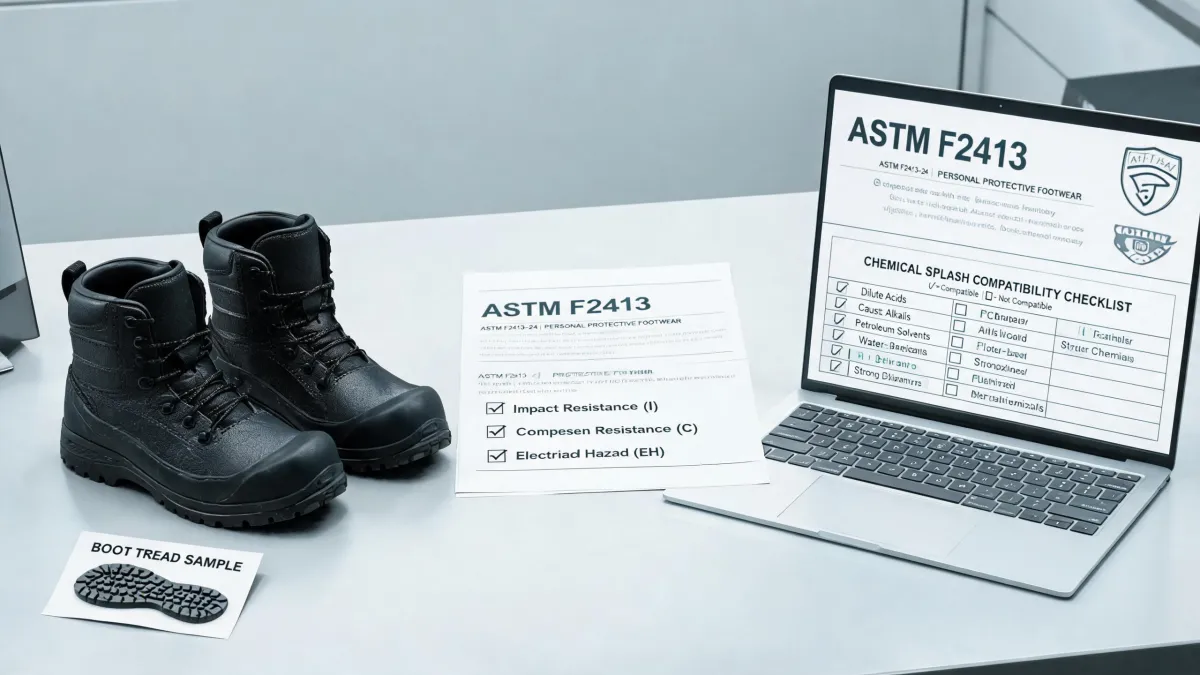
In the U.S., look for ASTM F2413-18 (or the current edition) on the liner, tongue, or shaft. In Europe, it's usually EN ISO 20345. In Canada, CSA Z195. If a listing doesn't show any standard, treat that boot as general purpose.
From the outside, every boot with a toe cap looks like a safety boot. The reality is that a steel toe alone doesn't tell you whether the boot passed impact and compression tests at a rated level. The label does.
OSHA's foot protection rule, 29 CFR 1910.136, requires employers to ensure workers wear protective footwear when there's a risk of falling or rolling objects, objects piercing the sole, or electrical hazards. The rule tells you whether you need safety boots. The label tells you which protections the boot actually passed.
I check the label before I trust the brochure. In Q1 2024, I rejected a batch because the vendor's spec sheet said ASTM but the boots had no marking inside. The replacement shipment was fine, but the paperwork had promised something the product didn't show. So when a brand says safety boot, my first question is always: what standard is printed on it?
One more red flag: a listing that says OSHA certified or OSHA approved. OSHA sets the employer requirement; it doesn't certify individual boots. The recognized standard is what matters. Standards can be updated, so verify the current edition at osha.gov or astm.org before you spec a big order.
Dunlop Steel Toe Boots vs. Dunlop Metatarsal Boots: What's the Difference?
A steel toe protects your toes. A metatarsal boot adds a guard that covers the top of the foot—the metatarsal bones—from about the ankle area forward. Dunlop metatarsal boots give you that coverage either as an integrated guard or as an external strap over the boot.
Why does it matter? A falling object can hit the foot farther back than the toe cap. If a 15-pound part slips off a pallet, a steel toe catches the front half; the metatarsal guard covers the bones behind it. That can be the difference between a bruise and a fracture.
ASTM F2413-18 treats metatarsal protection as a separate rating. A boot can have a steel toe and no metatarsal rating. If you work around suspended loads, metal fabrication, or anything where materials can land on the top of your foot, get Dunlop metatarsal boots and don't overthink the extra cost.
Are Dunlop Boots Waterproof?
Most Dunlop industrial boots are waterproof because they're made from rubber or a waterproof polymer rather than leather. That's a real advantage in wet process areas, washdowns, and outdoor work.
But waterproof is not the same as chemical-proof. A standard rubber boot can handle water and some splashes, but not every sole or compound is rated for solvents, acids, or fuel. Dunlop's chemical-resistant models—sometimes described as hazmat boots—are tested against specific chemicals and have documented ratings. If your exposure is aggressive, check the chemical resistance data before you buy.
One more limit: a boot is waterproof up to its shaft height. If you step into a puddle deeper than the boot, you're going to get wet. A 16-inch boot is not a wader.
How Do Dunlop Boots Fit?
In my experience, most Dunlop work boots run close to true to size, but not all styles come in half sizes or wide widths. If you're between sizes, I'd size up. You'll likely wear a thicker sock, especially on cold sites.
The question everyone asks is, what size should I get? The question I'd ask first is whether the model you want even has the size and safety rating you need. If it doesn't, the fit conversation is moot.
For insulated or metatarsal styles, try the boot with the sock you'll actually wear at work. Rubber boots don't break in like leather. If a rubber boot is tight on day one, it will probably stay tight.
A lot of buyers also focus on toe space and miss the calf opening. If you wear pants over your boots or have wide calves, check the shaft circumference. A tall Dunlop boot can fit the foot perfectly and still be too snug at the top.
Are Dunlop Boots Comfortable to Wear All Day?
For wet or harsh environments, yes. For dry indoor work, maybe not. Rubber boots are heavier and less breathable than leather. That's not a flaw—it's a trade-off. If you're standing in a washdown bay for eight hours, you want that heavy waterproof shaft. If you're walking 20,000 steps through a warehouse on dry floors, you might want a lighter boot.
This is where people ask me about brands like Merrell work boots. Merrell makes comfortable footwear. But a hiking-inspired work boot and an industrial rubber boot are built for different jobs. If you're comparing Merrell work boots to Dunlop boots, compare the safety label first, then the environment. A boot that feels great but doesn't have the rating you need isn't a safe choice.
Where to Buy Steel Toe Boots from Dunlop
Buy from an authorized Dunlop industrial distributor. That could be a large safety supplier, a regional construction supply house, or an online retailer that lists the Dunlop model number clearly. Authorized channels matter because it's easier to verify genuine ASTM-marked product and handle issues if the boot doesn't fit.
When you're searching where to buy steel toe boots, don't shop by the hero photo. Search by model number. Check that the listing includes the safety standard and the model identifier on the boot. If the photo doesn't show a label, ask for one.
For a crew order, ask for a sample or a sizing kit before you commit. One pair in the wrong size costs less than 20 pairs. And if you're building a site PPE list, bundle it: Dunlop boots, heat waves safety glasses, gloves, and hearing protection from one distributor reduces shipping and return headaches.
When Would I Choose Something Other Than Dunlop?
When the hazard doesn't call for a rubber boot. If you're doing mostly dry concrete work, working in a temperature-controlled building, or walking long distances, a leather or composite-toe work boot may be more comfortable. Dunlop is a specialist, and that specialty is wet, tough, chemical-exposed environments.
Here's how I put it to customers: Dunlop is excellent when the job is wet, heavy, or chemical-exposed. But if your site doesn't match those conditions, don't force it. Buy the right tool for the work.
What matters at the end of the day is that the boot has the right rating, fits well, and gets worn by the person doing the job. That last part is the one no spec sheet can answer.