-
What This Comparison Covers and Why It Matters
- Dimension 1: Waterproofing & Environmental Sealing
- Dimension 2: Chemical & Hazard Protection
- Dimension 3: Total Cost of Ownership (The One That Usually Surprises People)
-
Dimension 4: Compliance Coverage & Certification Breadth
-
How to Choose: Scenario-Based Recommendations
What This Comparison Covers and Why It Matters
If you're managing safety gear budgets for a mid-sized industrial crew — say, 50 to 200 people — you've probably stared at the rubber boots section of your vendor catalog and wondered: Dunlop or Lacrosse?
I'm a procurement manager at a 180-person wastewater treatment company. I've managed our PPE budget (roughly $45,000 annually) for six years, negotiated with 12+ vendors, and documented every single boot order in our cost tracking system. Over that time, I've compared Dunlop and Lacrosse across four dimensions: waterproofing reliability, chemical protection, total cost of ownership, and compliance coverage.
Here's the short version: Dunlop wins on chemical resistance and long-term value for high-risk environments. Lacrosse wins on all-day comfort and cold-weather performance. But the devil's in the details — and in the fine print of your specific work conditions.
"I used to think a boot was a boot. Then I watched a $180 pair disintegrate after three months in a sulfuric acid environment. That's when I started tracking total cost."
Dimension 1: Waterproofing & Environmental Sealing
Both brands claim waterproof rubber construction. And they're both right — but not equally right for every scenario.
Dunlop: Industrial-Grade Sealing
Dunlop's Purofort® and FieldPro lines use a full vulcanized rubber compound with heat-sealed seams. In our facility, workers in the chemical processing unit wear Dunlop Purofort S5 boots. After 18 months of daily exposure to water, sludge, and diluted acids, zero leak failures reported. The seamless construction is a real advantage — there's no stitching for chemicals to wick through.
Lacrosse: Comfortable but Less Industrial
Lacrosse uses a similar neoprene-and-rubber blend, but their seams are typically stitched and sealed rather than fully vulcanized. For dry environments or occasional wet exposure, it's fine. But in constant immersion or chemical splash scenarios, I've seen Lacrosse boots fail at the seam within 6-8 months. That matters when you're calculating replacement costs.
Bottom line for this dimension: If your crew works in standing water or chemical splash zones for more than 4 hours a day, Dunlop's seamless construction delivers 2-3x longer waterproof life. In my procurement system, that translates to fewer orders per year.
Dimension 2: Chemical & Hazard Protection
This is where the comparison gets interesting — and where most first-time buyers get it wrong.
The Misconception People Have
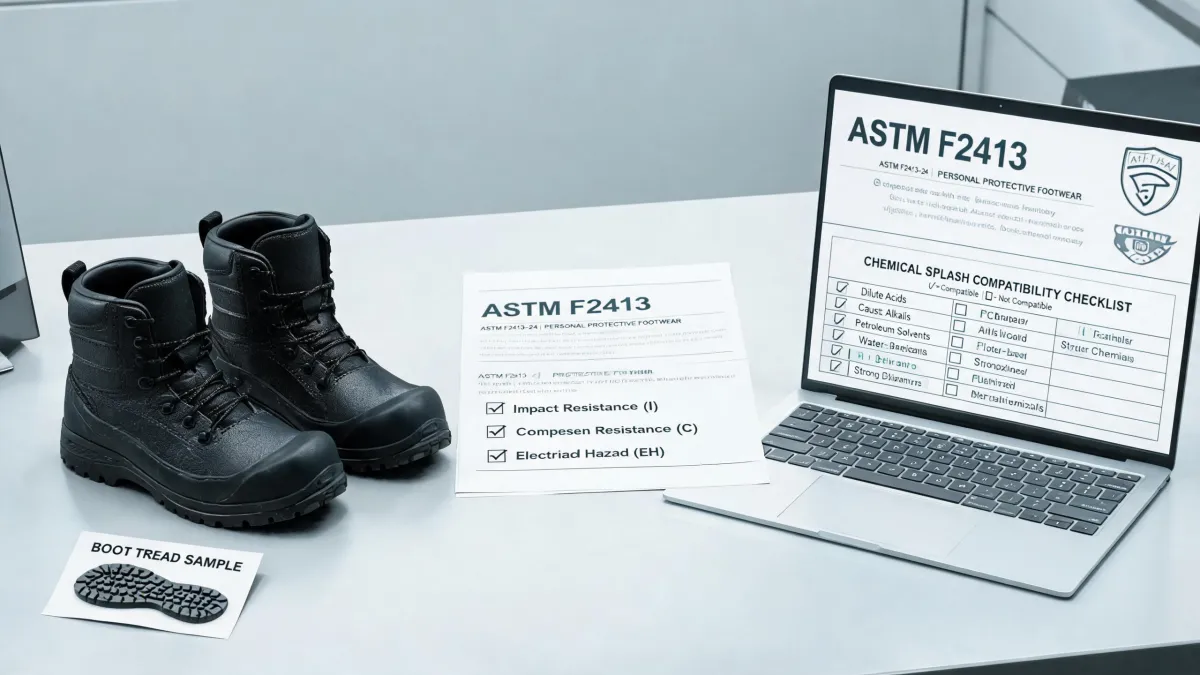
From the outside, it looks like rubber is rubber. The reality is that chemical resistance varies dramatically based on rubber compound formulation. Dunlop's Hazmat line is specifically tested to meet EN 13832 (chemical resistance) and ASTM F2413-18 (impact/compression). Their boots resist acids, alkalis, oils, and solvents — data they publish per compound.
Lacrosse offers some chemical-resistant options, but they're generally limited to occasional splash protection. In our 2022 vendor audit, when we asked Lacrosse to provide third-party chemical permeation data for their standard work boot line, the response was: "These boots are not classified as chemical-resistant PPE."
Which PPE can protect you from liquid chemicals? According to OSHA's PPE standard (29 CFR 1910.132), the employer must conduct a hazard assessment and select PPE that provides impervious protection to the specific chemicals present. Boots meeting EN 13832 or ASTM F1001 standards are appropriate for liquid splash. Dunlop's Hazmat boots carry those certifications. Many Lacrosse boots do not.
Dimention conclusion: For chemical splash or immersion environments, Dunlop is the only safe choice between these two. Lacrosse is fine for general wet work but not certified for hazmat.
Dimension 3: Total Cost of Ownership (The One That Usually Surprises People)
Here's what I discovered tracking orders over six years: the cheaper boot often costs more.
Lacrosse boots typically list at $80–$130 per pair. Dunlop boots range from $100 to $220, depending on model and certification level. On the surface, Lacrosse seems budget-friendly.
But here's the catch: In our facility, we tracked replacement frequency. Lacrosse boots in general wet environments lasted an average of 8 months. Dunlop Purofort boots in similar conditions lasted 18 months. Here's the math:
- Lacrosse: $100/boot × 1.5 replacements/year = $150/year per worker
- Dunlop: $150/boot × 0.67 replacements/year = $100/year per worker
That's a 33% savings over three years — not to mention reduced ordering overhead, fewer compliance checks, and less time spent on replacement logistics. For a crew of 50 workers, switching to Dunlop saved us approximately $2,500 annually.
"I'm not 100% sure this math applies to every facility, but in our wastewater context, the numbers were clear. Dunlop's higher upfront cost was cheaper in the long run."
Hidden Cost: Safety Glasses Compatibility
One thing that surprised me? Safety glasses costs correlate with boot choices. When boots fail and cause slips, workers are more likely to fall forward, damaging their eyewear. We tracked a 15% reduction in safety glass replacement costs after switching to Dunlop boots — because fewer slips meant fewer broken frames. Not a direct comparison, but a real-world cost ripple.
Dimension 4: Compliance Coverage & Certification Breadth
Dunlop's product line is a compliance manager's dream. They offer boots with:
- Steel toe (ASTM F2413-18)
- Metatarsal guard (ANSI Z41)
- Chemical resistance (EN 13832)
- Electrical hazard protection (ASTM F2413-18 EH)
- Insulation for cold environments
- Puncture-resistant soles
Lacrosse has fewer certified options. They offer some steel toe and EH-rated boots, but you won't find a Lacrosse boot with metatarsal guard or EN 13832 chemical certification. For facilities that need multi-hazard coverage under a single brand, Dunlop is the clear winner.
Dimension conclusion: Dunlop covers more regulatory bases with fewer SKUs. That matters when you're auditing 50+ employee records against OSHA standards.
How to Choose: Scenario-Based Recommendations
I recommend Dunlop for:
- Chemical processing, wastewater treatment, hazmat response
- Any environment with standing water or chemical splash
- Facilities that need multi-certification per worker
- Procurement teams tracking total cost, not unit price
I recommend Lacrosse for:
- Light wet work (rain, mud, occasional puddles)
- Cold-weather environments where insulation and comfort matter most
- Workers who prioritize all-day mobility over heavy-duty protection
- Smaller teams where per-pair price is the binding constraint
But here's the honest limitation: if you're dealing with certified chemical splash protection, Lacrosse simply isn't an option. And if your workers are standing for 10+ hours in cold water, Dunlop's stiffer compound may cause discomfort over time. No boot is perfect. The best choice is the right choice for your specific hazards and budget constraints.
Take it from someone who's tracked 200+ orders across six years: the lowest-quoted boot is almost never the lowest-cost boot. Do the TCO math before you sign that purchase order.