-
Before anything else: think in total cost, not price
-
Scenario 1: Wet, cold, and muddy — start with Dunlop insulated rubber boots
-
Scenario 2: Liquid chemicals — the answer is a system, not a single item
-
Scenario 3: Impact and compression — steel toe vs. composite toe work boots
-
Scenario 4: Eye protection without the grumbling
-
How to figure out which scenario you're in
There's no single 'best' safety boot. Anyone who tells you otherwise probably hasn't run a job site with multiple teams, different hazards, and one procurement budget. I'm a procurement manager at a 180-person industrial services company, and I've managed our safety equipment budget for six years—about $180,000 annually, tracked through every invoice, repair, and warranty claim. The question I get most often is: 'Should we buy Dunlop boots, composite toe work boots, or just the cheapest thing that passes inspection?' The answer depends entirely on your scenario.
Before anything else: think in total cost, not price
When I audited our 2023 spending, I found that about a third of our safety boot replacements came from choosing the wrong type of boot for the job, not from a defective product. Cheap boots don't fail because they're cheap; they fail because they were never built for the environment where they're used.
I use a simple mental formula:
TCO = (price + shipping + replacement frequency + downtime + injury risk) / lifespan
A $45 boot that lasts three months costs more than a $95 boot that lasts a year. That sounds obvious on paper, but it's amazing how often it gets ignored when a purchase order is waiting to be signed.
Scenario 1: Wet, cold, and muddy — start with Dunlop insulated rubber boots
For crews working in standing water, rain, or freezing mud, a leather work boot is not enough. You need a waterproof rubber boot, and if overnight lows are in the teens, you need one with insulation too.
Dunlop insulated rubber boots are the option I keep ordering for our utility and municipal crews. The rubber shell keeps water out, the insulation keeps feet warm enough to get through a full shift, and if you pair that with a steel toe (the 'Dunlop rubber boots steel toe' version), you also cover impact hazards from dropped tools or equipment.
But the TCO part is more important than the brand: an uninsulated rubber boot can be the right call for summer crews. If you buy insulated boots for people who work in 80-degree weather, you're paying for warmth that creates a bigger problem. There's no universal 'best Dunlop boot.' There's the best boot for your specific scenario.
In 2024, we ordered 12 pairs of mid-tier insulated rubber boots for our sewer inspection crew. I questioned the price until the crew reported zero leaks after a full winter. (As of January 2025, they're still on those same pairs.) That's the kind of quiet win that makes procurement feel less like paperwork and more like common sense.
Scenario 2: Liquid chemicals — the answer is a system, not a single item
Whenever someone asks 'which PPE can protect you from liquid chemicals,' the honest answer is: a combination of gloves, barrier clothing, eye or face protection, and chemical-resistant footwear. No one piece does it alone.
For boots specifically, the mistake I keep seeing (note to self: add this to our safety training) is assuming steel toe equals protection. Steel toe is for impact and compression. It doesn't stop a chemical from soaking into the boot's lining and sitting against the skin. What matters is the material and construction.
For liquid chemical exposure, look for boots made from nitrile, neoprene, or a rubber compound that is compatible with the specific chemical you're using. Dunlop's hazmat-style rubber boots are one option, but I'd never order a pair without asking the supplier for the chemical compatibility and permeation data. If they won't send the chart, that's a red flag.
Also check the safety glasses question in the same discussion. Heat Waves safety glasses are comfortable and look good enough that people actually wear them, which I like for our fabrication shop. But for liquid chemical splash, safety glasses don't form a tight seal around the eye. You need indirect-vented chemical goggles or a face shield that meets ANSI/ISEA Z87.1. The comfortable glasses can be part of the system; they're just not the whole answer.
According to OSHA (osha.gov), employers are required to assess workplace hazards and select PPE that fits the hazard. That's 29 CFR 1910.132, and it applies to chemical-resistant boots as much as it does to goggles. Let the standard be your starting point, not a marketing photo.
Scenario 3: Impact and compression — steel toe vs. composite toe work boots
Steel toe work boots have been the default for decades. For good reason: they handle impact and compression, and they're usually less expensive up front. But they are not always the least expensive option over the long run.
Composite toe work boots are lighter, nonmetallic, and don't turn your feet into ice cubes in cold weather. In my opinion, the extra upfront cost is worth it for technicians who climb ladders or work outside in winter. Composite toes also don't set off metal detectors, which matters if your team is moving between secured facilities.
That doesn't mean steel toe is obsolete. If you're on a site with forklifts and heavy equipment, I'd argue steel toe is still the safer default. The key is matching the material to the hazard, not to fashion.
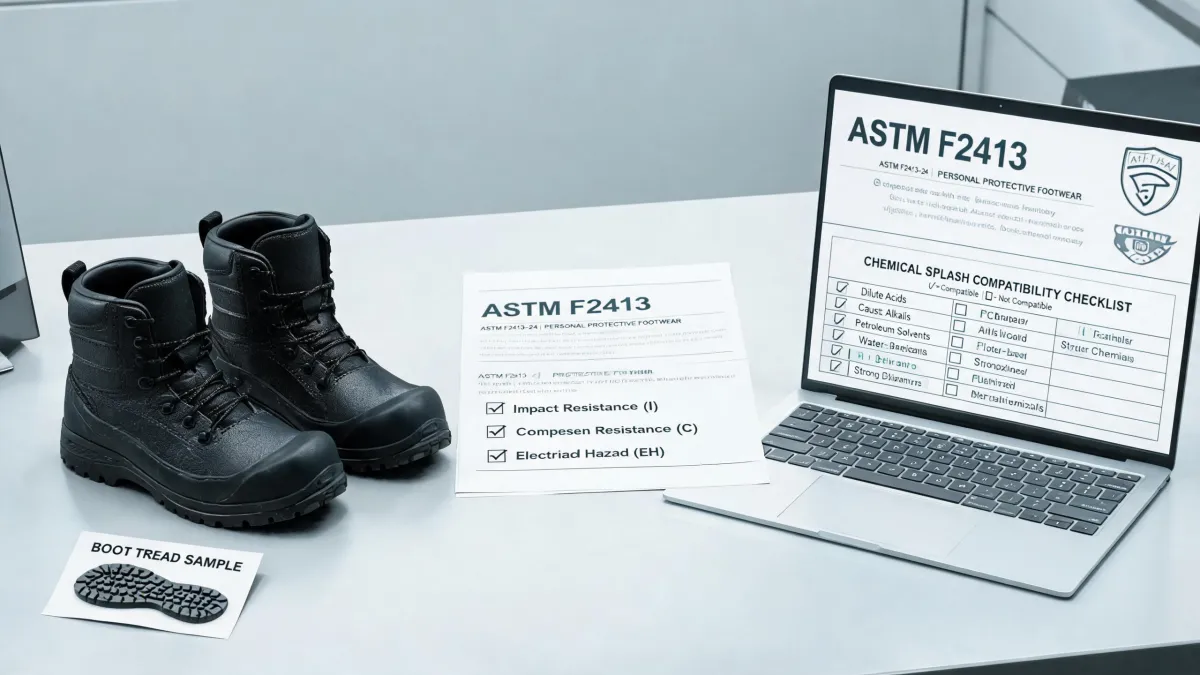
One thing I look for before ordering any safety boot is the label. In the US, it should say ASTM F2413-18. In Europe, it should show EN ISO 20345 with a rating like S3. If a boot doesn't have one of those marks, it's a work boot, not a safety boot. (I'm not 100% sure every Dunlop insulated boot carries the same rating, so check the spec sheet for the particular model before you buy.)
Scenario 4: Eye protection without the grumbling
Eye protection is the easiest place to waste money. If you buy the cheapest $2 safety glasses, people will scratch them, lose them, or stop wearing them because they fog up. Then you buy another pair. And another. The total cost is higher than buying one decent pair that gets used.
Heat Waves safety glasses are the ones that keep coming back in our employee requests. They look normal and, as long as they carry the Z87.1 marking, they're a reasonable choice for impact hazards like dust and fragments. For chemical splash, remember the rule from Scenario 2: goggles or a face shield, not just glasses. If someone is doing both jobs in one day, get both. You can have a pair of comfy safety glasses for the shop and a pair of chemical goggles for the tasks that need a seal.
How to figure out which scenario you're in
If you're still unsure, use this quick rule of thumb:
- Wet, cold, muddy work → Dunlop insulated rubber boots (add steel toe if there's any drop or crush risk).
- Liquid chemical work → chemical-resistant boots plus chemical goggles or a face shield, not just safety glasses.
- Heavy impact or compression → steel toe or composite toe with an ASTM F2413-18 or EN ISO 20345 label.
- Cold weather, lots of walking, or metal detectors → composite toe work boots.
- Eye protection from impact → Z87.1 safety glasses like Heat Waves. Eye protection from chemical splash → goggles or a face shield.
The surprise wasn't the price difference between cheap boots and good boots. It was how much hidden value came with the more expensive option: fewer leaks, warmer feet, longer lifespan, and zero emergency orders. When I compared two crews side by side over a full season, I finally understood why the right material matters more than the number on the invoice.
There's something satisfying about seeing the same boots on the same employee after a second winter. After six years of tracking every invoice, that's the payoff. And it's exactly why I'll keep calculating total cost before I sign my next purchase order.
Prices and standards mentioned here are based on my experience and memory; verify current specs and regulations before ordering.