-
Why this Dunlop vs Twisted X comparison exists
-
Protection: what the boot is actually protecting against
-
Durability: environment beats price
-
Comfort and break-in: the spec sheet doesn't tell you this
-
Total cost over time: the math that changed how I buy boots
- How to wash work boots (nobody taught me this, so here it is)
-
So: Dunlop or Twisted X?
Why this Dunlop vs Twisted X comparison exists
I'm a maintenance supervisor. I've been handling safety footwear orders for our crew since 2017, and I've personally made—and documented—six significant buying mistakes, totaling roughly $3,200 in wasted budget. So this isn't a lab test. This is a checklist born from real orders that failed, got reordered, and eventually taught our team how to buy boots properly.
The safety footwear market has changed a lot since I started in this role. Choices are better than they used to be—and more confusing. This comparison looks at two very different approaches:
- Dunlop work boots—rubber boots built for wet, muddy, and chemical-exposed environments. I'll reference the Dunlop Chesapeake men's rubber boots plain toe and the Dunlop Dakota safety boots, the two models we've ordered most.
- Twisted X steel toe boots—leather work boots made for impact protection, dry site work, and all-day comfort.
I'll compare them on four dimensions: protection, durability, comfort, and total cost. The cost section is where I got surprised—stick around for that one.
Protection: what the boot is actually protecting against
The most expensive mistake of my first year? Treating "safety boots" as a single category. It's tempting to think you can just compare steel toe vs plain toe and move on. But that oversimplification ignores what the actual hazards are on your site.
Dunlop rubber boots prioritize liquid hazards. The Dunlop Dakota safety boots combine a steel toe cap with a waterproof rubber shell, so you get impact protection plus chemical splash resistance in one boot. The Dunlop Hazmat line goes further with acid and alkali resistance built into the rubber itself.
The Dunlop Chesapeake men's rubber boots plain toe is the lighter-duty option. Fully waterproof, comfortable, easy to pull on. But there's no toe cap. If something heavy drops on your foot, the rubber isn't going to save that toe.
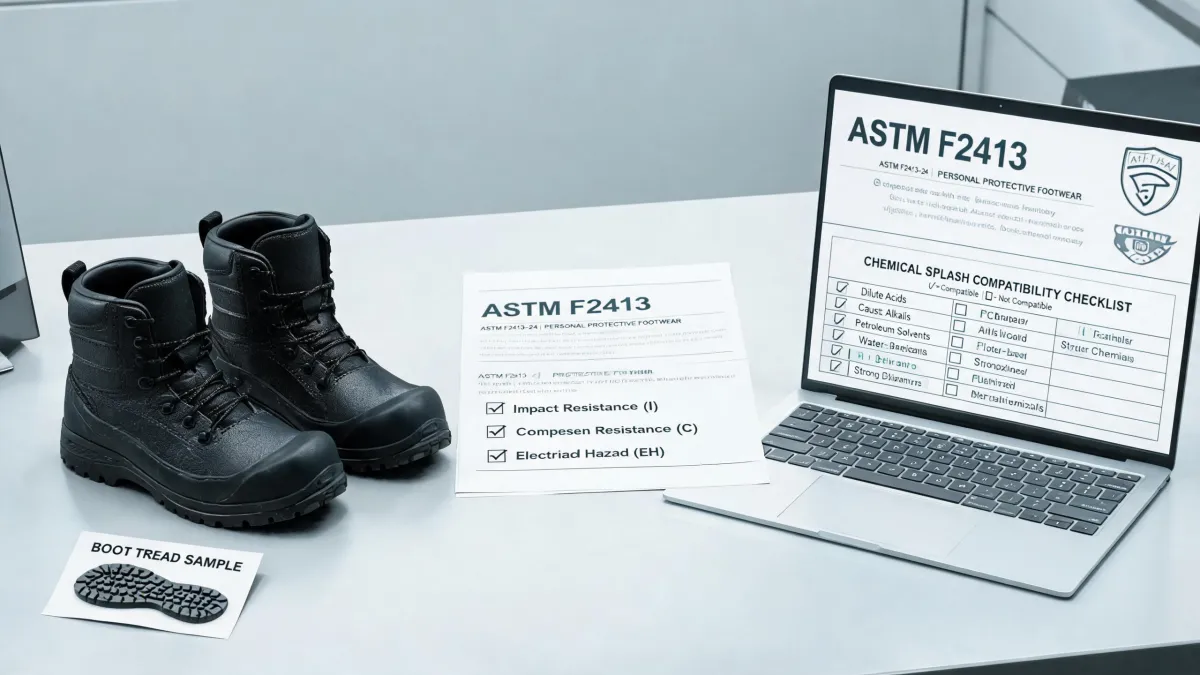
Twisted X steel toe boots answer a different set of hazards. Their steel toe caps meet ASTM F2413-18 impact and compression standards (Source: ASTM International, astm.org). Many models also carry electrical hazard ratings. In a dry environment with falling objects or electrical exposure, this is the more direct protection.
Here's the mistake that cost me the most: in September 2021, I ordered 12 pairs of Twisted X for our chemical disposal team. On paper they looked great—leather, steel toe, strong reviews. In practice, chemical splashes destroyed the uppers within two months. Rubber would've shrugged off those same splashes. The boots weren't bad; they just weren't right for that environment.
The reverse happened in 2019: I bought Chesapeake plain toe boots for a crew doing tank repairs. I was so focused on wet conditions that I ignored the falling tools risk. A dropped crescent wrench can break a toe. Saving about $25 per pair cost us way more once we reordered proper steel toe boots.
Verdict on this dimension: Dunlop wins for wet and chemical environments. Twisted X wins for dry sites with impact hazards. They're not really competing for the same job—that's the point I kept missing.
Durability: environment beats price
People think expensive boots last longer. In my experience, it's the other way: boots that match the environment last longer. Price doesn't create durability—the match does. The causation runs the opposite of what most people assume.
Dunlop's rubber boots hold up seriously well in wet, dirty conditions. The rubber compound handles water, mud, diluted chemicals, livestock waste—you name it. Our wastewater guys get two to three years from a pair of Dakotas. But rubber has a weakness: heat and UV. Leave rubber boots baking in a truck bed through a summer, and they'll crack. We lost two pairs that way in 2022.
Twisted X leather boots are tough in dry environments. With routine cleaning and conditioning, the leather handles scrapes and abrasion well, and some models can be resoled. But leather does not tolerate constant moisture or chemical contact. Our 2021 disaster is proof—$1,860 of boots, basically ruined by week eight.
The Dunlop Dakota sits in a useful middle zone: rubber shell for wet conditions, steel toe for impact. They're heavier than a typical leather boot, but in mixed industrial environments they've been the longest-lasting option we've ordered.
One more thing: Dunlop has upgraded their rubber compounds and insoles significantly since 2017. The boots we bought back then were clunky compared to the same models today. Old assumptions about rubber boots—that they're cheap, stiff, and uncomfortable—are outdated. What was best practice in 2020 may not apply in 2025.
Verdict: Neither brand "lasts longer" on its own. Durability is determined by how well the boot material matches your working conditions.
Comfort and break-in: the spec sheet doesn't tell you this
This one is personal, because more than any other factor, comfort determines whether your crew actually wears the boots. And boots that sit in a locker protect nobody.
Dunlop rubber boots have basically no break-in. You put them on, they flex, you work. The Chesapeake is especially easy right out of the box. The tradeoff is breathability—rubber doesn't breathe. On a hot summer day, your feet will sweat. Our wastewater crew started rotating two pairs each just to manage the moisture.
Twisted X steel toe boots take one to two weeks to break in. The leather needs to soften and mold to your foot. Expect some stiffness during that window, maybe a hot spot. But after break-in, they're seriously comfortable for long days—the footbed and arch support are genuinely good. Several of our guys wear them on weekends too, which is about the best compliment a work boot can get.
The Dunlop Dakota sits between these two: no break-in, but heavier than the Chesapeake, and the steel toe adds some stiffness. If you need steel toe plus waterproofing, it's the right tradeoff.
What I've learned: don't buy "the most comfortable boot" based on someone else's review. Comfort comes from fit with your specific work pace, environment, and foot type. We keep both brands in our boot rack for different seasons and tasks—that's not indecision, it's just matching boots to the work.
Total cost over time: the math that changed how I buy boots
Alright, here's where my assumptions flipped.
Sticker prices alone make Dunlop look like the obvious budget choice. The Chesapeake typically lists around $60–80; the Dakota around $90–120. A typical Twisted X steel toe boot goes for $130–200 (based on publicly listed prices, March 2025; verify current pricing).
But purchase price isn't the real cost. In that 2021 incident: 12 pairs of Twisted X at $155 each = $1,860, failed in two months. Then 12 pairs of Dunlop Hazmat boots at around $110 each = $1,320, which actually worked. Total: $3,180 spent on one job. The right boots alone would have been $1,320. That's a $1,860 mistake—my single largest documented one.
The irony? I ordered "premium" Twisted X for that crew specifically to avoid replacing boots so often. Better quality, I thought, equals longer life. But in that environment, a $155 leather boot was never going to outlast a $110 rubber boot. The material was wrong before the price even mattered.
Here's the framework we use now:
- Wet or chemical environment + rubber boots (Dunlop): low upkeep, two to three years of service. High value.
- Wet or chemical environment + leather boots (Twisted X): material breakdown, immediate replacement. Lowest value.
- Dry site work + leather steel toe (Twisted X): low upkeep, multi-year service, often resolable. High value.
- Dry site work + plain rubber boots (Chesapeake): no impact protection. Hidden risk.
Bottom line: A $120 Dakota that lasts two years in wet conditions is way cheaper than a $155 Twisted X that fails in two months. And a $180 Twisted X that lasts three years on a construction site beats a $70 rubber boot that doesn't protect against falling objects. The cheapest boot is always the one that matches the job.
How to wash work boots (nobody taught me this, so here it is)
The third time someone told me their boots were "falling apart after one winter," I realized we had a process gap: nobody on our team had ever been shown how to wash work boots properly. We pressure-washed rubber boots. We dried leather boots next to a space heater. Both are terrible ideas. Since Q1 2024, we've followed a written care routine, and our PPE replacement costs have dropped noticeably. We've caught at least 40 preventable issues with this checklist—maybe 45, I'd have to check the spreadsheet.
For Dunlop rubber boots
- Rinse off chemicals, mud, or salt with fresh water as soon as the shift ends. Don't let anything dry onto the rubber.
- Wash with warm water and mild soap (dish soap works fine) and a soft brush.
- Wipe down, then air dry away from direct heat or sunlight. A shaded rack works.
- Store upright. Don't fold the shafts or stack heavy gear on top of them.
One warning: don't pressure-wash rubber boots up close. The high-pressure water forces its way past the seams and traps moisture inside the lining. We ruined a pair of Dakotas exactly that way—looked clean outside, stayed soggy inside.
For Twisted X leather boots
- Brush off loose dirt with a stiff brush or dry cloth.
- Clean with saddle soap or a dedicated leather cleaner. Don't soak the leather.
- Dry at room temperature, naturally. Never set leather boots near a heater or in direct sun.
- Apply a thin layer of leather conditioner once dry, and let it absorb overnight.
Never machine-wash leather boots. Never put them in a dryer. Heat destroys the leather fibers and weakens the sole adhesive. If leather boots get soaked, stuff them with newspaper—it pulls out the moisture without shrinking the material.
The same logic applies to hand protection. When you're doing a PPE review, leather gloves for men on your crew need the same treatment: clean, condition, air dry. We upgraded glove care at the same time as boot care, and our overall PPE replacement spending went down.
So: Dunlop or Twisted X?
After seven years of getting it wrong sometimes and right other times, here's my rule:
Buy Dunlop rubber boots when your site is wet, muddy, or chemical-exposed. If steel toe protection is required in a wet environment, get the Dunlop Dakota safety boots. If not, the Chesapeake plain toe is a solid, budget-friendly choice.
Buy Twisted X steel toe boots when your site is dry and impact hazards are real. Construction, contracting, warehouse, general industrial work. You want a boot that molds to your foot and can be resoled.
And if your crew works across both environments? Don't order one model for everyone. That was mistake number one back in 2017, and it's the reason this checklist exists.