It was 2:17 on a Friday afternoon when my phone rang. The caller ID read "Grayson Foods," which isn't a name I normally see before the weekend. I almost let it roll to voicemail.
Glad I didn't.
Their safety manager, Dave, was on the line, and his voice had that tight, controlled urgency you learn to pick up on after years in this job. A state OSHA audit had just been scheduled for Monday morning—an inspection nobody saw coming. And his PPE program was about to come up short.
"How many boots are we talking?" I asked.
"Thirty-four pairs," he said. "Steel toe rubber boots. Sizes 9 to 13. And I need them here by Sunday night."
I told him I'd call back in an hour.
For context: in the six years I've spent coordinating safety equipment for food processing and industrial facilities, I've handled well over 200 rush orders. It's not the emergencies that get you—it's the way they always show up at the same time: late on a Friday, with a hard deadline, when all the easy answers have left for the weekend.
Why "just order them online" wasn't going to work
The internet makes buying steel toe boots look effortless. Open a tab, find a pair with a few thousand five-star reviews, click checkout, wait for a box. With a two-week lead time, that's a perfectly good way to shop.
Dave didn't have two weeks. He had about 60 hours before an auditor walked onto his production floor.
His facility runs a USDA-inspected food processing operation—constant water, slippery surfaces, and strict sanitation rules. Same-day delivery of the right boot was out of the question. Even next-day options from the big online retailers were unreliable when you need a specific safety rating, an actual size run, and a shipping promise that isn't just a tracking number generated in a warehouse somewhere. If you've ever watched a USPS scan sit in limbo for 48 hours, you know exactly what I'm talking about.
So I started the old-fashioned hunt: calling distributors and whispering "dunlop rubber boots near me" into my phone between emails. It sounds like a joke, but a search results page doesn't tell you what's actually sitting on a shelf. That requires a real human picking up a phone.
My first call was to Maria, our regular distributor's inside sales rep. She picked up on the second ring—another small Friday miracle—and pulled their inventory. She had plenty of Dunlop boots, but the numbers didn't line up. She carried the Dunlop Chesapeake rubber boots in sizes 7 through 12, but Dave needed five pairs in size 13. And she was nearly out of the steel-toe Dunlop FieldPro, which is normally my first pick for wet food environments.
"I can get you twelve pairs of the FieldPro by Wednesday," she said.
Wednesday wasn't Sunday night. I thanked her and kept moving.
The call that changed the scope
About 45 minutes into the search, Dave phoned back with an update that made everything harder.
"The audit checklist also flags head protection and eye protection in the maintenance and weld shop zones," he said. "Seventeen guys on the maintenance mezzanine are bumping their heads on overhead lines. We need bump caps. And the weld shop needs safety glasses with side shields—we only have basic lenses."
That was the moment I understood this wasn't a boot order anymore. It was a PPE compliance package with a hard deadline.
Now, let me be clear about my limits here. I'm not a safety engineer, so I'm not going to pretend I can quote every OSHA interpretation from memory. What I can tell you is the procurement side—how to find and deliver the right gear when the clock is running. That part I know cold.
The parts that nearly broke the order
The bump caps were the easy part. We keep Milwaukee bump caps in our own warehouse for exactly this kind of situation. They're lightweight, fit under welding hoods without getting in the way, and they cover the mezzanine hazard without making the crew feel like they're wearing a hard hat for no reason.
Sidenote: per ANSI/ISEA Z89.1, a bump cap is not a protective helmet. It doesn't meet Type I or Type II impact criteria for falling objects—it's meant for bumping your head on a pipe, not for serious overhead impact. Matching the certificate to the actual hazard is what matters for compliance, a lesson I've watched more than one client learn the hard way.
The glasses were harder than they had any right to be. I called a local welding supply shop and they had one model on the shelf: the Uvex Genesis with molded-in side shields. The side shields are built into the frame, which means they can't be lost or popped off at an inconvenient moment—a small detail that absolutely counts during an audit. They met ANSI Z87.1, and the shop had 24 pairs. We needed 22.
That was the surprise of the whole afternoon, honestly. The ancillary safety gear—the items that were supposed to be the straightforward part—took nearly as much time to source as the boots themselves. Nobody writes a budget line for that, and nobody plans for the extra two hours of phone calls.
Where the boots actually came from
Here's what I've learned about same-weekend sourcing: "near me" is a starting point, not a strategy. A supplier ten minutes away with the wrong spec is a dead end. A distributor 90 minutes up the highway with actual stock and overnight freight is a lifeline.
The lifeline this time was a three-generation safety supply house run by a guy named Ray, who answered his own phone on a Friday afternoon. He had 28 pairs of Dunlop 6801 PVC steel toe boots in the size range Dave needed. Close, but not enough. Then Ray found four more pairs in his back room from a canceled customer order—that made 32. Between Dave's plant and a sister facility down the road, we pulled two extra pairs from storage. Total: 34. Size 13s included.
Just before I told Ray to ship, a question caught in my throat. Dave had used the word "chemical" earlier when describing the cleaning lines. The 6801 is a solid general-purpose rubber boot—waterproof, washable, steel toe, good on wet tile—but if his maintenance crew was actually dealing with chemical residue on a regular basis, we were talking about a different category of boot. That's exactly where a routine rush order turns into a compliance issue.
I'm not a chemist, so I won't get deep into polymer ratings here. What I know from experience is that "hazmat" and "chemical resistant" are specific claims, and per FTC guidelines, manufacturers have to substantiate what they print on a label. But it's the buyer who has to know which claim to look for.
Dave, to his credit, dug through his SDS binder and confirmed the chemical exposure on the cleaning lines was diluted acids and alkalis at low concentration. That meant the Dunlop Hazmax line would have been the ideal choice—but Ray didn't have Hazmax boots in stock, and nobody else did either. On a Saturday afternoon, that's just the reality.
So we made an honest judgment call:
- 26 pairs of Dunlop Chesapeake steel toe rubber boots for general production—waterproof, washable, dependable on wet floors
- 6 pairs of Dunlop FieldPro boots for team leads and maintenance, offering better oil and fat resistance
- 2 pairs of Dunlop 6801 boots as temporary spares, with a clear follow-up for Dave's chemical safety consultant to spec proper Hazmax replacements
It wasn't a pretty, uniform order—or rather, it was exactly what a 48-hour deadline produces: a practical compromise. But it was honest about the difference between "what's ideal for this facility" and "what can be delivered before Monday." The per-pair price landed between $45 and $65 depending on the model, plus a $200 rush fee that Ray charged without apology. I didn't argue.
Sunday, 4:10 PM
The truck arrived at Grayson Foods at 4:10 on Sunday afternoon. Dave had two crew members waiting to unload, and the boots were sorted by size within twenty minutes.
Monday at 9:47 AM, Dave texted me a photo: thirty-four guys lined up on the production floor in new boots, with the caption, "Auditor just left. Said our PPE program was 'impressively thorough.'"
I'd be lying if I said I wasn't relieved. There were at least four points where this order could have fallen apart—Maria's stock gap, the size 13 shortage, the bump cap and glasses add-on, the chemical exposure question. Any one of those could have meant a failed audit. Instead, everything lined up.
So glad I didn't let that Friday call go to voicemail.
What this experience taught me about buying safety boots
If you've ever been responsible for PPE purchasing, you know the simple sentence "I need to buy work boots" can turn into a compliance research project faster than you'd believe. Here are the takeaways I'd pass along to anyone asking "where to buy steel toe boots"—whether it's a routine order or a 48-hour emergency.
1. Match the boot to the actual hazard
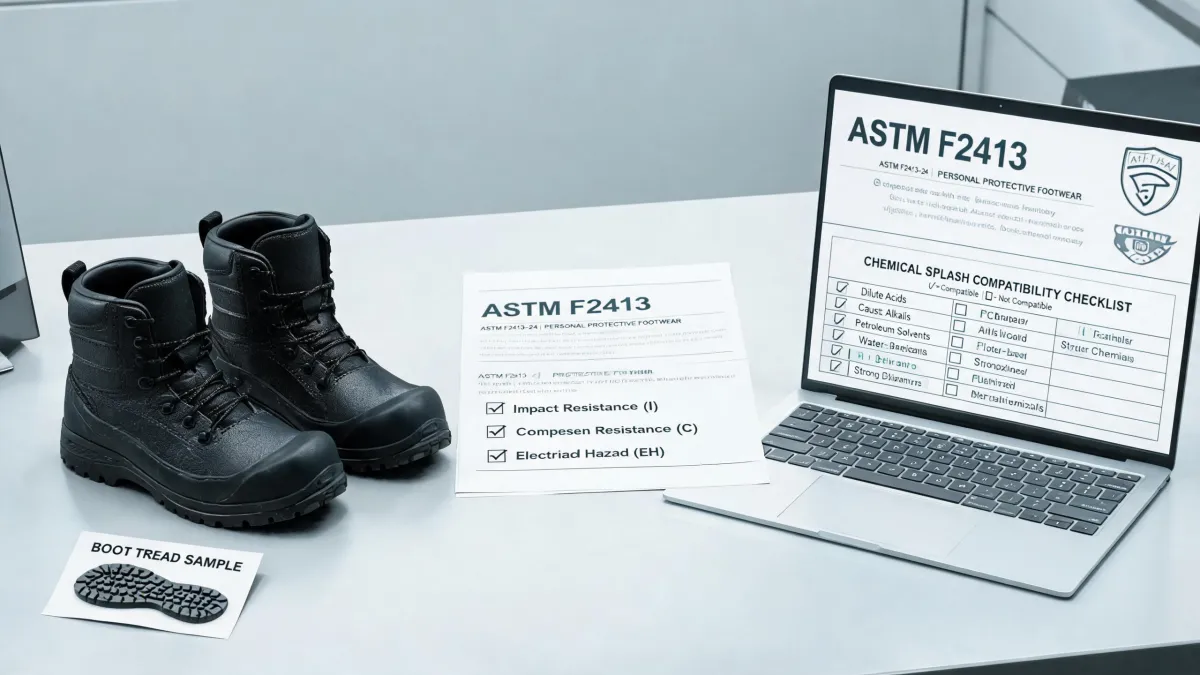
The best boot in the world is the wrong boot if it doesn't address what the work environment throws at it. Know whether you need ASTM F2413-18 impact protection for falling objects, chemical resistance for caustic materials, or an electrical hazard rating for live work. Then compare that list against the boot's spec sheet—don't just buy the pair with the best reviews.
2. Verify real stock before you get attached to a model
Feature lists are easy to sell. Physical inventory is harder. In an emergency, call first, ask what's actually on a shelf near you, and let availability help shape your selection. That applies to online orders too—talk to a human and confirm the full size run before you enter payment details.
3. "Near me" only counts if the shelf has the right size
A rubber boot is not like a roll of shrink wrap or a box of gloves; a wrong size is completely useless. Local stores can be great partners, but their stock depth is limited. A regional distributor with overnight freight often solves a deadline that a local shelf simply can't.
4. Don't tunnel-vision on the headline item
This story was about 34 pairs of boots, but the audit itself flagged bump caps and side-shield glasses too. When preparing for a compliance visit, walk the whole facility. Look up. Look at what's on people's faces, not just their feet.
5. The industry has changed—but the fundamentals haven't
What was best practice in 2020 may not hold up in 2025. Online buying options have multiplied, supply chains have shifted, and SKUs that used to be reliable stock items now have quirks. But the fundamentals remain the same: ask the right questions about exposure, verify the safety rating, confirm the delivery date. The buying process has transformed. The underlying risks haven't.
Was the order perfect? No. We paid a rush fee, blended three boot models, and left one gap—the Hazmax replacement—for Dave's consultant to fill after the audit. But the crew had safe, compliant footwear on Monday morning, the inspection passed, and Dave learned something that no product page will tell you: a two-minute phone call on Friday afternoon is worth more than twenty browser tabs open on Saturday night.
That's the trade I'll take every time. A little controlled chaos on the front end, a clean result on the back end, and a client who now understands the difference between ordering boots online and sourcing the right boots for a specific workplace.