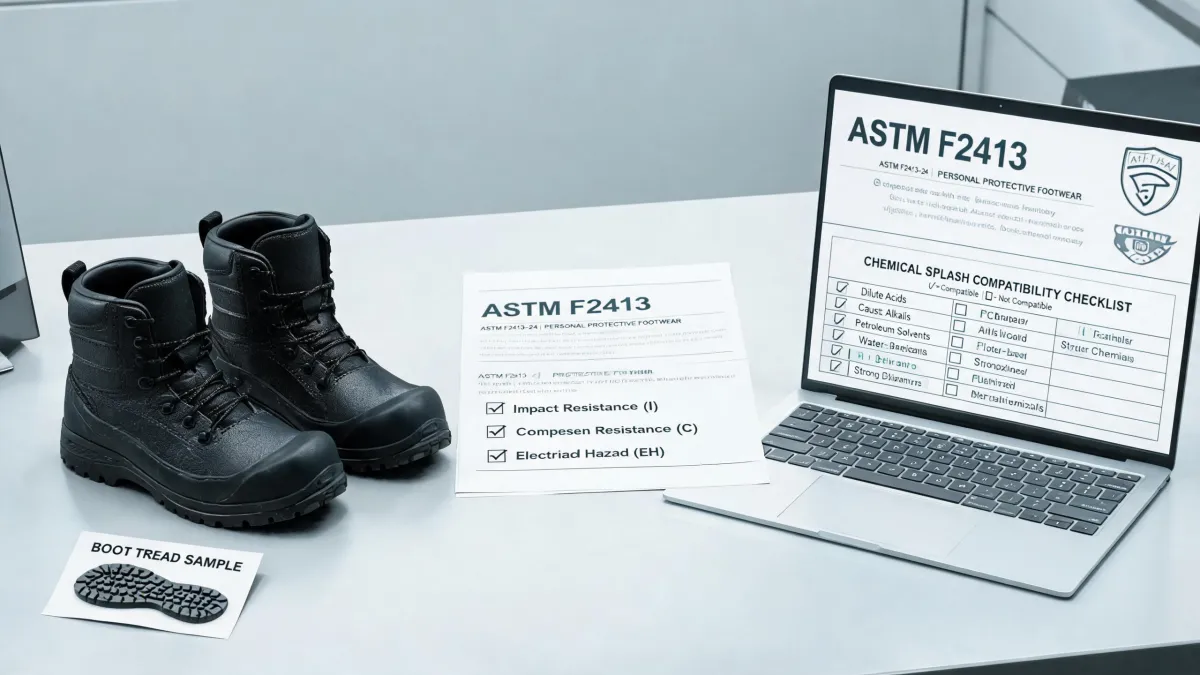
Let me start with a scene I bet you know. A requisition lands on my desk: "Need 10 pairs of men's safety boots for the warehouse crew." I open the catalog, search by price—low to high—and place the order. Done. Two months later, I'm spending half a day dealing with complaints about blisters, boots that soaked through after a week, and a foreman who is wondering why I chose "those cheap things."
That was me, about three years ago. I was an office administrator for a 50-person industrial parts company. I managed all our PPE purchasing—roughly $150,000 annually across 10 vendors. I reported to both operations (who wanted comfort and safety) and finance (who wanted the lowest unit price). And I was failing at it because I was only looking at one number.
I learned the hard way that the total cost of a pair of safety boots isn't the sticker price. It’s the price plus the replacements, the downtime, and, honestly, the headache. That’s why we eventually standardized on men's Dunlop rubber boots for most of our heavy-duty roles. Not because they were the cheapest (they weren't), but because they were the most cost-effective over a 12-month cycle.
The Trap I Fell Into: Sticker Price vs. True Cost
When I took over purchasing in 2021, my mandate was simple: "Cut costs." So, I did. I found a pair of work boots from a discount supplier for $38. The Dunlop safety boots we were considering were $65. The math seemed obvious. I bought 20 pairs of the $38 boots.
Here is what the $38 pair actually cost us:
- Replacement Cycle: The cheap boots lasted an average of 4 months. The Dunlop boots we eventually switched to last 12-14 months.
- Down Time: When a pair failed (sole separated, steel toe broke), the worker had to stop, fill out a form, and wait for a replacement. That was 45 minutes of lost productivity per incident.
- Discomfort: The insoles flattened in 2 weeks. We had three complaints about blisters. One worker went to urgent care for an infection caused by a boot rubbing his ankle raw.
I remember sitting with the ops manager, looking at the total spend for that year. The per-unit cost was low, but the total cost per worker per year was higher than if I had bought the Dunlop boots in the first place. It was a classic case of being penny-wise and pound-foolish.
The Real Problem: It’s Not About the Boot—It’s About the System
So, the obvious problem was that I chose cheap boots. But the deeper problem was my purchasing system. I was optimizing for the wrong metric.
When I finally analyzed our spend, I realized the real issue wasn't the boot quality—it was the transaction cost of managing failures.
Put another way: every time a cheap boot failed, someone (me) had to process a return, find a replacement, update the inventory list, and explain to finance why we had a "write-off." That hidden labor cost was eating up whatever savings I thought I had made.
Seeing our rush orders vs. standard orders over a full year made me realize we were spending 40% more than necessary on artificial emergencies. We weren't buying boots; we were buying firefighting hours.
The Moment Everything Changed
In 2022, we had a safety audit. The auditor asked to see our PPE inventory list. When he saw the sku for the cheap boots (let's call it "model XYZ"), he raised an eyebrow.
"These don't meet the ASTM F2413-18 standard for impact and compression resistance. You know that?"
I did not know that. I had assumed that if it was for sale as a "work boot," it was compliant. I was wrong.
That was the moment I realized that not all safety boots are created equal. The Dunlop products we eventually evaluated clearly stated their certifications on the spec sheet: ASTM F2413-18 for the steel toe models, and specific ratings for slip resistance and electrical hazard protection. The cheap supplier’s page? It just said "tough."
After that audit, I decided to test a batch of men's Dunlop rubber boots for our shipping and receiving team. The FieldPro series, specifically. I wanted to see if the higher price was justified by fewer claims and less downtime.
The 12-Month Test: Dunlop vs. The Old Standard
We ran a controlled test in 2023. I split a team of 15 into two groups. Group A wore the Dunlop boots. Group B wore the old discount boots. We tracked everything:
- Comfort Score (1-10): Group A averaged 8.5. Group B averaged 5.2.
- Boot Failures: Group A had 1 (a lace broke). Group B had 6 (3 sole separations, 2 waterproof failures, 1 comp toe crack).
- Productivity Loss: Group A lost 0 hours to boot issues. Group B lost ~8 hours (returns, redistributing gear).
I should add that the Dunlop boots are heavier. I was worried about that. Turns out, the crew didn't mind. They liked the durable rubber construction and the fact that their feet stayed dry even when cleaning out a flooded floor drain. One worker told me, "These feel like they're built for work, not for looking cool."
Dodged a bullet on the weight issue. Almost rejected the whole idea based on the spec sheet weight difference.
The Hidden Savings
The most surprising thing? The time I saved. With the discount boots, I was processing small orders every month to replace failures. With the Dunlop boots, I placed one bulk order for the year and didn't think about it again until budget planning.
Calculating this out:
- Old system: 12 orders/year for boots × 30 min to process each = 6 hours. Plus 5-6 hours dealing with complaints and returns. Total: 11 hours of admin time.
- New system: 2 orders/year (initial + one mid-year fill) = 1 hour. Zero complaint time. Total: 1 hour.
I saved 10 hours of my own time. Time I could spend on other, more important problems. If you value my time at roughly $30/hour (plus benefits), that's $300 in hidden savings just from me. Multiply that across the entire warehouse team's satisfaction and reduced safety incidents, and the real savings were much higher.
So, Where Does the Value Come From?
I am not saying Dunlop is the only option. But I am saying that when you look at the total cost of ownership (TCO), the math changes significantly. Here is what I now tell other procurement people when they ask about buying men's safety boots:
- Check the Certification: Make sure the boot meets ASTM or ANSI standards for your specific environment. Don't assume. Verify the sku against the standard.
- Look at the Construction: A vulcanized rubber boot (like most Dunlop boots) will have a much better bond between the sole and the upper than a glued boot. Glue fails. Vulcanization lasts.
- Factor in the Fit: Chelsea work boots (like Dunlop’s Chelsea models) are easier to take on and off, which means less time in the locker room. That might sound small, but over a year, it adds up.
- Consider the Job Role: If you have workers dealing with chemicals, you need a Hazmat-rated boot. Dunlop has specific models for that. Buying a standard rubber boot for a Hazmat role is a safety disaster waiting to happen.
I've found that men's Dunlop rubber boots specifically are a sweet spot for durability and protection in wet or oily environments. The Chelsea work boot style is also a winner for logistics teams that need to slip them on and off quickly.
Final Thought: You Have to Trust the Process
I still get asked, "But aren't the tactical boots from Under Armour lighter?" Yes, they are. But they are designed for dry, tactical use, not for standing in a puddle of cutting oil for 8 hours. Context matters. Where to buy work boots is a secondary question. The primary question is: which boot is safest and most cost-effective for my specific environment?
If you are buying safety footwear for a team, ignore the unit price. Calculate the total cost over 12 months. Include your time, the worker's comfort, and the safety compliance risk. If you do that honestly, you might find—as I did—that a quality pair of Dunlop boots is actually the cheaper option in the long run.
Oh, and about that 18% savings I mentioned in the title? That was our total PPE spend reduction in the first year after switching. The boots cost more up front, but the savings from fewer replacements, less admin time, and zero safety fines made it a no-brainer.