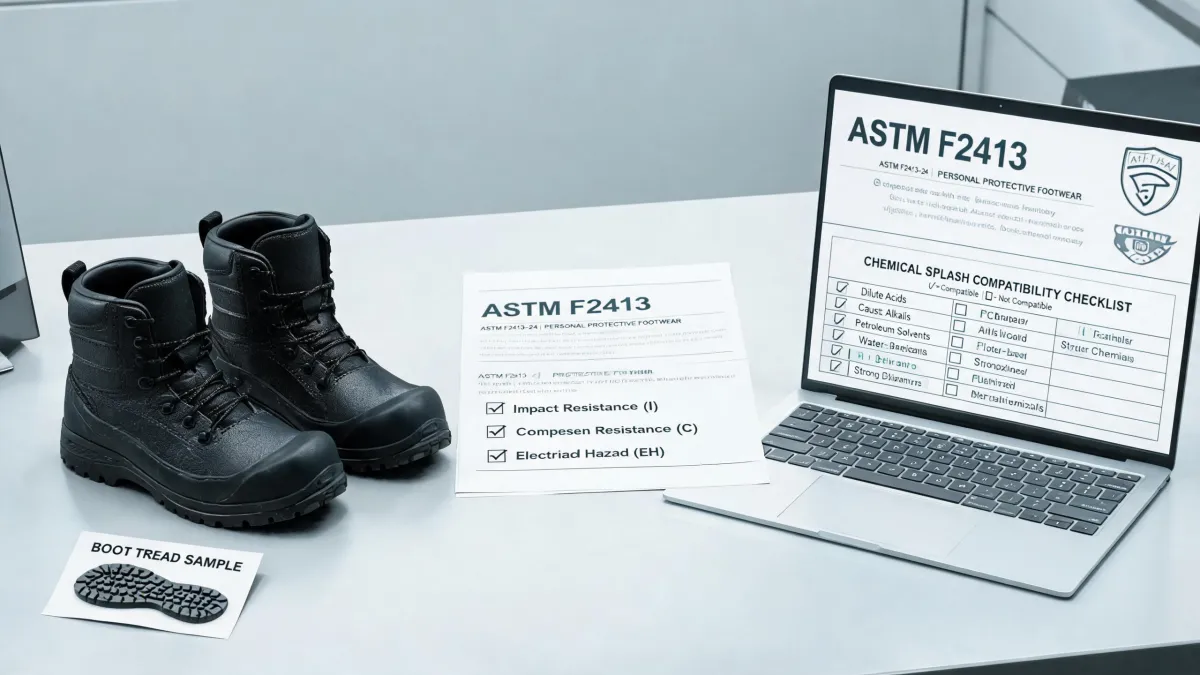
Let me start with the lesson that cost me the most money: there is no single 'best Dunlop boot.' There are only Dunlop boots that fit the job, and boots that don't. The difference isn't the logo. It's the spec.
I've handled safety footwear orders for eight years. I've personally made and documented 14 significant mistakes, totaling roughly $26,000 in wasted budget. That's not a flex. It's why I now maintain our team's checklist before any boot order.
Before we get to scenarios, let's answer a question you probably didn't expect in a boot review: how does a smoke detector work? It either uses ionization—ions in an electric chamber that get disrupted by flame particles—or photoelectric, which uses a light beam and sensor to detect smoke. Neither is perfectly universal. Flaming fires trigger ionization faster; smoldering fires trigger photoelectric faster. The best detector depends on what kind of fire you're likely to have.
Dunlop boots work the same way. The right choice depends on what you're protecting against: chemicals, impact, electricity, or just mud and nails. In my experience, you're in one of four situations: hazmat or chemical exposure, fence installation and outdoor work, electrical work, or an emergency replacement. Each needs a different Dunlop boot.
What Dunlop Hazmat Boots Reviews Miss
Search for 'dunlop hazmat boots reviews' and you'll get a mix of 'they're tough' and 'they run big.' That's not useful. The real question is: which chemical are you handling?
Dunlop makes several styles of hazmat and chemical-resistant boots. They're not interchangeable. Different materials—natural rubber, neoprene, nitrile, PVC—hold up to different chemicals. A boot that shrugs off water and mud can swell, crack, or soften when it hits a solvent.
Here's the exact mistake I made in 2019. I said to the supplier, 'we need chemical-resistant boots.' They heard 'rubber boots.' We were using the same words but meaning different things. The order showed up, looked perfect, and fell apart on the first contact with the chemical we were handling. That cost $890 in replacements and a week of lost time. It wasn't just the money. It was the trust.
People think a higher price means higher protection. Actually, protection comes from the spec and certification. The price just reflects the material and testing. A $400 boot might not be safer for your chemical than a $150 boot with the right chart. The causation runs the other way: boots with a proven spec can charge more.
Per FTC guidelines (ftc.gov), claims have to be truthful and substantiated. So if you see a product described only as 'chemical resistant' with no mention of which chemicals, that's a red flag. Ask for the manufacturer's chemical-resistance chart. If it doesn't exist, don't buy.
Scenario 1: Hazmat or Chemical Exposure
When people search for 'dunlop chemical resistant boots,' they often assume one model covers every chemical. It doesn't. If you're in hazmat cleanup, chemical processing, or agriculture with pesticides, your priority is chemical compatibility. Look for a Dunlop hazmat boot with an explicit chemical-resistance chart. Check the seams too—a welded or dipped boot can be more impermeable than a stitched one.
Also consider whether the boot can be decontaminated. Some rubber compounds absorb chemicals over time. Some can be washed down. That difference matters more than the tread pattern. The chart should tell you the chemical, the concentration, and the exposure time. A rating that says 'oil resistant' doesn't tell you if it handles diesel, hydraulic fluid, or crude oil. They're not the same.
Scenario 2: Fence Installation and General Outdoor Work
If your job search involves 'fence installation near me,' you're likely on your feet in wet grass, mud, or rocky ground. The boots I recommend for fence work are not necessarily hazmat boots. They're Dunlop steel-toe rubber boots—often the Fieldpro style—with a decent tread. A steel toe handles a dropped fence post. A thick rubber sole handles nails. Waterproof is non-negotiable.
Don't over-buy hazmat protection you don't need. It costs more and usually feels heavier. The best review for fence work is the one that mentions how the sole performs on wet slopes.
That was my 2022 mistake. I bought a 'heavy duty' boot based on specs alone. Every number said it was waterproof and durable. My gut said the tread looked shallow. I ignored it. The crew spent a week slipping on damp grass. Nothing about the boot was technically wrong; it was wrong for the ground. Now we order one pair of each model for a crew member to test before we buy 20.
Scenario 3: Electrical and Utility Work
If you're around live circuits, the spec you need is an electrical hazard (EH) rating or proper insulation for the voltage. Don't assume because it's rubber it insulates. Rubber boots can offer some electrical resistance, but the difference between a work boot and a certified insulating boot is night and day. Check the label. If it doesn't say EH or a voltage rating, it's not the boot for electrical work.
Dunlop also makes insulated boots. But 'insulated' usually means thermal, not electrical. Do not confuse the two. If you're not sure, ask for the manufacturer's documentation. An unlabeled boot doesn't meet an electrical spec.
Scenario 4: You Need It Yesterday
This is where I hold a slightly unpopular opinion: in an emergency, pay for shipping speed.
In March 2024, we paid $110 extra for overnight delivery on Dunlop boots. It felt stupid until the alternative was missing a $15,000 compliance deadline. The extra cost wasn't for the boots. It was for certainty.
Whenever someone tells you 'probably on time' or 'should get there by Friday,' remember: uncertain cheap is more expensive than certain expensive. In an emergency, choose a retailer that can guarantee the delivery date, not the one that saves you $12.
Zappos and Amazon both carry Dunlop boots. I get why people search 'zappos amazon safety shoes'—they're trying to figure out which online store will actually get the boots to the jobsite on time. If you need boots for a job that starts in three days, check the delivery date and the return policy before you click. Buying safety shoes online is fine as long as you know what happens when the size is wrong.
How to Decide Which Dunlop Boot Scenario You're In
If you're still not sure, answer these three questions before reading another 'dunlop boots review':
- What are your feet actually exposed to? Chemicals, impact, electricity, or water and mud?
- What happens if the boot fails? A wet sock, a bruise, a chemical burn, or a fine?
- When do you need it? Tomorrow vs. next month changes the buying strategy.
If you can't answer the first question, contact a safety equipment supplier and ask for the chemical-resistance chart. Don't ask for 'a boot.' Ask for 'a boot that resists [specific chemical] for [amount of time].' Those are two different conversations.
And if you're still thinking about smoke detectors: the device type matters because the hazard type matters. A detector optimized for smoldering fires isn't the same as one optimized for fast-flaming fires. Same with Dunlop boots. Don't buy a mud boot for a hazmat spill, and don't buy a hazmat boot for a fence crew. Match the protection to the hazard, not the hype.
Bottom line: name the hazard before you name the boot. That checklist—the one I built after $26,000 in mistakes—starts with one line: 'Name the hazard before you name the boot.' I hope you don't need to lose the budget to learn it.